

New investigations and discoveries about the hidden life of wood-dwelling insects
04.02.2026
Wood, far from being an inert environment, hosts a rich biodiversity. Within it live beetles that dig complex tunnels and cultivate symbiotic fungi, essential for feeding their offspring. These tunnels have long been considered isolated family units, founded by a single female, although some observations suggested possible interactions between them, difficult to study without advanced tools.
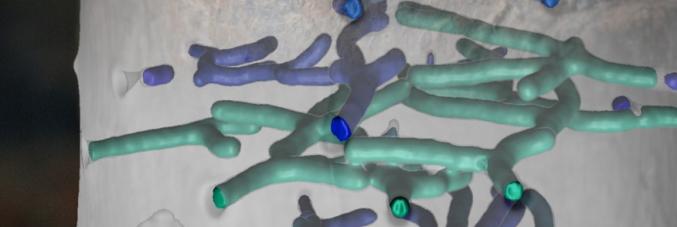
The study "Three-dimensional gallery system reconstruction reveals more frequent intraspecific than interspecific interactions in ambrosia beetles," published in the «Proceedings of the Royal Society B» was conducted by the DAFNAE Department of the University of Padua with national and international partners. The research investigated the interactions between tunnels dug by individuals of the same species and those of different species.
To analyze these interactions, researchers applied X-ray tomography to logs colonized by beetles. Potted trees were subjected to stress (flooding or ethanol injection) to promote colonization; after a month, the logs were analyzed without damaging the wood. The technique allowed the researchers to reconstruct the tunnels in 3D, identify their connections, and attribute them to different species.
"Our results show that the tunnels of these important wood-dwelling insects are not isolated systems at all, as previously thought," explains Davide Rassati, coordinator of the research team and professor at the University of Padua. "On the contrary, these tunnels frequently intersect, giving rise to a network of surprising ecological interactions. The most common connections occur between individuals of the same species, increasing the chances of reproduction between different family units and, consequently, the potential increase in genetic diversity. More rare, but not absent, are the interactions between different species, which could promote the exchange of symbiotic microorganisms and have important ecological repercussions, especially when native species come into contact with exotic species from other continents."
The results demonstrate how X-ray tomography can reveal previously invisible ecological interactions. In the case of wood-dwelling beetles, these discoveries open up new perspectives on the mechanisms that promote genetic diversity and reduce the risks of predation, offering a new insight into the "secret life" of wood-dwelling insects and the balance of their communities.