

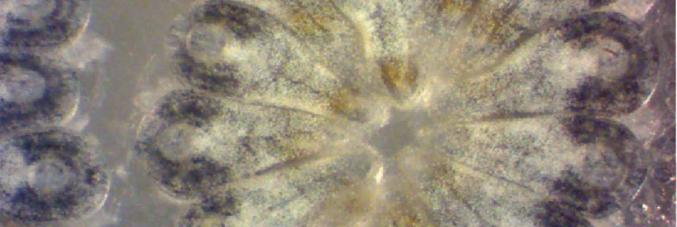
Molecular effects in Botryllus
03.03.2026
Tunicates, widely distributed marine invertebrates, are the closest relatives of vertebrates and serve as true "laboratories" for studying the mechanisms of dementia because they share many genetic characteristics and exhibit brain degeneration similar to that of humans. Among them, Botryllus schlosseri is an emerging model for aging and neurodegeneration.
A team from the University of Padua and the University of Milan, in an article in «Neurobiology of Disease», analyzed the molecular effects of direct current stimulation (DCS), a non-invasive neuromodulation technique increasingly used in clinical settings, but with molecular mechanisms that are still not fully understood. In the study, colonies of Botryllus were subjected to electrical stimulation (0.5 mA for 30 minutes). The researchers measured heart rate and oral siphon reactivity (the "mouth" of the animals) and evaluated the molecular response after 3, 24, and 48 hours to understand how DCS influences gene activity over time.
"We observed that non-invasive electrical stimulation can modulate, in the hours following, the expression of hundreds of genes in a marine invertebrate," explains Chiara Anselmi, first author of the study and researcher in the Department of Biology at the University of Padua. "Since Botryllus belongs to the chordates, this model helps us experimentally investigate evolutionarily conserved molecular programs that link neuromodulation, cellular stress response, and neural functions, offering useful insights into how these mechanisms have been maintained throughout evolution and how they might act in humans."
The results show a transient increase in heart rate immediately after stimulation, without lasting effects on the organism and behavior. At the molecular level, however, gene activity changes over time (191 genes after 3 hours, 104 after 24 hours, 529 after 48 hours), primarily involving immune and inflammatory responses, oxidative balance, and neuron communication; after 48 hours, signals related to cell survival and mitochondria, the "powerhouses" of cells, emerge.
"Understanding which cellular pathways are activated after stimulation is crucial for interpreting the effects of DCS and improving protocols applied to humans," adds Tommaso Bocci, first author and neurologist at the University of Milan. "An experimental model like Botryllus allows for the generation of hypotheses in a short time and reading molecular responses with a temporal detail that is difficult to achieve in other contexts."
"Botryllus is a unique experimental system because it combines laboratory accessibility with extraordinary biological plasticity, which is based on natural processes of tissue renewal and regression," comments Lucia Manni, corresponding author and professor in the Department of Biology at the University of Padua. "This allows us to observe how cellular and molecular programs are activated or turned off in a controllable way, offering a comparative perspective on the mechanisms that regulate tissue maintenance and vulnerability."
"Experimental data linking neuromodulation to measurable molecular responses help build a bridge between basic research and clinical applications. This type of evidence is useful for clarifying mechanisms of action and guiding future studies more precisely," concludes neurologist Alberto Priori, corresponding author and professor at the University of Milan.
The study thus proposes Botryllus schlosseri as a complementary preclinical platform for studying the effects of DCS over time and understanding how neuromodulation can influence conserved and potentially relevant biological programs for neuroprotection.