

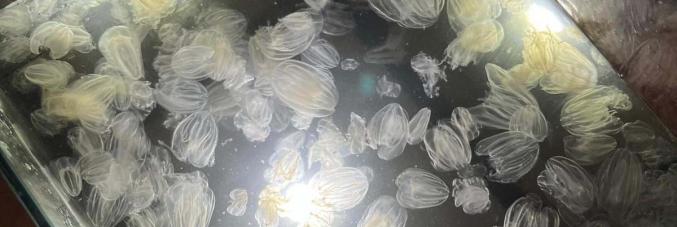
A silent invader in the Venice Lagoon
26.01.2026
The ctenophore Mnemiopsis leidyi, considered one of the world’s 100 most harmful invasive species, has been present in the Adriatic Sea for nearly a decade, causing serious problems for those working in the fishing sector, particularly in lagoon environments. A research team from the University of Padua and the National Institute of Oceanography and Applied Geophysics – OGS has recently published in the journal Estuarine, Coastal and Shelf Science the study An invader chronicles: local ecological niche of Mnemiopsis leidyi in the Venice Lagoon, which highlights how Mnemiopsis leidyi represents a potential ecological threat to the Venice Lagoon due to its high adaptability and ongoing climate change, which may favor its proliferation at the expense of other species within the ecosystem.
“Although the dynamics of this species have been studied in other parts of the world, information on Mediterranean lagoons—characterized by strong spatial and seasonal variability in environmental conditions—is still limited,” explains Filippo Piccardi, first author of the study and researcher at the University of Padua. “Our study represents the first integrated field and laboratory investigation of the ecological niche of Mnemiopsis leidyi in the Venice Lagoon. We adopted an interdisciplinary approach and monitored the spatial distribution of the species over two years, combining this with controlled experiments to define the main environmental survival thresholds. The results show that Mnemiopsis leidyi follows a seasonal pattern, with blooms (events of mass reproduction) occurring in late spring and between late summer and early autumn, probably linked to higher temperatures and optimal salinity conditions.”
The abundance of the species is therefore positively correlated with both water temperature and salinity.
Laboratory experiments, integrated with in situ observations, indicate that Mnemiopsis leidyi is able to survive across a wide range of temperatures (10–32 °C) and salinity levels (10–34). However, the study highlights that extreme conditions within these ranges—very high temperatures (32 °C) or low salinity (10)—can significantly reduce the survival of the species.
“By integrating field observations with experimental results on the tolerance of Mnemiopsis leidyi to changes in temperature and salinity, our study provides new insights into the ecological niche of this species in the Venice Lagoon,” explains Valentina Tirelli, co-author of the study and researcher at the National Institute of Oceanography and Applied Geophysics. “Our results suggest that ongoing climate change could promote increasingly suitable environmental conditions for this ctenophore, increasing its presence in large aggregations and, consequently, raising the risk of severe repercussions for the functioning of the entire lagoon ecosystem.”
The study therefore highlights the need for targeted monitoring and adaptive management strategies to mitigate the ecological and socio-economic consequences of the expansion of Mnemiopsis leidyi.