Two Young Students from Gaza at the University of Padua

Array ( [body] => Array ( [#theme] => field [#weight] => 0 [#title] => Body [#access] => 1 [#label_display] => hidden [#view_mode] => teaser [#language] => und [#field_name] => body [#field_type] => text_with_summary [#field_translatable] => 0 [#entity_type] => node [#bundle] => box_lancio_news [#object] => stdClass Object ( [vid] => 505277 [uid] => 13 [title] => Two Young Students from Gaza at the University of Padua [log] => [status] => 1 [comment] => 0 [promote] => 1 [sticky] => 0 [nid] => 121496 [type] => box_lancio_news [language] => it [created] => 1760104733 [changed] => 1761576191 [tnid] => 0 [translate] => 0 [revision_timestamp] => 1761576191 [revision_uid] => 2032 [body] => Array ( [und] => Array ( [0] => Array ( [value] =>

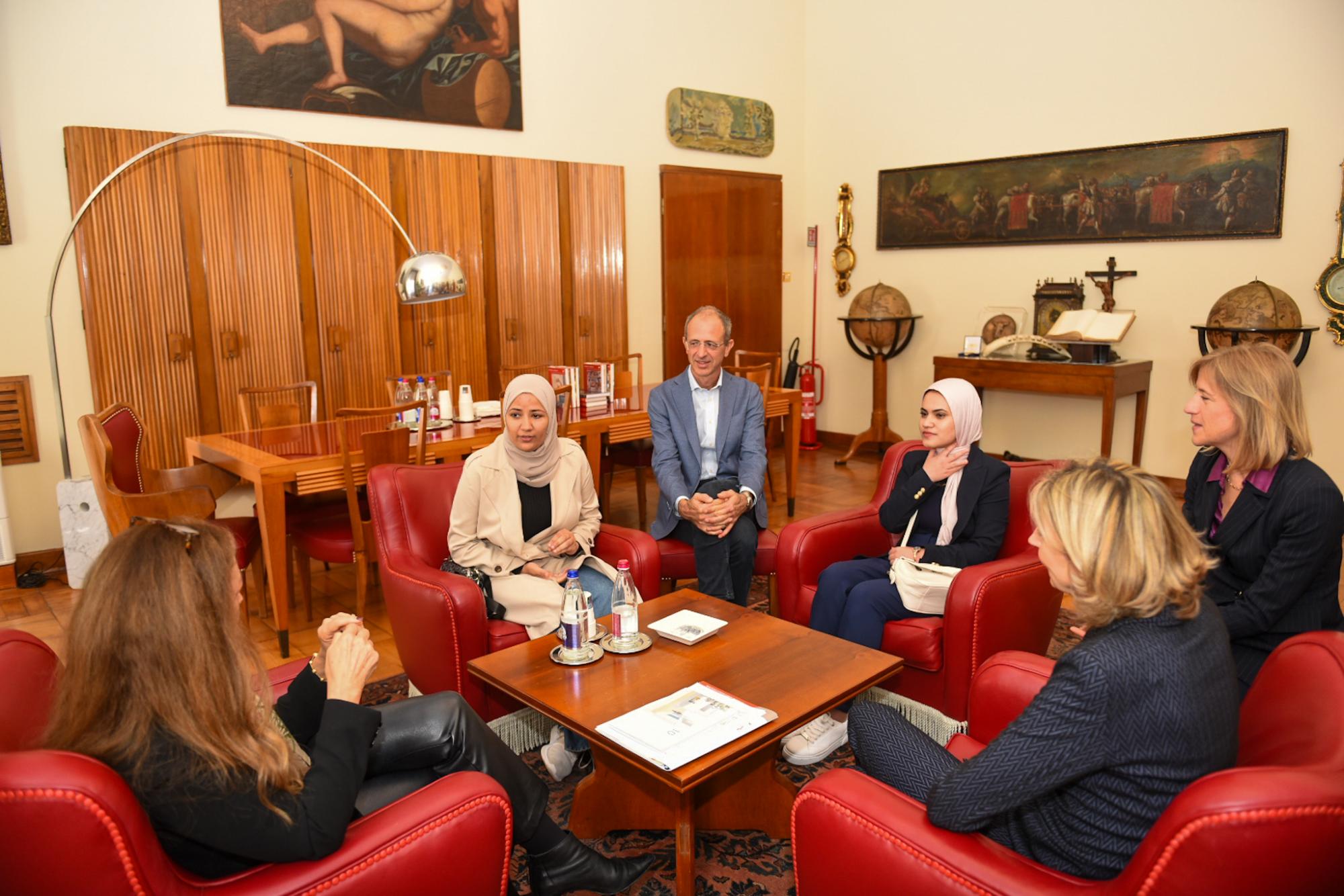
Two young scholarship students from Gaza have recently arrived in Padua through the Italian Universities for Palestinian Students (IUPALS) initiative. They were welcomed today at Palazzo del Bo by Rector Daniela Mapelli.

The students, Albhaisi Nour and Aseel F. J. Elmuqayad, are enrolled at the University of Padua in the Master’s Degree Programme in Food and Health and the Master’s Degree Programme in Astrophysics and Cosmology, respectively.

The IUPALS project, coordinated by the Conference of Italian University Rectors (CRUI) in collaboration with the Ministry of Foreign Affairs and International Cooperation, the Ministry of Universities and Research, and the Consulate General of Italy in Jerusalem, offers Palestinian students scholarships to complete a full academic programme in Italy, thereby strengthening academic cooperation between Italy and Palestine. “The University of Padua has a long tradition of hospitality and international cooperation. In recent months, we have intensified our commitment to supporting students affected by the crisis in the Middle East. After welcoming a student and a researcher from Gaza, today we are pleased to welcome two young women from the West Bank, who will be able to safely resume their studies and build a future of knowledge and hope,” the Rector commented in recent weeks when greeting two other students from the West Bank. “In a complex historical moment marked by suffering and uncertainty, culture and knowledge remain fundamental tools for building bridges, fostering dialogue, and creating the future. The University of Padua will continue to be an open and welcoming place, where the right to study and freedom of thought know no borders.”

To date, six students and researchers have been welcomed to the University of Padua thanks to the IUPALS project.
In addition to the two students who arrived today at Palazzo del Bo, Shaer Salma and Swindan Maid Rami Hussein—enrolled respectively in the Master’s Degree Programme in Communication Strategies and the Master’s Degree Programme in Molecular Biology—recently began their studies in Padua. Ayah Altarhawi, enrolled in the Bachelor’s Degree Programme in Italian Medieval and Renaissance Studies, and Sabra MahmoudAssociate Professor of Economics at Al-Azhar University of Gaza, currently in Padua for a research project at the Department of Economics, have also joined the university community.

[summary] => [format] => 2 [safe_value] =>

Two young scholarship students from Gaza have recently arrived in Padua through the Italian Universities for Palestinian Students (IUPALS) initiative. They were welcomed today at Palazzo del Bo by Rector Daniela Mapelli.

The students, Albhaisi Nour and Aseel F. J. Elmuqayad, are enrolled at the University of Padua in the Master’s Degree Programme in Food and Health and the Master’s Degree Programme in Astrophysics and Cosmology, respectively.

The IUPALS project, coordinated by the Conference of Italian University Rectors (CRUI) in collaboration with the Ministry of Foreign Affairs and International Cooperation, the Ministry of Universities and Research, and the Consulate General of Italy in Jerusalem, offers Palestinian students scholarships to complete a full academic programme in Italy, thereby strengthening academic cooperation between Italy and Palestine. “The University of Padua has a long tradition of hospitality and international cooperation. In recent months, we have intensified our commitment to supporting students affected by the crisis in the Middle East. After welcoming a student and a researcher from Gaza, today we are pleased to welcome two young women from the West Bank, who will be able to safely resume their studies and build a future of knowledge and hope,” the Rector commented in recent weeks when greeting two other students from the West Bank. “In a complex historical moment marked by suffering and uncertainty, culture and knowledge remain fundamental tools for building bridges, fostering dialogue, and creating the future. The University of Padua will continue to be an open and welcoming place, where the right to study and freedom of thought know no borders.”

To date, six students and researchers have been welcomed to the University of Padua thanks to the IUPALS project.
In addition to the two students who arrived today at Palazzo del Bo, Shaer Salma and Swindan Maid Rami Hussein—enrolled respectively in the Master’s Degree Programme in Communication Strategies and the Master’s Degree Programme in Molecular Biology—recently began their studies in Padua. Ayah Altarhawi, enrolled in the Bachelor’s Degree Programme in Italian Medieval and Renaissance Studies, and Sabra MahmoudAssociate Professor of Economics at Al-Azhar University of Gaza, currently in Padua for a research project at the Department of Economics, have also joined the university community.

[safe_summary] => ) ) ) [field_date_box_lancio_news] => Array ( [und] => Array ( [0] => Array ( [value] => 2025-10-27T00:00:00 [timezone] => Europe/Paris [timezone_db] => Europe/Paris [date_type] => date ) ) ) [field_etichetta_box_lancio_news] => Array ( ) [field_img_box_lancio_news] => Array ( [und] => Array ( [0] => Array ( [fid] => 143618 [uid] => 2032 [filename] => 1000158818 (1).jpg [uri] => public://1000158818 (1)_0.jpg [filemime] => image/jpeg [filesize] => 103290 [status] => 1 [timestamp] => 1761576063 [type] => image [field_file_image_alt_text] => Array ( ) [field_file_image_title_text] => Array ( ) [field_folder] => Array ( [und] => Array ( [0] => Array ( [tid] => 2048 ) ) ) [metadata] => Array ( [height] => 563 [width] => 2048 ) [height] => 563 [width] => 2048 [alt] => palestinian students [title] => ) ) ) [field_link_alla_news] => Array ( ) [field_link_esterno_news] => Array ( ) [field_pagina_associata] => Array ( ) [field_link_etichetta] => Array ( ) [field_abstract_news] => Array ( [und] => Array ( [0] => Array ( [value] => Albhaisi Nour and Aseel F. J. Elmuqayad are enrolled at the University of Padua in the Master’s Degree Programmes in Food and Health and Astrophysics and Cosmology, respectively, and are IUPALS (Italian Universities for Palestinian Students) scholarship holders [format] => [safe_value] => Albhaisi Nour and Aseel F. J. Elmuqayad are enrolled at the University of Padua in the Master’s Degree Programmes in Food and Health and Astrophysics and Cosmology, respectively, and are IUPALS (Italian Universities for Palestinian Students) scholarship holders ) ) ) [field_allegato_news] => Array ( ) [field_categorie_news] => Array ( [und] => Array ( [0] => Array ( [tid] => 2296 ) ) ) [field_pub_date] => Array ( [und] => Array ( [0] => Array ( [value] => 2025-10-27T00:00:00 [value2] => 2026-05-05T00:00:00 [timezone] => Europe/Paris [timezone_db] => Europe/Paris [date_type] => date ) ) ) [field_layout_news] => Array ( [und] => Array ( [0] => Array ( [value] => single ) ) ) [field_testo_opzionale_news] => Array ( ) [field_url_en_page] => Array ( [und] => Array ( [0] => Array ( [value] => /news/rettrice-accoglie-bo-due-studentesse-provenienti-dalla-cisgiordania [format] => [safe_value] => /news/rettrice-accoglie-bo-due-studentesse-provenienti-dalla-cisgiordania ) ) ) [field_url_en_page_label] => Array ( [und] => Array ( [0] => Array ( [value] => Italian version [format] => [safe_value] => Italian version ) ) ) [path] => Array ( [pathauto] => 0 ) [name] => chiara.mezzalira [picture] => 0 [data] => a:2:{s:13:"form_build_id";s:37:"form-e496b743db3766e42eb8a4d1ccc1c014";s:14:"wysiwyg_status";a:1:{i:1;i:1;}} [num_revisions] => 12 [current_revision_id] => 505277 [is_current] => 1 [is_pending] => [revision_moderation] => [entity_view_prepared] => 1 ) [#items] => Array ( [0] => Array ( [value] =>

Two young scholarship students from Gaza have recently arrived in Padua through the Italian Universities for Palestinian Students (IUPALS) initiative. They were welcomed today at Palazzo del Bo by Rector Daniela Mapelli.

The students, Albhaisi Nour and Aseel F. J. Elmuqayad, are enrolled at the University of Padua in the Master’s Degree Programme in Food and Health and the Master’s Degree Programme in Astrophysics and Cosmology, respectively.

The IUPALS project, coordinated by the Conference of Italian University Rectors (CRUI) in collaboration with the Ministry of Foreign Affairs and International Cooperation, the Ministry of Universities and Research, and the Consulate General of Italy in Jerusalem, offers Palestinian students scholarships to complete a full academic programme in Italy, thereby strengthening academic cooperation between Italy and Palestine. “The University of Padua has a long tradition of hospitality and international cooperation. In recent months, we have intensified our commitment to supporting students affected by the crisis in the Middle East. After welcoming a student and a researcher from Gaza, today we are pleased to welcome two young women from the West Bank, who will be able to safely resume their studies and build a future of knowledge and hope,” the Rector commented in recent weeks when greeting two other students from the West Bank. “In a complex historical moment marked by suffering and uncertainty, culture and knowledge remain fundamental tools for building bridges, fostering dialogue, and creating the future. The University of Padua will continue to be an open and welcoming place, where the right to study and freedom of thought know no borders.”

To date, six students and researchers have been welcomed to the University of Padua thanks to the IUPALS project.
In addition to the two students who arrived today at Palazzo del Bo, Shaer Salma and Swindan Maid Rami Hussein—enrolled respectively in the Master’s Degree Programme in Communication Strategies and the Master’s Degree Programme in Molecular Biology—recently began their studies in Padua. Ayah Altarhawi, enrolled in the Bachelor’s Degree Programme in Italian Medieval and Renaissance Studies, and Sabra MahmoudAssociate Professor of Economics at Al-Azhar University of Gaza, currently in Padua for a research project at the Department of Economics, have also joined the university community.

[summary] => [format] => 2 [safe_value] =>

Two young scholarship students from Gaza have recently arrived in Padua through the Italian Universities for Palestinian Students (IUPALS) initiative. They were welcomed today at Palazzo del Bo by Rector Daniela Mapelli.

The students, Albhaisi Nour and Aseel F. J. Elmuqayad, are enrolled at the University of Padua in the Master’s Degree Programme in Food and Health and the Master’s Degree Programme in Astrophysics and Cosmology, respectively.

The IUPALS project, coordinated by the Conference of Italian University Rectors (CRUI) in collaboration with the Ministry of Foreign Affairs and International Cooperation, the Ministry of Universities and Research, and the Consulate General of Italy in Jerusalem, offers Palestinian students scholarships to complete a full academic programme in Italy, thereby strengthening academic cooperation between Italy and Palestine. “The University of Padua has a long tradition of hospitality and international cooperation. In recent months, we have intensified our commitment to supporting students affected by the crisis in the Middle East. After welcoming a student and a researcher from Gaza, today we are pleased to welcome two young women from the West Bank, who will be able to safely resume their studies and build a future of knowledge and hope,” the Rector commented in recent weeks when greeting two other students from the West Bank. “In a complex historical moment marked by suffering and uncertainty, culture and knowledge remain fundamental tools for building bridges, fostering dialogue, and creating the future. The University of Padua will continue to be an open and welcoming place, where the right to study and freedom of thought know no borders.”

To date, six students and researchers have been welcomed to the University of Padua thanks to the IUPALS project.
In addition to the two students who arrived today at Palazzo del Bo, Shaer Salma and Swindan Maid Rami Hussein—enrolled respectively in the Master’s Degree Programme in Communication Strategies and the Master’s Degree Programme in Molecular Biology—recently began their studies in Padua. Ayah Altarhawi, enrolled in the Bachelor’s Degree Programme in Italian Medieval and Renaissance Studies, and Sabra MahmoudAssociate Professor of Economics at Al-Azhar University of Gaza, currently in Padua for a research project at the Department of Economics, have also joined the university community.

[safe_summary] => ) ) [#formatter] => text_summary_or_trimmed [0] => Array ( [#markup] =>

Two young scholarship students from Gaza have recently arrived in Padua through the Italian Universities for Palestinian Students (IUPALS) initiative. They were welcomed today at Palazzo del Bo by Rector Daniela Mapelli.

) ) [field_img_box_lancio_news] => Array ( [#theme] => field [#weight] => 0 [#title] => Immagine [#access] => 1 [#label_display] => above [#view_mode] => teaser [#language] => und [#field_name] => field_img_box_lancio_news [#field_type] => image [#field_translatable] => 0 [#entity_type] => node [#bundle] => box_lancio_news [#object] => stdClass Object ( [vid] => 505277 [uid] => 13 [title] => Two Young Students from Gaza at the University of Padua [log] => [status] => 1 [comment] => 0 [promote] => 1 [sticky] => 0 [nid] => 121496 [type] => box_lancio_news [language] => it [created] => 1760104733 [changed] => 1761576191 [tnid] => 0 [translate] => 0 [revision_timestamp] => 1761576191 [revision_uid] => 2032 [body] => Array ( [und] => Array ( [0] => Array ( [value] =>

Two young scholarship students from Gaza have recently arrived in Padua through the Italian Universities for Palestinian Students (IUPALS) initiative. They were welcomed today at Palazzo del Bo by Rector Daniela Mapelli.

The students, Albhaisi Nour and Aseel F. J. Elmuqayad, are enrolled at the University of Padua in the Master’s Degree Programme in Food and Health and the Master’s Degree Programme in Astrophysics and Cosmology, respectively.

The IUPALS project, coordinated by the Conference of Italian University Rectors (CRUI) in collaboration with the Ministry of Foreign Affairs and International Cooperation, the Ministry of Universities and Research, and the Consulate General of Italy in Jerusalem, offers Palestinian students scholarships to complete a full academic programme in Italy, thereby strengthening academic cooperation between Italy and Palestine. “The University of Padua has a long tradition of hospitality and international cooperation. In recent months, we have intensified our commitment to supporting students affected by the crisis in the Middle East. After welcoming a student and a researcher from Gaza, today we are pleased to welcome two young women from the West Bank, who will be able to safely resume their studies and build a future of knowledge and hope,” the Rector commented in recent weeks when greeting two other students from the West Bank. “In a complex historical moment marked by suffering and uncertainty, culture and knowledge remain fundamental tools for building bridges, fostering dialogue, and creating the future. The University of Padua will continue to be an open and welcoming place, where the right to study and freedom of thought know no borders.”

To date, six students and researchers have been welcomed to the University of Padua thanks to the IUPALS project.
In addition to the two students who arrived today at Palazzo del Bo, Shaer Salma and Swindan Maid Rami Hussein—enrolled respectively in the Master’s Degree Programme in Communication Strategies and the Master’s Degree Programme in Molecular Biology—recently began their studies in Padua. Ayah Altarhawi, enrolled in the Bachelor’s Degree Programme in Italian Medieval and Renaissance Studies, and Sabra MahmoudAssociate Professor of Economics at Al-Azhar University of Gaza, currently in Padua for a research project at the Department of Economics, have also joined the university community.

[summary] => [format] => 2 [safe_value] =>

Two young scholarship students from Gaza have recently arrived in Padua through the Italian Universities for Palestinian Students (IUPALS) initiative. They were welcomed today at Palazzo del Bo by Rector Daniela Mapelli.

The students, Albhaisi Nour and Aseel F. J. Elmuqayad, are enrolled at the University of Padua in the Master’s Degree Programme in Food and Health and the Master’s Degree Programme in Astrophysics and Cosmology, respectively.

The IUPALS project, coordinated by the Conference of Italian University Rectors (CRUI) in collaboration with the Ministry of Foreign Affairs and International Cooperation, the Ministry of Universities and Research, and the Consulate General of Italy in Jerusalem, offers Palestinian students scholarships to complete a full academic programme in Italy, thereby strengthening academic cooperation between Italy and Palestine. “The University of Padua has a long tradition of hospitality and international cooperation. In recent months, we have intensified our commitment to supporting students affected by the crisis in the Middle East. After welcoming a student and a researcher from Gaza, today we are pleased to welcome two young women from the West Bank, who will be able to safely resume their studies and build a future of knowledge and hope,” the Rector commented in recent weeks when greeting two other students from the West Bank. “In a complex historical moment marked by suffering and uncertainty, culture and knowledge remain fundamental tools for building bridges, fostering dialogue, and creating the future. The University of Padua will continue to be an open and welcoming place, where the right to study and freedom of thought know no borders.”

To date, six students and researchers have been welcomed to the University of Padua thanks to the IUPALS project.
In addition to the two students who arrived today at Palazzo del Bo, Shaer Salma and Swindan Maid Rami Hussein—enrolled respectively in the Master’s Degree Programme in Communication Strategies and the Master’s Degree Programme in Molecular Biology—recently began their studies in Padua. Ayah Altarhawi, enrolled in the Bachelor’s Degree Programme in Italian Medieval and Renaissance Studies, and Sabra MahmoudAssociate Professor of Economics at Al-Azhar University of Gaza, currently in Padua for a research project at the Department of Economics, have also joined the university community.

[safe_summary] => ) ) ) [field_date_box_lancio_news] => Array ( [und] => Array ( [0] => Array ( [value] => 2025-10-27T00:00:00 [timezone] => Europe/Paris [timezone_db] => Europe/Paris [date_type] => date ) ) ) [field_etichetta_box_lancio_news] => Array ( ) [field_img_box_lancio_news] => Array ( [und] => Array ( [0] => Array ( [fid] => 143618 [uid] => 2032 [filename] => 1000158818 (1).jpg [uri] => public://1000158818 (1)_0.jpg [filemime] => image/jpeg [filesize] => 103290 [status] => 1 [timestamp] => 1761576063 [type] => image [field_file_image_alt_text] => Array ( ) [field_file_image_title_text] => Array ( ) [field_folder] => Array ( [und] => Array ( [0] => Array ( [tid] => 2048 ) ) ) [metadata] => Array ( [height] => 563 [width] => 2048 ) [height] => 563 [width] => 2048 [alt] => palestinian students [title] => ) ) ) [field_link_alla_news] => Array ( ) [field_link_esterno_news] => Array ( ) [field_pagina_associata] => Array ( ) [field_link_etichetta] => Array ( ) [field_abstract_news] => Array ( [und] => Array ( [0] => Array ( [value] => Albhaisi Nour and Aseel F. J. Elmuqayad are enrolled at the University of Padua in the Master’s Degree Programmes in Food and Health and Astrophysics and Cosmology, respectively, and are IUPALS (Italian Universities for Palestinian Students) scholarship holders [format] => [safe_value] => Albhaisi Nour and Aseel F. J. Elmuqayad are enrolled at the University of Padua in the Master’s Degree Programmes in Food and Health and Astrophysics and Cosmology, respectively, and are IUPALS (Italian Universities for Palestinian Students) scholarship holders ) ) ) [field_allegato_news] => Array ( ) [field_categorie_news] => Array ( [und] => Array ( [0] => Array ( [tid] => 2296 ) ) ) [field_pub_date] => Array ( [und] => Array ( [0] => Array ( [value] => 2025-10-27T00:00:00 [value2] => 2026-05-05T00:00:00 [timezone] => Europe/Paris [timezone_db] => Europe/Paris [date_type] => date ) ) ) [field_layout_news] => Array ( [und] => Array ( [0] => Array ( [value] => single ) ) ) [field_testo_opzionale_news] => Array ( ) [field_url_en_page] => Array ( [und] => Array ( [0] => Array ( [value] => /news/rettrice-accoglie-bo-due-studentesse-provenienti-dalla-cisgiordania [format] => [safe_value] => /news/rettrice-accoglie-bo-due-studentesse-provenienti-dalla-cisgiordania ) ) ) [field_url_en_page_label] => Array ( [und] => Array ( [0] => Array ( [value] => Italian version [format] => [safe_value] => Italian version ) ) ) [path] => Array ( [pathauto] => 0 ) [name] => chiara.mezzalira [picture] => 0 [data] => a:2:{s:13:"form_build_id";s:37:"form-e496b743db3766e42eb8a4d1ccc1c014";s:14:"wysiwyg_status";a:1:{i:1;i:1;}} [num_revisions] => 12 [current_revision_id] => 505277 [is_current] => 1 [is_pending] => [revision_moderation] => [entity_view_prepared] => 1 ) [#items] => Array ( [0] => Array ( [fid] => 143618 [uid] => 2032 [filename] => 1000158818 (1).jpg [uri] => public://1000158818 (1)_0.jpg [filemime] => image/jpeg [filesize] => 103290 [status] => 1 [timestamp] => 1761576063 [type] => image [field_file_image_alt_text] => Array ( ) [field_file_image_title_text] => Array ( ) [field_folder] => Array ( [und] => Array ( [0] => Array ( [tid] => 2048 ) ) ) [metadata] => Array ( [height] => 563 [width] => 2048 ) [height] => 563 [width] => 2048 [alt] => palestinian students [title] => ) ) [#formatter] => image [0] => Array ( [#theme] => image_formatter [#item] => Array ( [fid] => 143618 [uid] => 2032 [filename] => 1000158818 (1).jpg [uri] => public://1000158818 (1)_0.jpg [filemime] => image/jpeg [filesize] => 103290 [status] => 1 [timestamp] => 1761576063 [type] => image [field_file_image_alt_text] => Array ( ) [field_file_image_title_text] => Array ( ) [field_folder] => Array ( [und] => Array ( [0] => Array ( [tid] => 2048 ) ) ) [metadata] => Array ( [height] => 563 [width] => 2048 ) [height] => 563 [width] => 2048 [alt] => palestinian students [title] => ) [#image_style] => [#path] => ) ) [field_abstract_news] => Array ( [#theme] => field [#weight] => 0 [#title] => Abstract [#access] => 1 [#label_display] => above [#view_mode] => teaser [#language] => und [#field_name] => field_abstract_news [#field_type] => text_long [#field_translatable] => 0 [#entity_type] => node [#bundle] => box_lancio_news [#object] => stdClass Object ( [vid] => 505277 [uid] => 13 [title] => Two Young Students from Gaza at the University of Padua [log] => [status] => 1 [comment] => 0 [promote] => 1 [sticky] => 0 [nid] => 121496 [type] => box_lancio_news [language] => it [created] => 1760104733 [changed] => 1761576191 [tnid] => 0 [translate] => 0 [revision_timestamp] => 1761576191 [revision_uid] => 2032 [body] => Array ( [und] => Array ( [0] => Array ( [value] =>

Two young scholarship students from Gaza have recently arrived in Padua through the Italian Universities for Palestinian Students (IUPALS) initiative. They were welcomed today at Palazzo del Bo by Rector Daniela Mapelli.

The students, Albhaisi Nour and Aseel F. J. Elmuqayad, are enrolled at the University of Padua in the Master’s Degree Programme in Food and Health and the Master’s Degree Programme in Astrophysics and Cosmology, respectively.

The IUPALS project, coordinated by the Conference of Italian University Rectors (CRUI) in collaboration with the Ministry of Foreign Affairs and International Cooperation, the Ministry of Universities and Research, and the Consulate General of Italy in Jerusalem, offers Palestinian students scholarships to complete a full academic programme in Italy, thereby strengthening academic cooperation between Italy and Palestine. “The University of Padua has a long tradition of hospitality and international cooperation. In recent months, we have intensified our commitment to supporting students affected by the crisis in the Middle East. After welcoming a student and a researcher from Gaza, today we are pleased to welcome two young women from the West Bank, who will be able to safely resume their studies and build a future of knowledge and hope,” the Rector commented in recent weeks when greeting two other students from the West Bank. “In a complex historical moment marked by suffering and uncertainty, culture and knowledge remain fundamental tools for building bridges, fostering dialogue, and creating the future. The University of Padua will continue to be an open and welcoming place, where the right to study and freedom of thought know no borders.”

To date, six students and researchers have been welcomed to the University of Padua thanks to the IUPALS project.
In addition to the two students who arrived today at Palazzo del Bo, Shaer Salma and Swindan Maid Rami Hussein—enrolled respectively in the Master’s Degree Programme in Communication Strategies and the Master’s Degree Programme in Molecular Biology—recently began their studies in Padua. Ayah Altarhawi, enrolled in the Bachelor’s Degree Programme in Italian Medieval and Renaissance Studies, and Sabra MahmoudAssociate Professor of Economics at Al-Azhar University of Gaza, currently in Padua for a research project at the Department of Economics, have also joined the university community.

[summary] => [format] => 2 [safe_value] =>

Two young scholarship students from Gaza have recently arrived in Padua through the Italian Universities for Palestinian Students (IUPALS) initiative. They were welcomed today at Palazzo del Bo by Rector Daniela Mapelli.

The students, Albhaisi Nour and Aseel F. J. Elmuqayad, are enrolled at the University of Padua in the Master’s Degree Programme in Food and Health and the Master’s Degree Programme in Astrophysics and Cosmology, respectively.

The IUPALS project, coordinated by the Conference of Italian University Rectors (CRUI) in collaboration with the Ministry of Foreign Affairs and International Cooperation, the Ministry of Universities and Research, and the Consulate General of Italy in Jerusalem, offers Palestinian students scholarships to complete a full academic programme in Italy, thereby strengthening academic cooperation between Italy and Palestine. “The University of Padua has a long tradition of hospitality and international cooperation. In recent months, we have intensified our commitment to supporting students affected by the crisis in the Middle East. After welcoming a student and a researcher from Gaza, today we are pleased to welcome two young women from the West Bank, who will be able to safely resume their studies and build a future of knowledge and hope,” the Rector commented in recent weeks when greeting two other students from the West Bank. “In a complex historical moment marked by suffering and uncertainty, culture and knowledge remain fundamental tools for building bridges, fostering dialogue, and creating the future. The University of Padua will continue to be an open and welcoming place, where the right to study and freedom of thought know no borders.”

To date, six students and researchers have been welcomed to the University of Padua thanks to the IUPALS project.
In addition to the two students who arrived today at Palazzo del Bo, Shaer Salma and Swindan Maid Rami Hussein—enrolled respectively in the Master’s Degree Programme in Communication Strategies and the Master’s Degree Programme in Molecular Biology—recently began their studies in Padua. Ayah Altarhawi, enrolled in the Bachelor’s Degree Programme in Italian Medieval and Renaissance Studies, and Sabra MahmoudAssociate Professor of Economics at Al-Azhar University of Gaza, currently in Padua for a research project at the Department of Economics, have also joined the university community.

[safe_summary] => ) ) ) [field_date_box_lancio_news] => Array ( [und] => Array ( [0] => Array ( [value] => 2025-10-27T00:00:00 [timezone] => Europe/Paris [timezone_db] => Europe/Paris [date_type] => date ) ) ) [field_etichetta_box_lancio_news] => Array ( ) [field_img_box_lancio_news] => Array ( [und] => Array ( [0] => Array ( [fid] => 143618 [uid] => 2032 [filename] => 1000158818 (1).jpg [uri] => public://1000158818 (1)_0.jpg [filemime] => image/jpeg [filesize] => 103290 [status] => 1 [timestamp] => 1761576063 [type] => image [field_file_image_alt_text] => Array ( ) [field_file_image_title_text] => Array ( ) [field_folder] => Array ( [und] => Array ( [0] => Array ( [tid] => 2048 ) ) ) [metadata] => Array ( [height] => 563 [width] => 2048 ) [height] => 563 [width] => 2048 [alt] => palestinian students [title] => ) ) ) [field_link_alla_news] => Array ( ) [field_link_esterno_news] => Array ( ) [field_pagina_associata] => Array ( ) [field_link_etichetta] => Array ( ) [field_abstract_news] => Array ( [und] => Array ( [0] => Array ( [value] => Albhaisi Nour and Aseel F. J. Elmuqayad are enrolled at the University of Padua in the Master’s Degree Programmes in Food and Health and Astrophysics and Cosmology, respectively, and are IUPALS (Italian Universities for Palestinian Students) scholarship holders [format] => [safe_value] => Albhaisi Nour and Aseel F. J. Elmuqayad are enrolled at the University of Padua in the Master’s Degree Programmes in Food and Health and Astrophysics and Cosmology, respectively, and are IUPALS (Italian Universities for Palestinian Students) scholarship holders ) ) ) [field_allegato_news] => Array ( ) [field_categorie_news] => Array ( [und] => Array ( [0] => Array ( [tid] => 2296 ) ) ) [field_pub_date] => Array ( [und] => Array ( [0] => Array ( [value] => 2025-10-27T00:00:00 [value2] => 2026-05-05T00:00:00 [timezone] => Europe/Paris [timezone_db] => Europe/Paris [date_type] => date ) ) ) [field_layout_news] => Array ( [und] => Array ( [0] => Array ( [value] => single ) ) ) [field_testo_opzionale_news] => Array ( ) [field_url_en_page] => Array ( [und] => Array ( [0] => Array ( [value] => /news/rettrice-accoglie-bo-due-studentesse-provenienti-dalla-cisgiordania [format] => [safe_value] => /news/rettrice-accoglie-bo-due-studentesse-provenienti-dalla-cisgiordania ) ) ) [field_url_en_page_label] => Array ( [und] => Array ( [0] => Array ( [value] => Italian version [format] => [safe_value] => Italian version ) ) ) [path] => Array ( [pathauto] => 0 ) [name] => chiara.mezzalira [picture] => 0 [data] => a:2:{s:13:"form_build_id";s:37:"form-e496b743db3766e42eb8a4d1ccc1c014";s:14:"wysiwyg_status";a:1:{i:1;i:1;}} [num_revisions] => 12 [current_revision_id] => 505277 [is_current] => 1 [is_pending] => [revision_moderation] => [entity_view_prepared] => 1 ) [#items] => Array ( [0] => Array ( [value] => Albhaisi Nour and Aseel F. J. Elmuqayad are enrolled at the University of Padua in the Master’s Degree Programmes in Food and Health and Astrophysics and Cosmology, respectively, and are IUPALS (Italian Universities for Palestinian Students) scholarship holders [format] => [safe_value] => Albhaisi Nour and Aseel F. J. Elmuqayad are enrolled at the University of Padua in the Master’s Degree Programmes in Food and Health and Astrophysics and Cosmology, respectively, and are IUPALS (Italian Universities for Palestinian Students) scholarship holders ) ) [#formatter] => text_default [0] => Array ( [#markup] => Albhaisi Nour and Aseel F. J. Elmuqayad are enrolled at the University of Padua in the Master’s Degree Programmes in Food and Health and Astrophysics and Cosmology, respectively, and are IUPALS (Italian Universities for Palestinian Students) scholarship holders ) ) [links] => Array ( [#theme] => links__node [#pre_render] => Array ( [0] => drupal_pre_render_links ) [#attributes] => Array ( [class] => Array ( [0] => links [1] => inline ) ) [node] => Array ( [#theme] => links__node__node [#links] => Array ( [node-readmore] => Array ( [title] => Read more about Two Young Students from Gaza at the University of Padua [href] => node/121496 [html] => 1 [attributes] => Array ( [rel] => tag [title] => Two Young Students from Gaza at the University of Padua ) ) ) [#attributes] => Array ( [class] => Array ( [0] => links [1] => inline ) ) ) ) [field_date_box_lancio_news] => Array ( [#theme] => field [#weight] => 1 [#title] => Data [#access] => 1 [#label_display] => above [#view_mode] => teaser [#language] => und [#field_name] => field_date_box_lancio_news [#field_type] => date [#field_translatable] => 0 [#entity_type] => node [#bundle] => box_lancio_news [#object] => stdClass Object ( [vid] => 505277 [uid] => 13 [title] => Two Young Students from Gaza at the University of Padua [log] => [status] => 1 [comment] => 0 [promote] => 1 [sticky] => 0 [nid] => 121496 [type] => box_lancio_news [language] => it [created] => 1760104733 [changed] => 1761576191 [tnid] => 0 [translate] => 0 [revision_timestamp] => 1761576191 [revision_uid] => 2032 [body] => Array ( [und] => Array ( [0] => Array ( [value] =>

Two young scholarship students from Gaza have recently arrived in Padua through the Italian Universities for Palestinian Students (IUPALS) initiative. They were welcomed today at Palazzo del Bo by Rector Daniela Mapelli.

The students, Albhaisi Nour and Aseel F. J. Elmuqayad, are enrolled at the University of Padua in the Master’s Degree Programme in Food and Health and the Master’s Degree Programme in Astrophysics and Cosmology, respectively.

The IUPALS project, coordinated by the Conference of Italian University Rectors (CRUI) in collaboration with the Ministry of Foreign Affairs and International Cooperation, the Ministry of Universities and Research, and the Consulate General of Italy in Jerusalem, offers Palestinian students scholarships to complete a full academic programme in Italy, thereby strengthening academic cooperation between Italy and Palestine. “The University of Padua has a long tradition of hospitality and international cooperation. In recent months, we have intensified our commitment to supporting students affected by the crisis in the Middle East. After welcoming a student and a researcher from Gaza, today we are pleased to welcome two young women from the West Bank, who will be able to safely resume their studies and build a future of knowledge and hope,” the Rector commented in recent weeks when greeting two other students from the West Bank. “In a complex historical moment marked by suffering and uncertainty, culture and knowledge remain fundamental tools for building bridges, fostering dialogue, and creating the future. The University of Padua will continue to be an open and welcoming place, where the right to study and freedom of thought know no borders.”

To date, six students and researchers have been welcomed to the University of Padua thanks to the IUPALS project.
In addition to the two students who arrived today at Palazzo del Bo, Shaer Salma and Swindan Maid Rami Hussein—enrolled respectively in the Master’s Degree Programme in Communication Strategies and the Master’s Degree Programme in Molecular Biology—recently began their studies in Padua. Ayah Altarhawi, enrolled in the Bachelor’s Degree Programme in Italian Medieval and Renaissance Studies, and Sabra MahmoudAssociate Professor of Economics at Al-Azhar University of Gaza, currently in Padua for a research project at the Department of Economics, have also joined the university community.

[summary] => [format] => 2 [safe_value] =>

Two young scholarship students from Gaza have recently arrived in Padua through the Italian Universities for Palestinian Students (IUPALS) initiative. They were welcomed today at Palazzo del Bo by Rector Daniela Mapelli.

The students, Albhaisi Nour and Aseel F. J. Elmuqayad, are enrolled at the University of Padua in the Master’s Degree Programme in Food and Health and the Master’s Degree Programme in Astrophysics and Cosmology, respectively.

The IUPALS project, coordinated by the Conference of Italian University Rectors (CRUI) in collaboration with the Ministry of Foreign Affairs and International Cooperation, the Ministry of Universities and Research, and the Consulate General of Italy in Jerusalem, offers Palestinian students scholarships to complete a full academic programme in Italy, thereby strengthening academic cooperation between Italy and Palestine. “The University of Padua has a long tradition of hospitality and international cooperation. In recent months, we have intensified our commitment to supporting students affected by the crisis in the Middle East. After welcoming a student and a researcher from Gaza, today we are pleased to welcome two young women from the West Bank, who will be able to safely resume their studies and build a future of knowledge and hope,” the Rector commented in recent weeks when greeting two other students from the West Bank. “In a complex historical moment marked by suffering and uncertainty, culture and knowledge remain fundamental tools for building bridges, fostering dialogue, and creating the future. The University of Padua will continue to be an open and welcoming place, where the right to study and freedom of thought know no borders.”

To date, six students and researchers have been welcomed to the University of Padua thanks to the IUPALS project.
In addition to the two students who arrived today at Palazzo del Bo, Shaer Salma and Swindan Maid Rami Hussein—enrolled respectively in the Master’s Degree Programme in Communication Strategies and the Master’s Degree Programme in Molecular Biology—recently began their studies in Padua. Ayah Altarhawi, enrolled in the Bachelor’s Degree Programme in Italian Medieval and Renaissance Studies, and Sabra MahmoudAssociate Professor of Economics at Al-Azhar University of Gaza, currently in Padua for a research project at the Department of Economics, have also joined the university community.

[safe_summary] => ) ) ) [field_date_box_lancio_news] => Array ( [und] => Array ( [0] => Array ( [value] => 2025-10-27T00:00:00 [timezone] => Europe/Paris [timezone_db] => Europe/Paris [date_type] => date ) ) ) [field_etichetta_box_lancio_news] => Array ( ) [field_img_box_lancio_news] => Array ( [und] => Array ( [0] => Array ( [fid] => 143618 [uid] => 2032 [filename] => 1000158818 (1).jpg [uri] => public://1000158818 (1)_0.jpg [filemime] => image/jpeg [filesize] => 103290 [status] => 1 [timestamp] => 1761576063 [type] => image [field_file_image_alt_text] => Array ( ) [field_file_image_title_text] => Array ( ) [field_folder] => Array ( [und] => Array ( [0] => Array ( [tid] => 2048 ) ) ) [metadata] => Array ( [height] => 563 [width] => 2048 ) [height] => 563 [width] => 2048 [alt] => palestinian students [title] => ) ) ) [field_link_alla_news] => Array ( ) [field_link_esterno_news] => Array ( ) [field_pagina_associata] => Array ( ) [field_link_etichetta] => Array ( ) [field_abstract_news] => Array ( [und] => Array ( [0] => Array ( [value] => Albhaisi Nour and Aseel F. J. Elmuqayad are enrolled at the University of Padua in the Master’s Degree Programmes in Food and Health and Astrophysics and Cosmology, respectively, and are IUPALS (Italian Universities for Palestinian Students) scholarship holders [format] => [safe_value] => Albhaisi Nour and Aseel F. J. Elmuqayad are enrolled at the University of Padua in the Master’s Degree Programmes in Food and Health and Astrophysics and Cosmology, respectively, and are IUPALS (Italian Universities for Palestinian Students) scholarship holders ) ) ) [field_allegato_news] => Array ( ) [field_categorie_news] => Array ( [und] => Array ( [0] => Array ( [tid] => 2296 ) ) ) [field_pub_date] => Array ( [und] => Array ( [0] => Array ( [value] => 2025-10-27T00:00:00 [value2] => 2026-05-05T00:00:00 [timezone] => Europe/Paris [timezone_db] => Europe/Paris [date_type] => date ) ) ) [field_layout_news] => Array ( [und] => Array ( [0] => Array ( [value] => single ) ) ) [field_testo_opzionale_news] => Array ( ) [field_url_en_page] => Array ( [und] => Array ( [0] => Array ( [value] => /news/rettrice-accoglie-bo-due-studentesse-provenienti-dalla-cisgiordania [format] => [safe_value] => /news/rettrice-accoglie-bo-due-studentesse-provenienti-dalla-cisgiordania ) ) ) [field_url_en_page_label] => Array ( [und] => Array ( [0] => Array ( [value] => Italian version [format] => [safe_value] => Italian version ) ) ) [path] => Array ( [pathauto] => 0 ) [name] => chiara.mezzalira [picture] => 0 [data] => a:2:{s:13:"form_build_id";s:37:"form-e496b743db3766e42eb8a4d1ccc1c014";s:14:"wysiwyg_status";a:1:{i:1;i:1;}} [num_revisions] => 12 [current_revision_id] => 505277 [is_current] => 1 [is_pending] => [revision_moderation] => [entity_view_prepared] => 1 ) [#items] => Array ( [0] => Array ( [value] => 2025-10-27T00:00:00 [timezone] => Europe/Paris [timezone_db] => Europe/Paris [date_type] => date ) ) [#formatter] => date_default [0] => Array ( [#markup] => Lun, 27/10/2025 ) ) )

Due giovani studentesse da Gaza all'Università di Padova

Array ( [body] => Array ( [#theme] => field [#weight] => 0 [#title] => Body [#access] => 1 [#label_display] => hidden [#view_mode] => teaser [#language] => und [#field_name] => body [#field_type] => text_with_summary [#field_translatable] => 0 [#entity_type] => node [#bundle] => box_lancio_news [#object] => stdClass Object ( [vid] => 512074 [uid] => 13 [title] => Due giovani studentesse da Gaza all'Università di Padova [log] => [status] => 1 [comment] => 0 [promote] => 1 [sticky] => 0 [nid] => 121495 [type] => box_lancio_news [language] => it [created] => 1760102407 [changed] => 1764853199 [tnid] => 0 [translate] => 0 [revision_timestamp] => 1764853199 [revision_uid] => 4 [body] => Array ( [und] => Array ( [0] => Array ( [value] =>

Due giovani studentesse, borsiste dell’Università di Padova, sono arrivate nei giorni scorsi da Gaza a Padova attraverso l'iniziativa Italian Universities for Palestinian Students (Iupals). Ad accoglierle oggi, a Palazzo del Bo, la rettrice Daniela Mapelli.

Le studentesse Albhaisi Nour e Aseel F. J. Elmuqayad sono iscritte all’Università di Padova, rispettivamente al corso di laurea magistrale in Food and Health e al corso di laurea magistrale in Astrophysics and Cosmology.

Il progetto IUPALS, coordinato dalla Conferenza dei Rettori delle Università Italiane (CRUI) in collaborazione con il Ministero degli Affari Esteri e della Cooperazione Internazionale, il Ministero dell’Università e della Ricerca e il Consolato Generale d’Italia a Gerusalemme, offre – attraverso borse di studio – a studentesse e studenti palestinesi l’opportunità di compiere un intero percorso universitario in Italia, rafforzando così la cooperazione accademica tra Italia e Palestina.

«L’Ateneo di Padova ha una lunga tradizione di accoglienza e cooperazione internazionale. Negli ultimi mesi abbiamo intensificato il nostro impegno per sostenere le studentesse e gli studenti colpiti dalla crisi in Medio Oriente. Dopo aver accolto una studentessa e un ricercatore provenienti da Gaza, oggi diamo il benvenuto a due giovani donne dalla Cisgiordania, che potranno riprendere in sicurezza i loro studi e costruire un futuro di conoscenza e speranza – aveva commentato la Rettrice nelle scorse settimane, accogliendo altre due studentesse arrivate a Padova dalla Cisgiordania. – In un momento storico complesso, segnato da sofferenze e incertezze, la cultura e la conoscenza restano strumenti fondamentali per costruire ponti, favorire il dialogo e generare futuro. L’Università di Padova continuerà a essere un luogo aperto e accogliente, dove il diritto allo studio e alla libertà di pensiero non conoscono confini.»

Ad oggi sono sei le studentesse e gli studenti accolti dall’Ateneo patavino grazie al progetto IUPALS.
Oltre alle due giovani arrivate oggi a Palazzo del Bo, nelle scorse settimane hanno iniziato il loro percorso a Padova Shaer Salma e Swindan Maid Rami Hussein, iscritte rispettivamente ai corsi di laurea magistrale in Strategie di Comunicazione e in Biologia Molecolare, Ayah Altarhawi, iscritta al corso triennale in Italian Medieval and Renaissance Studies, e Sabra Mahmoud, professoressa associata di Economia presso l’Università Al-Azhar di Gaza, ospite a Padova per un progetto di ricerca presso il Dipartimento di Economia.

[summary] => [format] => 2 [safe_value] =>

Due giovani studentesse, borsiste dell’Università di Padova, sono arrivate nei giorni scorsi da Gaza a Padova attraverso l'iniziativa Italian Universities for Palestinian Students (Iupals). Ad accoglierle oggi, a Palazzo del Bo, la rettrice Daniela Mapelli.

Le studentesse Albhaisi Nour e Aseel F. J. Elmuqayad sono iscritte all’Università di Padova, rispettivamente al corso di laurea magistrale in Food and Health e al corso di laurea magistrale in Astrophysics and Cosmology.

Il progetto IUPALS, coordinato dalla Conferenza dei Rettori delle Università Italiane (CRUI) in collaborazione con il Ministero degli Affari Esteri e della Cooperazione Internazionale, il Ministero dell’Università e della Ricerca e il Consolato Generale d’Italia a Gerusalemme, offre – attraverso borse di studio – a studentesse e studenti palestinesi l’opportunità di compiere un intero percorso universitario in Italia, rafforzando così la cooperazione accademica tra Italia e Palestina.

«L’Ateneo di Padova ha una lunga tradizione di accoglienza e cooperazione internazionale. Negli ultimi mesi abbiamo intensificato il nostro impegno per sostenere le studentesse e gli studenti colpiti dalla crisi in Medio Oriente. Dopo aver accolto una studentessa e un ricercatore provenienti da Gaza, oggi diamo il benvenuto a due giovani donne dalla Cisgiordania, che potranno riprendere in sicurezza i loro studi e costruire un futuro di conoscenza e speranza – aveva commentato la Rettrice nelle scorse settimane, accogliendo altre due studentesse arrivate a Padova dalla Cisgiordania. – In un momento storico complesso, segnato da sofferenze e incertezze, la cultura e la conoscenza restano strumenti fondamentali per costruire ponti, favorire il dialogo e generare futuro. L’Università di Padova continuerà a essere un luogo aperto e accogliente, dove il diritto allo studio e alla libertà di pensiero non conoscono confini.»

Ad oggi sono sei le studentesse e gli studenti accolti dall’Ateneo patavino grazie al progetto IUPALS.
Oltre alle due giovani arrivate oggi a Palazzo del Bo, nelle scorse settimane hanno iniziato il loro percorso a Padova Shaer Salma e Swindan Maid Rami Hussein, iscritte rispettivamente ai corsi di laurea magistrale in Strategie di Comunicazione e in Biologia Molecolare, Ayah Altarhawi, iscritta al corso triennale in Italian Medieval and Renaissance Studies, e Sabra Mahmoud, professoressa associata di Economia presso l’Università Al-Azhar di Gaza, ospite a Padova per un progetto di ricerca presso il Dipartimento di Economia.

[safe_summary] => ) ) ) [field_date_box_lancio_news] => Array ( [und] => Array ( [0] => Array ( [value] => 2025-10-27T00:00:00 [timezone] => Europe/Paris [timezone_db] => Europe/Paris [date_type] => date ) ) ) [field_etichetta_box_lancio_news] => Array ( ) [field_img_box_lancio_news] => Array ( [und] => Array ( [0] => Array ( [fid] => 143615 [uid] => 2032 [filename] => 1000158818 (1).jpg [uri] => public://1000158818 (1).jpg [filemime] => image/jpeg [filesize] => 103290 [status] => 1 [timestamp] => 1761575040 [type] => image [field_file_image_alt_text] => Array ( ) [field_file_image_title_text] => Array ( ) [field_folder] => Array ( [und] => Array ( [0] => Array ( [tid] => 2048 ) ) ) [metadata] => Array ( [height] => 563 [width] => 2048 ) [height] => 563 [width] => 2048 [alt] => [title] => ) ) ) [field_link_alla_news] => Array ( ) [field_link_esterno_news] => Array ( ) [field_pagina_associata] => Array ( ) [field_link_etichetta] => Array ( ) [field_abstract_news] => Array ( [und] => Array ( [0] => Array ( [value] => Albhaisi Nour e Aseel F. J. Elmuqayad sono iscritte all’Università di Padova rispettivamente alla laurea magistrale in Food and Health e in Astrophysics and Cosmology, e sono borsiste IUPSAL, Italian Universities for Palestinian Students [format] => [safe_value] => Albhaisi Nour e Aseel F. J. Elmuqayad sono iscritte all’Università di Padova rispettivamente alla laurea magistrale in Food and Health e in Astrophysics and Cosmology, e sono borsiste IUPSAL, Italian Universities for Palestinian Students ) ) ) [field_allegato_news] => Array ( ) [field_categorie_news] => Array ( [und] => Array ( [0] => Array ( [tid] => 2264 ) [1] => Array ( [tid] => 2266 ) [2] => Array ( [tid] => 2462 ) ) ) [field_pub_date] => Array ( [und] => Array ( [0] => Array ( [value] => 2025-10-27T00:00:00 [value2] => 2026-05-05T00:00:00 [timezone] => Europe/Paris [timezone_db] => Europe/Paris [date_type] => date ) ) ) [field_layout_news] => Array ( [und] => Array ( [0] => Array ( [value] => single ) ) ) [field_testo_opzionale_news] => Array ( ) [field_url_en_page] => Array ( [und] => Array ( [0] => Array ( [value] => /news-en/westbank-students [format] => [safe_value] => /news-en/westbank-students ) ) ) [field_url_en_page_label] => Array ( [und] => Array ( [0] => Array ( [value] => English version [format] => [safe_value] => English version ) ) ) [path] => Array ( [pathauto] => 1 ) [name] => chiara.mezzalira [picture] => 0 [data] => a:2:{s:13:"form_build_id";s:37:"form-e496b743db3766e42eb8a4d1ccc1c014";s:14:"wysiwyg_status";a:1:{i:1;i:1;}} [num_revisions] => 8 [current_revision_id] => 512074 [is_current] => 1 [is_pending] => [revision_moderation] => [entity_view_prepared] => 1 ) [#items] => Array ( [0] => Array ( [value] =>

Due giovani studentesse, borsiste dell’Università di Padova, sono arrivate nei giorni scorsi da Gaza a Padova attraverso l'iniziativa Italian Universities for Palestinian Students (Iupals). Ad accoglierle oggi, a Palazzo del Bo, la rettrice Daniela Mapelli.

Le studentesse Albhaisi Nour e Aseel F. J. Elmuqayad sono iscritte all’Università di Padova, rispettivamente al corso di laurea magistrale in Food and Health e al corso di laurea magistrale in Astrophysics and Cosmology.

Il progetto IUPALS, coordinato dalla Conferenza dei Rettori delle Università Italiane (CRUI) in collaborazione con il Ministero degli Affari Esteri e della Cooperazione Internazionale, il Ministero dell’Università e della Ricerca e il Consolato Generale d’Italia a Gerusalemme, offre – attraverso borse di studio – a studentesse e studenti palestinesi l’opportunità di compiere un intero percorso universitario in Italia, rafforzando così la cooperazione accademica tra Italia e Palestina.

«L’Ateneo di Padova ha una lunga tradizione di accoglienza e cooperazione internazionale. Negli ultimi mesi abbiamo intensificato il nostro impegno per sostenere le studentesse e gli studenti colpiti dalla crisi in Medio Oriente. Dopo aver accolto una studentessa e un ricercatore provenienti da Gaza, oggi diamo il benvenuto a due giovani donne dalla Cisgiordania, che potranno riprendere in sicurezza i loro studi e costruire un futuro di conoscenza e speranza – aveva commentato la Rettrice nelle scorse settimane, accogliendo altre due studentesse arrivate a Padova dalla Cisgiordania. – In un momento storico complesso, segnato da sofferenze e incertezze, la cultura e la conoscenza restano strumenti fondamentali per costruire ponti, favorire il dialogo e generare futuro. L’Università di Padova continuerà a essere un luogo aperto e accogliente, dove il diritto allo studio e alla libertà di pensiero non conoscono confini.»

Ad oggi sono sei le studentesse e gli studenti accolti dall’Ateneo patavino grazie al progetto IUPALS.
Oltre alle due giovani arrivate oggi a Palazzo del Bo, nelle scorse settimane hanno iniziato il loro percorso a Padova Shaer Salma e Swindan Maid Rami Hussein, iscritte rispettivamente ai corsi di laurea magistrale in Strategie di Comunicazione e in Biologia Molecolare, Ayah Altarhawi, iscritta al corso triennale in Italian Medieval and Renaissance Studies, e Sabra Mahmoud, professoressa associata di Economia presso l’Università Al-Azhar di Gaza, ospite a Padova per un progetto di ricerca presso il Dipartimento di Economia.

[summary] => [format] => 2 [safe_value] =>

Due giovani studentesse, borsiste dell’Università di Padova, sono arrivate nei giorni scorsi da Gaza a Padova attraverso l'iniziativa Italian Universities for Palestinian Students (Iupals). Ad accoglierle oggi, a Palazzo del Bo, la rettrice Daniela Mapelli.

Le studentesse Albhaisi Nour e Aseel F. J. Elmuqayad sono iscritte all’Università di Padova, rispettivamente al corso di laurea magistrale in Food and Health e al corso di laurea magistrale in Astrophysics and Cosmology.

Il progetto IUPALS, coordinato dalla Conferenza dei Rettori delle Università Italiane (CRUI) in collaborazione con il Ministero degli Affari Esteri e della Cooperazione Internazionale, il Ministero dell’Università e della Ricerca e il Consolato Generale d’Italia a Gerusalemme, offre – attraverso borse di studio – a studentesse e studenti palestinesi l’opportunità di compiere un intero percorso universitario in Italia, rafforzando così la cooperazione accademica tra Italia e Palestina.

«L’Ateneo di Padova ha una lunga tradizione di accoglienza e cooperazione internazionale. Negli ultimi mesi abbiamo intensificato il nostro impegno per sostenere le studentesse e gli studenti colpiti dalla crisi in Medio Oriente. Dopo aver accolto una studentessa e un ricercatore provenienti da Gaza, oggi diamo il benvenuto a due giovani donne dalla Cisgiordania, che potranno riprendere in sicurezza i loro studi e costruire un futuro di conoscenza e speranza – aveva commentato la Rettrice nelle scorse settimane, accogliendo altre due studentesse arrivate a Padova dalla Cisgiordania. – In un momento storico complesso, segnato da sofferenze e incertezze, la cultura e la conoscenza restano strumenti fondamentali per costruire ponti, favorire il dialogo e generare futuro. L’Università di Padova continuerà a essere un luogo aperto e accogliente, dove il diritto allo studio e alla libertà di pensiero non conoscono confini.»

Ad oggi sono sei le studentesse e gli studenti accolti dall’Ateneo patavino grazie al progetto IUPALS.
Oltre alle due giovani arrivate oggi a Palazzo del Bo, nelle scorse settimane hanno iniziato il loro percorso a Padova Shaer Salma e Swindan Maid Rami Hussein, iscritte rispettivamente ai corsi di laurea magistrale in Strategie di Comunicazione e in Biologia Molecolare, Ayah Altarhawi, iscritta al corso triennale in Italian Medieval and Renaissance Studies, e Sabra Mahmoud, professoressa associata di Economia presso l’Università Al-Azhar di Gaza, ospite a Padova per un progetto di ricerca presso il Dipartimento di Economia.

[safe_summary] => ) ) [#formatter] => text_summary_or_trimmed [0] => Array ( [#markup] =>

Due giovani studentesse, borsiste dell’Università di Padova, sono arrivate nei giorni scorsi da Gaza a Padova attraverso l'iniziativa Italian Universities for Palestinian Students (Iupals). Ad accoglierle oggi, a Palazzo del Bo, la rettrice Daniela Mapelli.

) ) [field_img_box_lancio_news] => Array ( [#theme] => field [#weight] => 0 [#title] => Immagine [#access] => 1 [#label_display] => above [#view_mode] => teaser [#language] => und [#field_name] => field_img_box_lancio_news [#field_type] => image [#field_translatable] => 0 [#entity_type] => node [#bundle] => box_lancio_news [#object] => stdClass Object ( [vid] => 512074 [uid] => 13 [title] => Due giovani studentesse da Gaza all'Università di Padova [log] => [status] => 1 [comment] => 0 [promote] => 1 [sticky] => 0 [nid] => 121495 [type] => box_lancio_news [language] => it [created] => 1760102407 [changed] => 1764853199 [tnid] => 0 [translate] => 0 [revision_timestamp] => 1764853199 [revision_uid] => 4 [body] => Array ( [und] => Array ( [0] => Array ( [value] =>

Due giovani studentesse, borsiste dell’Università di Padova, sono arrivate nei giorni scorsi da Gaza a Padova attraverso l'iniziativa Italian Universities for Palestinian Students (Iupals). Ad accoglierle oggi, a Palazzo del Bo, la rettrice Daniela Mapelli.

Le studentesse Albhaisi Nour e Aseel F. J. Elmuqayad sono iscritte all’Università di Padova, rispettivamente al corso di laurea magistrale in Food and Health e al corso di laurea magistrale in Astrophysics and Cosmology.

Il progetto IUPALS, coordinato dalla Conferenza dei Rettori delle Università Italiane (CRUI) in collaborazione con il Ministero degli Affari Esteri e della Cooperazione Internazionale, il Ministero dell’Università e della Ricerca e il Consolato Generale d’Italia a Gerusalemme, offre – attraverso borse di studio – a studentesse e studenti palestinesi l’opportunità di compiere un intero percorso universitario in Italia, rafforzando così la cooperazione accademica tra Italia e Palestina.

«L’Ateneo di Padova ha una lunga tradizione di accoglienza e cooperazione internazionale. Negli ultimi mesi abbiamo intensificato il nostro impegno per sostenere le studentesse e gli studenti colpiti dalla crisi in Medio Oriente. Dopo aver accolto una studentessa e un ricercatore provenienti da Gaza, oggi diamo il benvenuto a due giovani donne dalla Cisgiordania, che potranno riprendere in sicurezza i loro studi e costruire un futuro di conoscenza e speranza – aveva commentato la Rettrice nelle scorse settimane, accogliendo altre due studentesse arrivate a Padova dalla Cisgiordania. – In un momento storico complesso, segnato da sofferenze e incertezze, la cultura e la conoscenza restano strumenti fondamentali per costruire ponti, favorire il dialogo e generare futuro. L’Università di Padova continuerà a essere un luogo aperto e accogliente, dove il diritto allo studio e alla libertà di pensiero non conoscono confini.»

Ad oggi sono sei le studentesse e gli studenti accolti dall’Ateneo patavino grazie al progetto IUPALS.
Oltre alle due giovani arrivate oggi a Palazzo del Bo, nelle scorse settimane hanno iniziato il loro percorso a Padova Shaer Salma e Swindan Maid Rami Hussein, iscritte rispettivamente ai corsi di laurea magistrale in Strategie di Comunicazione e in Biologia Molecolare, Ayah Altarhawi, iscritta al corso triennale in Italian Medieval and Renaissance Studies, e Sabra Mahmoud, professoressa associata di Economia presso l’Università Al-Azhar di Gaza, ospite a Padova per un progetto di ricerca presso il Dipartimento di Economia.

[summary] => [format] => 2 [safe_value] =>

Due giovani studentesse, borsiste dell’Università di Padova, sono arrivate nei giorni scorsi da Gaza a Padova attraverso l'iniziativa Italian Universities for Palestinian Students (Iupals). Ad accoglierle oggi, a Palazzo del Bo, la rettrice Daniela Mapelli.

Le studentesse Albhaisi Nour e Aseel F. J. Elmuqayad sono iscritte all’Università di Padova, rispettivamente al corso di laurea magistrale in Food and Health e al corso di laurea magistrale in Astrophysics and Cosmology.

Il progetto IUPALS, coordinato dalla Conferenza dei Rettori delle Università Italiane (CRUI) in collaborazione con il Ministero degli Affari Esteri e della Cooperazione Internazionale, il Ministero dell’Università e della Ricerca e il Consolato Generale d’Italia a Gerusalemme, offre – attraverso borse di studio – a studentesse e studenti palestinesi l’opportunità di compiere un intero percorso universitario in Italia, rafforzando così la cooperazione accademica tra Italia e Palestina.

«L’Ateneo di Padova ha una lunga tradizione di accoglienza e cooperazione internazionale. Negli ultimi mesi abbiamo intensificato il nostro impegno per sostenere le studentesse e gli studenti colpiti dalla crisi in Medio Oriente. Dopo aver accolto una studentessa e un ricercatore provenienti da Gaza, oggi diamo il benvenuto a due giovani donne dalla Cisgiordania, che potranno riprendere in sicurezza i loro studi e costruire un futuro di conoscenza e speranza – aveva commentato la Rettrice nelle scorse settimane, accogliendo altre due studentesse arrivate a Padova dalla Cisgiordania. – In un momento storico complesso, segnato da sofferenze e incertezze, la cultura e la conoscenza restano strumenti fondamentali per costruire ponti, favorire il dialogo e generare futuro. L’Università di Padova continuerà a essere un luogo aperto e accogliente, dove il diritto allo studio e alla libertà di pensiero non conoscono confini.»

Ad oggi sono sei le studentesse e gli studenti accolti dall’Ateneo patavino grazie al progetto IUPALS.
Oltre alle due giovani arrivate oggi a Palazzo del Bo, nelle scorse settimane hanno iniziato il loro percorso a Padova Shaer Salma e Swindan Maid Rami Hussein, iscritte rispettivamente ai corsi di laurea magistrale in Strategie di Comunicazione e in Biologia Molecolare, Ayah Altarhawi, iscritta al corso triennale in Italian Medieval and Renaissance Studies, e Sabra Mahmoud, professoressa associata di Economia presso l’Università Al-Azhar di Gaza, ospite a Padova per un progetto di ricerca presso il Dipartimento di Economia.

[safe_summary] => ) ) ) [field_date_box_lancio_news] => Array ( [und] => Array ( [0] => Array ( [value] => 2025-10-27T00:00:00 [timezone] => Europe/Paris [timezone_db] => Europe/Paris [date_type] => date ) ) ) [field_etichetta_box_lancio_news] => Array ( ) [field_img_box_lancio_news] => Array ( [und] => Array ( [0] => Array ( [fid] => 143615 [uid] => 2032 [filename] => 1000158818 (1).jpg [uri] => public://1000158818 (1).jpg [filemime] => image/jpeg [filesize] => 103290 [status] => 1 [timestamp] => 1761575040 [type] => image [field_file_image_alt_text] => Array ( ) [field_file_image_title_text] => Array ( ) [field_folder] => Array ( [und] => Array ( [0] => Array ( [tid] => 2048 ) ) ) [metadata] => Array ( [height] => 563 [width] => 2048 ) [height] => 563 [width] => 2048 [alt] => [title] => ) ) ) [field_link_alla_news] => Array ( ) [field_link_esterno_news] => Array ( ) [field_pagina_associata] => Array ( ) [field_link_etichetta] => Array ( ) [field_abstract_news] => Array ( [und] => Array ( [0] => Array ( [value] => Albhaisi Nour e Aseel F. J. Elmuqayad sono iscritte all’Università di Padova rispettivamente alla laurea magistrale in Food and Health e in Astrophysics and Cosmology, e sono borsiste IUPSAL, Italian Universities for Palestinian Students [format] => [safe_value] => Albhaisi Nour e Aseel F. J. Elmuqayad sono iscritte all’Università di Padova rispettivamente alla laurea magistrale in Food and Health e in Astrophysics and Cosmology, e sono borsiste IUPSAL, Italian Universities for Palestinian Students ) ) ) [field_allegato_news] => Array ( ) [field_categorie_news] => Array ( [und] => Array ( [0] => Array ( [tid] => 2264 ) [1] => Array ( [tid] => 2266 ) [2] => Array ( [tid] => 2462 ) ) ) [field_pub_date] => Array ( [und] => Array ( [0] => Array ( [value] => 2025-10-27T00:00:00 [value2] => 2026-05-05T00:00:00 [timezone] => Europe/Paris [timezone_db] => Europe/Paris [date_type] => date ) ) ) [field_layout_news] => Array ( [und] => Array ( [0] => Array ( [value] => single ) ) ) [field_testo_opzionale_news] => Array ( ) [field_url_en_page] => Array ( [und] => Array ( [0] => Array ( [value] => /news-en/westbank-students [format] => [safe_value] => /news-en/westbank-students ) ) ) [field_url_en_page_label] => Array ( [und] => Array ( [0] => Array ( [value] => English version [format] => [safe_value] => English version ) ) ) [path] => Array ( [pathauto] => 1 ) [name] => chiara.mezzalira [picture] => 0 [data] => a:2:{s:13:"form_build_id";s:37:"form-e496b743db3766e42eb8a4d1ccc1c014";s:14:"wysiwyg_status";a:1:{i:1;i:1;}} [num_revisions] => 8 [current_revision_id] => 512074 [is_current] => 1 [is_pending] => [revision_moderation] => [entity_view_prepared] => 1 ) [#items] => Array ( [0] => Array ( [fid] => 143615 [uid] => 2032 [filename] => 1000158818 (1).jpg [uri] => public://1000158818 (1).jpg [filemime] => image/jpeg [filesize] => 103290 [status] => 1 [timestamp] => 1761575040 [type] => image [field_file_image_alt_text] => Array ( ) [field_file_image_title_text] => Array ( ) [field_folder] => Array ( [und] => Array ( [0] => Array ( [tid] => 2048 ) ) ) [metadata] => Array ( [height] => 563 [width] => 2048 ) [height] => 563 [width] => 2048 [alt] => [title] => ) ) [#formatter] => image [0] => Array ( [#theme] => image_formatter [#item] => Array ( [fid] => 143615 [uid] => 2032 [filename] => 1000158818 (1).jpg [uri] => public://1000158818 (1).jpg [filemime] => image/jpeg [filesize] => 103290 [status] => 1 [timestamp] => 1761575040 [type] => image [field_file_image_alt_text] => Array ( ) [field_file_image_title_text] => Array ( ) [field_folder] => Array ( [und] => Array ( [0] => Array ( [tid] => 2048 ) ) ) [metadata] => Array ( [height] => 563 [width] => 2048 ) [height] => 563 [width] => 2048 [alt] => [title] => ) [#image_style] => [#path] => ) ) [field_abstract_news] => Array ( [#theme] => field [#weight] => 0 [#title] => Abstract [#access] => 1 [#label_display] => above [#view_mode] => teaser [#language] => und [#field_name] => field_abstract_news [#field_type] => text_long [#field_translatable] => 0 [#entity_type] => node [#bundle] => box_lancio_news [#object] => stdClass Object ( [vid] => 512074 [uid] => 13 [title] => Due giovani studentesse da Gaza all'Università di Padova [log] => [status] => 1 [comment] => 0 [promote] => 1 [sticky] => 0 [nid] => 121495 [type] => box_lancio_news [language] => it [created] => 1760102407 [changed] => 1764853199 [tnid] => 0 [translate] => 0 [revision_timestamp] => 1764853199 [revision_uid] => 4 [body] => Array ( [und] => Array ( [0] => Array ( [value] =>

Due giovani studentesse, borsiste dell’Università di Padova, sono arrivate nei giorni scorsi da Gaza a Padova attraverso l'iniziativa Italian Universities for Palestinian Students (Iupals). Ad accoglierle oggi, a Palazzo del Bo, la rettrice Daniela Mapelli.

Le studentesse Albhaisi Nour e Aseel F. J. Elmuqayad sono iscritte all’Università di Padova, rispettivamente al corso di laurea magistrale in Food and Health e al corso di laurea magistrale in Astrophysics and Cosmology.

Il progetto IUPALS, coordinato dalla Conferenza dei Rettori delle Università Italiane (CRUI) in collaborazione con il Ministero degli Affari Esteri e della Cooperazione Internazionale, il Ministero dell’Università e della Ricerca e il Consolato Generale d’Italia a Gerusalemme, offre – attraverso borse di studio – a studentesse e studenti palestinesi l’opportunità di compiere un intero percorso universitario in Italia, rafforzando così la cooperazione accademica tra Italia e Palestina.

«L’Ateneo di Padova ha una lunga tradizione di accoglienza e cooperazione internazionale. Negli ultimi mesi abbiamo intensificato il nostro impegno per sostenere le studentesse e gli studenti colpiti dalla crisi in Medio Oriente. Dopo aver accolto una studentessa e un ricercatore provenienti da Gaza, oggi diamo il benvenuto a due giovani donne dalla Cisgiordania, che potranno riprendere in sicurezza i loro studi e costruire un futuro di conoscenza e speranza – aveva commentato la Rettrice nelle scorse settimane, accogliendo altre due studentesse arrivate a Padova dalla Cisgiordania. – In un momento storico complesso, segnato da sofferenze e incertezze, la cultura e la conoscenza restano strumenti fondamentali per costruire ponti, favorire il dialogo e generare futuro. L’Università di Padova continuerà a essere un luogo aperto e accogliente, dove il diritto allo studio e alla libertà di pensiero non conoscono confini.»

Ad oggi sono sei le studentesse e gli studenti accolti dall’Ateneo patavino grazie al progetto IUPALS.
Oltre alle due giovani arrivate oggi a Palazzo del Bo, nelle scorse settimane hanno iniziato il loro percorso a Padova Shaer Salma e Swindan Maid Rami Hussein, iscritte rispettivamente ai corsi di laurea magistrale in Strategie di Comunicazione e in Biologia Molecolare, Ayah Altarhawi, iscritta al corso triennale in Italian Medieval and Renaissance Studies, e Sabra Mahmoud, professoressa associata di Economia presso l’Università Al-Azhar di Gaza, ospite a Padova per un progetto di ricerca presso il Dipartimento di Economia.

[summary] => [format] => 2 [safe_value] =>

Due giovani studentesse, borsiste dell’Università di Padova, sono arrivate nei giorni scorsi da Gaza a Padova attraverso l'iniziativa Italian Universities for Palestinian Students (Iupals). Ad accoglierle oggi, a Palazzo del Bo, la rettrice Daniela Mapelli.

Le studentesse Albhaisi Nour e Aseel F. J. Elmuqayad sono iscritte all’Università di Padova, rispettivamente al corso di laurea magistrale in Food and Health e al corso di laurea magistrale in Astrophysics and Cosmology.

Il progetto IUPALS, coordinato dalla Conferenza dei Rettori delle Università Italiane (CRUI) in collaborazione con il Ministero degli Affari Esteri e della Cooperazione Internazionale, il Ministero dell’Università e della Ricerca e il Consolato Generale d’Italia a Gerusalemme, offre – attraverso borse di studio – a studentesse e studenti palestinesi l’opportunità di compiere un intero percorso universitario in Italia, rafforzando così la cooperazione accademica tra Italia e Palestina.

«L’Ateneo di Padova ha una lunga tradizione di accoglienza e cooperazione internazionale. Negli ultimi mesi abbiamo intensificato il nostro impegno per sostenere le studentesse e gli studenti colpiti dalla crisi in Medio Oriente. Dopo aver accolto una studentessa e un ricercatore provenienti da Gaza, oggi diamo il benvenuto a due giovani donne dalla Cisgiordania, che potranno riprendere in sicurezza i loro studi e costruire un futuro di conoscenza e speranza – aveva commentato la Rettrice nelle scorse settimane, accogliendo altre due studentesse arrivate a Padova dalla Cisgiordania. – In un momento storico complesso, segnato da sofferenze e incertezze, la cultura e la conoscenza restano strumenti fondamentali per costruire ponti, favorire il dialogo e generare futuro. L’Università di Padova continuerà a essere un luogo aperto e accogliente, dove il diritto allo studio e alla libertà di pensiero non conoscono confini.»

Ad oggi sono sei le studentesse e gli studenti accolti dall’Ateneo patavino grazie al progetto IUPALS.
Oltre alle due giovani arrivate oggi a Palazzo del Bo, nelle scorse settimane hanno iniziato il loro percorso a Padova Shaer Salma e Swindan Maid Rami Hussein, iscritte rispettivamente ai corsi di laurea magistrale in Strategie di Comunicazione e in Biologia Molecolare, Ayah Altarhawi, iscritta al corso triennale in Italian Medieval and Renaissance Studies, e Sabra Mahmoud, professoressa associata di Economia presso l’Università Al-Azhar di Gaza, ospite a Padova per un progetto di ricerca presso il Dipartimento di Economia.

[safe_summary] => ) ) ) [field_date_box_lancio_news] => Array ( [und] => Array ( [0] => Array ( [value] => 2025-10-27T00:00:00 [timezone] => Europe/Paris [timezone_db] => Europe/Paris [date_type] => date ) ) ) [field_etichetta_box_lancio_news] => Array ( ) [field_img_box_lancio_news] => Array ( [und] => Array ( [0] => Array ( [fid] => 143615 [uid] => 2032 [filename] => 1000158818 (1).jpg [uri] => public://1000158818 (1).jpg [filemime] => image/jpeg [filesize] => 103290 [status] => 1 [timestamp] => 1761575040 [type] => image [field_file_image_alt_text] => Array ( ) [field_file_image_title_text] => Array ( ) [field_folder] => Array ( [und] => Array ( [0] => Array ( [tid] => 2048 ) ) ) [metadata] => Array ( [height] => 563 [width] => 2048 ) [height] => 563 [width] => 2048 [alt] => [title] => ) ) ) [field_link_alla_news] => Array ( ) [field_link_esterno_news] => Array ( ) [field_pagina_associata] => Array ( ) [field_link_etichetta] => Array ( ) [field_abstract_news] => Array ( [und] => Array ( [0] => Array ( [value] => Albhaisi Nour e Aseel F. J. Elmuqayad sono iscritte all’Università di Padova rispettivamente alla laurea magistrale in Food and Health e in Astrophysics and Cosmology, e sono borsiste IUPSAL, Italian Universities for Palestinian Students [format] => [safe_value] => Albhaisi Nour e Aseel F. J. Elmuqayad sono iscritte all’Università di Padova rispettivamente alla laurea magistrale in Food and Health e in Astrophysics and Cosmology, e sono borsiste IUPSAL, Italian Universities for Palestinian Students ) ) ) [field_allegato_news] => Array ( ) [field_categorie_news] => Array ( [und] => Array ( [0] => Array ( [tid] => 2264 ) [1] => Array ( [tid] => 2266 ) [2] => Array ( [tid] => 2462 ) ) ) [field_pub_date] => Array ( [und] => Array ( [0] => Array ( [value] => 2025-10-27T00:00:00 [value2] => 2026-05-05T00:00:00 [timezone] => Europe/Paris [timezone_db] => Europe/Paris [date_type] => date ) ) ) [field_layout_news] => Array ( [und] => Array ( [0] => Array ( [value] => single ) ) ) [field_testo_opzionale_news] => Array ( ) [field_url_en_page] => Array ( [und] => Array ( [0] => Array ( [value] => /news-en/westbank-students [format] => [safe_value] => /news-en/westbank-students ) ) ) [field_url_en_page_label] => Array ( [und] => Array ( [0] => Array ( [value] => English version [format] => [safe_value] => English version ) ) ) [path] => Array ( [pathauto] => 1 ) [name] => chiara.mezzalira [picture] => 0 [data] => a:2:{s:13:"form_build_id";s:37:"form-e496b743db3766e42eb8a4d1ccc1c014";s:14:"wysiwyg_status";a:1:{i:1;i:1;}} [num_revisions] => 8 [current_revision_id] => 512074 [is_current] => 1 [is_pending] => [revision_moderation] => [entity_view_prepared] => 1 ) [#items] => Array ( [0] => Array ( [value] => Albhaisi Nour e Aseel F. J. Elmuqayad sono iscritte all’Università di Padova rispettivamente alla laurea magistrale in Food and Health e in Astrophysics and Cosmology, e sono borsiste IUPSAL, Italian Universities for Palestinian Students [format] => [safe_value] => Albhaisi Nour e Aseel F. J. Elmuqayad sono iscritte all’Università di Padova rispettivamente alla laurea magistrale in Food and Health e in Astrophysics and Cosmology, e sono borsiste IUPSAL, Italian Universities for Palestinian Students ) ) [#formatter] => text_default [0] => Array ( [#markup] => Albhaisi Nour e Aseel F. J. Elmuqayad sono iscritte all’Università di Padova rispettivamente alla laurea magistrale in Food and Health e in Astrophysics and Cosmology, e sono borsiste IUPSAL, Italian Universities for Palestinian Students ) ) [links] => Array ( [#theme] => links__node [#pre_render] => Array ( [0] => drupal_pre_render_links ) [#attributes] => Array ( [class] => Array ( [0] => links [1] => inline ) ) [node] => Array ( [#theme] => links__node__node [#links] => Array ( [node-readmore] => Array ( [title] => Read more about Due giovani studentesse da Gaza all'Università di Padova [href] => node/121495 [html] => 1 [attributes] => Array ( [rel] => tag [title] => Due giovani studentesse da Gaza all'Università di Padova ) ) ) [#attributes] => Array ( [class] => Array ( [0] => links [1] => inline ) ) ) ) [field_date_box_lancio_news] => Array ( [#theme] => field [#weight] => 1 [#title] => Data [#access] => 1 [#label_display] => above [#view_mode] => teaser [#language] => und [#field_name] => field_date_box_lancio_news [#field_type] => date [#field_translatable] => 0 [#entity_type] => node [#bundle] => box_lancio_news [#object] => stdClass Object ( [vid] => 512074 [uid] => 13 [title] => Due giovani studentesse da Gaza all'Università di Padova [log] => [status] => 1 [comment] => 0 [promote] => 1 [sticky] => 0 [nid] => 121495 [type] => box_lancio_news [language] => it [created] => 1760102407 [changed] => 1764853199 [tnid] => 0 [translate] => 0 [revision_timestamp] => 1764853199 [revision_uid] => 4 [body] => Array ( [und] => Array ( [0] => Array ( [value] =>

Due giovani studentesse, borsiste dell’Università di Padova, sono arrivate nei giorni scorsi da Gaza a Padova attraverso l'iniziativa Italian Universities for Palestinian Students (Iupals). Ad accoglierle oggi, a Palazzo del Bo, la rettrice Daniela Mapelli.

Le studentesse Albhaisi Nour e Aseel F. J. Elmuqayad sono iscritte all’Università di Padova, rispettivamente al corso di laurea magistrale in Food and Health e al corso di laurea magistrale in Astrophysics and Cosmology.

Il progetto IUPALS, coordinato dalla Conferenza dei Rettori delle Università Italiane (CRUI) in collaborazione con il Ministero degli Affari Esteri e della Cooperazione Internazionale, il Ministero dell’Università e della Ricerca e il Consolato Generale d’Italia a Gerusalemme, offre – attraverso borse di studio – a studentesse e studenti palestinesi l’opportunità di compiere un intero percorso universitario in Italia, rafforzando così la cooperazione accademica tra Italia e Palestina.

«L’Ateneo di Padova ha una lunga tradizione di accoglienza e cooperazione internazionale. Negli ultimi mesi abbiamo intensificato il nostro impegno per sostenere le studentesse e gli studenti colpiti dalla crisi in Medio Oriente. Dopo aver accolto una studentessa e un ricercatore provenienti da Gaza, oggi diamo il benvenuto a due giovani donne dalla Cisgiordania, che potranno riprendere in sicurezza i loro studi e costruire un futuro di conoscenza e speranza – aveva commentato la Rettrice nelle scorse settimane, accogliendo altre due studentesse arrivate a Padova dalla Cisgiordania. – In un momento storico complesso, segnato da sofferenze e incertezze, la cultura e la conoscenza restano strumenti fondamentali per costruire ponti, favorire il dialogo e generare futuro. L’Università di Padova continuerà a essere un luogo aperto e accogliente, dove il diritto allo studio e alla libertà di pensiero non conoscono confini.»

Ad oggi sono sei le studentesse e gli studenti accolti dall’Ateneo patavino grazie al progetto IUPALS.
Oltre alle due giovani arrivate oggi a Palazzo del Bo, nelle scorse settimane hanno iniziato il loro percorso a Padova Shaer Salma e Swindan Maid Rami Hussein, iscritte rispettivamente ai corsi di laurea magistrale in Strategie di Comunicazione e in Biologia Molecolare, Ayah Altarhawi, iscritta al corso triennale in Italian Medieval and Renaissance Studies, e Sabra Mahmoud, professoressa associata di Economia presso l’Università Al-Azhar di Gaza, ospite a Padova per un progetto di ricerca presso il Dipartimento di Economia.

[summary] => [format] => 2 [safe_value] =>

Due giovani studentesse, borsiste dell’Università di Padova, sono arrivate nei giorni scorsi da Gaza a Padova attraverso l'iniziativa Italian Universities for Palestinian Students (Iupals). Ad accoglierle oggi, a Palazzo del Bo, la rettrice Daniela Mapelli.

Le studentesse Albhaisi Nour e Aseel F. J. Elmuqayad sono iscritte all’Università di Padova, rispettivamente al corso di laurea magistrale in Food and Health e al corso di laurea magistrale in Astrophysics and Cosmology.

Il progetto IUPALS, coordinato dalla Conferenza dei Rettori delle Università Italiane (CRUI) in collaborazione con il Ministero degli Affari Esteri e della Cooperazione Internazionale, il Ministero dell’Università e della Ricerca e il Consolato Generale d’Italia a Gerusalemme, offre – attraverso borse di studio – a studentesse e studenti palestinesi l’opportunità di compiere un intero percorso universitario in Italia, rafforzando così la cooperazione accademica tra Italia e Palestina.

«L’Ateneo di Padova ha una lunga tradizione di accoglienza e cooperazione internazionale. Negli ultimi mesi abbiamo intensificato il nostro impegno per sostenere le studentesse e gli studenti colpiti dalla crisi in Medio Oriente. Dopo aver accolto una studentessa e un ricercatore provenienti da Gaza, oggi diamo il benvenuto a due giovani donne dalla Cisgiordania, che potranno riprendere in sicurezza i loro studi e costruire un futuro di conoscenza e speranza – aveva commentato la Rettrice nelle scorse settimane, accogliendo altre due studentesse arrivate a Padova dalla Cisgiordania. – In un momento storico complesso, segnato da sofferenze e incertezze, la cultura e la conoscenza restano strumenti fondamentali per costruire ponti, favorire il dialogo e generare futuro. L’Università di Padova continuerà a essere un luogo aperto e accogliente, dove il diritto allo studio e alla libertà di pensiero non conoscono confini.»

Ad oggi sono sei le studentesse e gli studenti accolti dall’Ateneo patavino grazie al progetto IUPALS.
Oltre alle due giovani arrivate oggi a Palazzo del Bo, nelle scorse settimane hanno iniziato il loro percorso a Padova Shaer Salma e Swindan Maid Rami Hussein, iscritte rispettivamente ai corsi di laurea magistrale in Strategie di Comunicazione e in Biologia Molecolare, Ayah Altarhawi, iscritta al corso triennale in Italian Medieval and Renaissance Studies, e Sabra Mahmoud, professoressa associata di Economia presso l’Università Al-Azhar di Gaza, ospite a Padova per un progetto di ricerca presso il Dipartimento di Economia.

[safe_summary] => ) ) ) [field_date_box_lancio_news] => Array ( [und] => Array ( [0] => Array ( [value] => 2025-10-27T00:00:00 [timezone] => Europe/Paris [timezone_db] => Europe/Paris [date_type] => date ) ) ) [field_etichetta_box_lancio_news] => Array ( ) [field_img_box_lancio_news] => Array ( [und] => Array ( [0] => Array ( [fid] => 143615 [uid] => 2032 [filename] => 1000158818 (1).jpg [uri] => public://1000158818 (1).jpg [filemime] => image/jpeg [filesize] => 103290 [status] => 1 [timestamp] => 1761575040 [type] => image [field_file_image_alt_text] => Array ( ) [field_file_image_title_text] => Array ( ) [field_folder] => Array ( [und] => Array ( [0] => Array ( [tid] => 2048 ) ) ) [metadata] => Array ( [height] => 563 [width] => 2048 ) [height] => 563 [width] => 2048 [alt] => [title] => ) ) ) [field_link_alla_news] => Array ( ) [field_link_esterno_news] => Array ( ) [field_pagina_associata] => Array ( ) [field_link_etichetta] => Array ( ) [field_abstract_news] => Array ( [und] => Array ( [0] => Array ( [value] => Albhaisi Nour e Aseel F. J. Elmuqayad sono iscritte all’Università di Padova rispettivamente alla laurea magistrale in Food and Health e in Astrophysics and Cosmology, e sono borsiste IUPSAL, Italian Universities for Palestinian Students [format] => [safe_value] => Albhaisi Nour e Aseel F. J. Elmuqayad sono iscritte all’Università di Padova rispettivamente alla laurea magistrale in Food and Health e in Astrophysics and Cosmology, e sono borsiste IUPSAL, Italian Universities for Palestinian Students ) ) ) [field_allegato_news] => Array ( ) [field_categorie_news] => Array ( [und] => Array ( [0] => Array ( [tid] => 2264 ) [1] => Array ( [tid] => 2266 ) [2] => Array ( [tid] => 2462 ) ) ) [field_pub_date] => Array ( [und] => Array ( [0] => Array ( [value] => 2025-10-27T00:00:00 [value2] => 2026-05-05T00:00:00 [timezone] => Europe/Paris [timezone_db] => Europe/Paris [date_type] => date ) ) ) [field_layout_news] => Array ( [und] => Array ( [0] => Array ( [value] => single ) ) ) [field_testo_opzionale_news] => Array ( ) [field_url_en_page] => Array ( [und] => Array ( [0] => Array ( [value] => /news-en/westbank-students [format] => [safe_value] => /news-en/westbank-students ) ) ) [field_url_en_page_label] => Array ( [und] => Array ( [0] => Array ( [value] => English version [format] => [safe_value] => English version ) ) ) [path] => Array ( [pathauto] => 1 ) [name] => chiara.mezzalira [picture] => 0 [data] => a:2:{s:13:"form_build_id";s:37:"form-e496b743db3766e42eb8a4d1ccc1c014";s:14:"wysiwyg_status";a:1:{i:1;i:1;}} [num_revisions] => 8 [current_revision_id] => 512074 [is_current] => 1 [is_pending] => [revision_moderation] => [entity_view_prepared] => 1 ) [#items] => Array ( [0] => Array ( [value] => 2025-10-27T00:00:00 [timezone] => Europe/Paris [timezone_db] => Europe/Paris [date_type] => date ) ) [#formatter] => date_default [0] => Array ( [#markup] => Lun, 27/10/2025 ) ) )

2025N38 - Comunicazione calendario e sedi prove di esame

Array ( [field_titolo_frontend_all] => Array ( [#theme] => field [#weight] => -4 [#title] => Titolo frontend [#access] => 1 [#label_display] => above [#view_mode] => teaser [#language] => und [#field_name] => field_titolo_frontend_all [#field_type] => text_long [#field_translatable] => 0 [#entity_type] => node [#bundle] => allegato [#object] => stdClass Object ( [vid] => 504141 [uid] => 29556 [title] => 2025N38 - Comunicazione calendario e sedi prove di esame [log] => [status] => 1 [comment] => 0 [promote] => 1 [sticky] => 0 [nid] => 121494 [type] => allegato [language] => it [created] => 1760099356 [changed] => 1760099356 [tnid] => 0 [translate] => 0 [revision_timestamp] => 1760099356 [revision_uid] => 29556 [taxonomy_vocabulary_2] => Array ( ) [taxonomy_vocabulary_8] => Array ( ) [body] => Array ( ) [field_titolo_frontend_all] => Array ( [und] => Array ( [0] => Array ( [value] => Comunicazione calendario e sedi prove di esame [format] => [safe_value] => Comunicazione calendario e sedi prove di esame ) ) ) [field_allegato_file] => Array ( [und] => Array ( [0] => Array ( [fid] => 143332 [uid] => 29556 [filename] => 21 comunicazione calendario prove di esame firmato 2025N38.pdf [uri] => public://2025/21 comunicazione calendario prove di esame firmato 2025N38.pdf [filemime] => application/pdf [filesize] => 155847 [status] => 1 [timestamp] => 1760098648 [type] => document [field_folder] => Array ( [und] => Array ( [0] => Array ( [tid] => 2664 ) ) ) [metadata] => Array ( ) [display] => 1 [description] => ) ) ) [name] => jessica.russo [picture] => 0 [data] => b:0; [num_revisions] => 1 [current_revision_id] => 504141 [is_current] => 1 [is_pending] => [revision_moderation] => [entity_view_prepared] => 1 ) [#items] => Array ( [0] => Array ( [value] => Comunicazione calendario e sedi prove di esame [format] => [safe_value] => Comunicazione calendario e sedi prove di esame ) ) [#formatter] => text_default [0] => Array ( [#markup] => Comunicazione calendario e sedi prove di esame ) ) [field_allegato_file] => Array ( [#theme] => field [#weight] => -3 [#title] => File [#access] => 1 [#label_display] => above [#view_mode] => teaser [#language] => und [#field_name] => field_allegato_file [#field_type] => file [#field_translatable] => 0 [#entity_type] => node [#bundle] => allegato [#object] => stdClass Object ( [vid] => 504141 [uid] => 29556 [title] => 2025N38 - Comunicazione calendario e sedi prove di esame [log] => [status] => 1 [comment] => 0 [promote] => 1 [sticky] => 0 [nid] => 121494 [type] => allegato [language] => it [created] => 1760099356 [changed] => 1760099356 [tnid] => 0 [translate] => 0 [revision_timestamp] => 1760099356 [revision_uid] => 29556 [taxonomy_vocabulary_2] => Array ( ) [taxonomy_vocabulary_8] => Array ( ) [body] => Array ( ) [field_titolo_frontend_all] => Array ( [und] => Array ( [0] => Array ( [value] => Comunicazione calendario e sedi prove di esame [format] => [safe_value] => Comunicazione calendario e sedi prove di esame ) ) ) [field_allegato_file] => Array ( [und] => Array ( [0] => Array ( [fid] => 143332 [uid] => 29556 [filename] => 21 comunicazione calendario prove di esame firmato 2025N38.pdf [uri] => public://2025/21 comunicazione calendario prove di esame firmato 2025N38.pdf [filemime] => application/pdf [filesize] => 155847 [status] => 1 [timestamp] => 1760098648 [type] => document [field_folder] => Array ( [und] => Array ( [0] => Array ( [tid] => 2664 ) ) ) [metadata] => Array ( ) [display] => 1 [description] => ) ) ) [name] => jessica.russo [picture] => 0 [data] => b:0; [num_revisions] => 1 [current_revision_id] => 504141 [is_current] => 1 [is_pending] => [revision_moderation] => [entity_view_prepared] => 1 ) [#items] => Array ( [0] => Array ( [fid] => 143332 [uid] => 29556 [filename] => 21 comunicazione calendario prove di esame firmato 2025N38.pdf [uri] => public://2025/21 comunicazione calendario prove di esame firmato 2025N38.pdf [filemime] => application/pdf [filesize] => 155847 [status] => 1 [timestamp] => 1760098648 [type] => document [field_folder] => Array ( [und] => Array ( [0] => Array ( [tid] => 2664 ) ) ) [metadata] => Array ( ) [display] => 1 [description] => ) ) [#formatter] => file_default [0] => Array ( [#theme] => file_link [#file] => stdClass Object ( [fid] => 143332 [uid] => 29556 [filename] => 21 comunicazione calendario prove di esame firmato 2025N38.pdf [uri] => public://2025/21 comunicazione calendario prove di esame firmato 2025N38.pdf [filemime] => application/pdf [filesize] => 155847 [status] => 1 [timestamp] => 1760098648 [type] => document [field_folder] => Array ( [und] => Array ( [0] => Array ( [tid] => 2664 ) ) ) [metadata] => Array ( ) [display] => 1 [description] => ) ) ) [links] => Array ( [#theme] => links__node [#pre_render] => Array ( [0] => drupal_pre_render_links ) [#attributes] => Array ( [class] => Array ( [0] => links [1] => inline ) ) [node] => Array ( [#theme] => links__node__node [#links] => Array ( [node-readmore] => Array ( [title] => Read more about 2025N38 - Comunicazione calendario e sedi prove di esame [href] => node/121494 [html] => 1 [attributes] => Array ( [rel] => tag [title] => 2025N38 - Comunicazione calendario e sedi prove di esame ) ) ) [#attributes] => Array ( [class] => Array ( [0] => links [1] => inline ) ) ) ) )

Proroga scadenza iscrizione alla Scuola di specializzazione in Beni archeologici

Array ( [field_titolo_frontend_all] => Array ( [#theme] => field [#weight] => -4 [#title] => Titolo frontend [#access] => 1 [#label_display] => above [#view_mode] => teaser [#language] => und [#field_name] => field_titolo_frontend_all [#field_type] => text_long [#field_translatable] => 0 [#entity_type] => node [#bundle] => allegato [#object] => stdClass Object ( [vid] => 504136 [uid] => 29556 [title] => Proroga scadenza iscrizione alla Scuola di specializzazione in Beni archeologici [log] => [status] => 1 [comment] => 0 [promote] => 1 [sticky] => 0 [nid] => 121493 [type] => allegato [language] => it [created] => 1760098469 [changed] => 1760098469 [tnid] => 0 [translate] => 0 [revision_timestamp] => 1760098469 [revision_uid] => 29556 [taxonomy_vocabulary_2] => Array ( ) [taxonomy_vocabulary_8] => Array ( ) [body] => Array ( ) [field_titolo_frontend_all] => Array ( [und] => Array ( [0] => Array ( [value] => Proroga scadenza iscrizione alla Scuola di specializzazione in Beni archeologici [format] => [safe_value] => Proroga scadenza iscrizione alla Scuola di specializzazione in Beni archeologici ) ) ) [field_allegato_file] => Array ( [und] => Array ( [0] => Array ( [fid] => 143331 [uid] => 29556 [filename] => Proroga scadenza bando firmato.pdf [uri] => public://2025/Proroga scadenza bando firmato.pdf [filemime] => application/pdf [filesize] => 279883 [status] => 1 [timestamp] => 1760098462 [type] => document [field_folder] => Array ( [und] => Array ( [0] => Array ( [tid] => 2664 ) ) ) [metadata] => Array ( ) [display] => 1 [description] => ) ) ) [name] => jessica.russo [picture] => 0 [data] => b:0; [num_revisions] => 1 [current_revision_id] => 504136 [is_current] => 1 [is_pending] => [revision_moderation] => [entity_view_prepared] => 1 ) [#items] => Array ( [0] => Array ( [value] => Proroga scadenza iscrizione alla Scuola di specializzazione in Beni archeologici [format] => [safe_value] => Proroga scadenza iscrizione alla Scuola di specializzazione in Beni archeologici ) ) [#formatter] => text_default [0] => Array ( [#markup] => Proroga scadenza iscrizione alla Scuola di specializzazione in Beni archeologici ) ) [field_allegato_file] => Array ( [#theme] => field [#weight] => -3 [#title] => File [#access] => 1 [#label_display] => above [#view_mode] => teaser [#language] => und [#field_name] => field_allegato_file [#field_type] => file [#field_translatable] => 0 [#entity_type] => node [#bundle] => allegato [#object] => stdClass Object ( [vid] => 504136 [uid] => 29556 [title] => Proroga scadenza iscrizione alla Scuola di specializzazione in Beni archeologici [log] => [status] => 1 [comment] => 0 [promote] => 1 [sticky] => 0 [nid] => 121493 [type] => allegato [language] => it [created] => 1760098469 [changed] => 1760098469 [tnid] => 0 [translate] => 0 [revision_timestamp] => 1760098469 [revision_uid] => 29556 [taxonomy_vocabulary_2] => Array ( ) [taxonomy_vocabulary_8] => Array ( ) [body] => Array ( ) [field_titolo_frontend_all] => Array ( [und] => Array ( [0] => Array ( [value] => Proroga scadenza iscrizione alla Scuola di specializzazione in Beni archeologici [format] => [safe_value] => Proroga scadenza iscrizione alla Scuola di specializzazione in Beni archeologici ) ) ) [field_allegato_file] => Array ( [und] => Array ( [0] => Array ( [fid] => 143331 [uid] => 29556 [filename] => Proroga scadenza bando firmato.pdf [uri] => public://2025/Proroga scadenza bando firmato.pdf [filemime] => application/pdf [filesize] => 279883 [status] => 1 [timestamp] => 1760098462 [type] => document [field_folder] => Array ( [und] => Array ( [0] => Array ( [tid] => 2664 ) ) ) [metadata] => Array ( ) [display] => 1 [description] => ) ) ) [name] => jessica.russo [picture] => 0 [data] => b:0; [num_revisions] => 1 [current_revision_id] => 504136 [is_current] => 1 [is_pending] => [revision_moderation] => [entity_view_prepared] => 1 ) [#items] => Array ( [0] => Array ( [fid] => 143331 [uid] => 29556 [filename] => Proroga scadenza bando firmato.pdf [uri] => public://2025/Proroga scadenza bando firmato.pdf [filemime] => application/pdf [filesize] => 279883 [status] => 1 [timestamp] => 1760098462 [type] => document [field_folder] => Array ( [und] => Array ( [0] => Array ( [tid] => 2664 ) ) ) [metadata] => Array ( ) [display] => 1 [description] => ) ) [#formatter] => file_default [0] => Array ( [#theme] => file_link [#file] => stdClass Object ( [fid] => 143331 [uid] => 29556 [filename] => Proroga scadenza bando firmato.pdf [uri] => public://2025/Proroga scadenza bando firmato.pdf [filemime] => application/pdf [filesize] => 279883 [status] => 1 [timestamp] => 1760098462 [type] => document [field_folder] => Array ( [und] => Array ( [0] => Array ( [tid] => 2664 ) ) ) [metadata] => Array ( ) [display] => 1 [description] => ) ) ) [links] => Array ( [#theme] => links__node [#pre_render] => Array ( [0] => drupal_pre_render_links ) [#attributes] => Array ( [class] => Array ( [0] => links [1] => inline ) ) [node] => Array ( [#theme] => links__node__node [#links] => Array ( [node-readmore] => Array ( [title] => Read more about Proroga scadenza iscrizione alla Scuola di specializzazione in Beni archeologici [href] => node/121493 [html] => 1 [attributes] => Array ( [rel] => tag [title] => Proroga scadenza iscrizione alla Scuola di specializzazione in Beni archeologici ) ) ) [#attributes] => Array ( [class] => Array ( [0] => links [1] => inline ) ) ) ) )

New Discoveries about Paleolithic Culture through the Analysis of Indigotin

Array ( [field_link_esterno_news] => Array ( [#theme] => field [#weight] => -1 [#title] => Link esterno news [#access] => 1 [#label_display] => above [#view_mode] => teaser [#language] => und [#field_name] => field_link_esterno_news [#field_type] => text_long [#field_translatable] => 0 [#entity_type] => node [#bundle] => box_lancio_news [#object] => stdClass Object ( [vid] => 504134 [uid] => 2032 [title] => New Discoveries about Paleolithic Culture through the Analysis of Indigotin [log] => [status] => 1 [comment] => 0 [promote] => 1 [sticky] => 0 [nid] => 121492 [type] => box_lancio_news [language] => it [created] => 1760097787 [changed] => 1760097787 [tnid] => 0 [translate] => 0 [revision_timestamp] => 1760097787 [revision_uid] => 2032 [body] => Array ( [und] => Array ( [0] => Array ( [value] =>

An international research team, coordinated by Ca’ Foscari University of Venice in collaboration with the University of Padua, has discovered traces of indigotin on stone pebbles dating back to the Upper Paleolithic. Indigotin is a blue dye derived from the leaves of Isatis tinctoria L., commonly known as woad, a biennial plant belonging to the Brassicaceae family and native to the Caucasus. This discovery, published in the scientific journal PLOS One, represents the first identification of a plant-derived organic dye molecule on artifacts this ancient.

The presence of indigotin shows that the plant was intentionally processed through a complex method, despite being inedible. This suggests that Upper Paleolithic populations used plants not only as a food source, but also for more complex functions such as dyeing and medicinal use.

“Our multi-analytical approach opens new perspectives for understanding the technological and cultural complexity of Upper Paleolithic populations, who were able to skillfully exploit an inexhaustible resource—plants—being fully aware of their potential,” explains Laura Longo, archaeologist at Ca’ Foscari University of Venice and lead author of the study.

“The research initially aimed to understand the function of stone tools, when unexpectedly it revealed the presence of blue residues, sometimes fibrous and associated with starch granules, concentrated in areas of the tools showing wear marks,” says Mauro Veronese, PhD candidate at the University of Padua and co-author of the study. Spectroscopic analyses at the NOL laboratory of the University of Padua subsequently identified and chemically characterized these blue residues, leading to the discovery.

Once the molecule responsible for the blue color was identified, a new challenge emerged: understanding how and why these residues ended up on those tools. Subsequent experimental archaeology involved collecting lithic raw materials and mechanically processing plants, including Isatis tinctoria, to replicate Paleolithic conditions and identify use-wear traces and plant residues.

Over the course of three summers, at Corte Badin in Marano di Valpolicella, Verona, experiments were conducted during which Isatis tinctoria plants, cultivated by farmer Giorgio Bonazzi, were ground using selected pebbles. The resulting materials enabled the creation of a reference collection to recognize use-wear traces and plant residues.

This interdisciplinary and innovative approach has shed light on the early use of plant-based compounds in the Paleolithic, highlighting the sophisticated use of available plant resources and opening new perspectives on the technological and cultural complexity of Paleolithic populations and the behavior of prehistoric humans.

[summary] => [format] => 2 [safe_value] =>

An international research team, coordinated by Ca’ Foscari University of Venice in collaboration with the University of Padua, has discovered traces of indigotin on stone pebbles dating back to the Upper Paleolithic. Indigotin is a blue dye derived from the leaves of Isatis tinctoria L., commonly known as woad, a biennial plant belonging to the Brassicaceae family and native to the Caucasus. This discovery, published in the scientific journal PLOS One, represents the first identification of a plant-derived organic dye molecule on artifacts this ancient.

The presence of indigotin shows that the plant was intentionally processed through a complex method, despite being inedible. This suggests that Upper Paleolithic populations used plants not only as a food source, but also for more complex functions such as dyeing and medicinal use.

“Our multi-analytical approach opens new perspectives for understanding the technological and cultural complexity of Upper Paleolithic populations, who were able to skillfully exploit an inexhaustible resource—plants—being fully aware of their potential,” explains Laura Longo, archaeologist at Ca’ Foscari University of Venice and lead author of the study.

“The research initially aimed to understand the function of stone tools, when unexpectedly it revealed the presence of blue residues, sometimes fibrous and associated with starch granules, concentrated in areas of the tools showing wear marks,” says Mauro Veronese, PhD candidate at the University of Padua and co-author of the study. Spectroscopic analyses at the NOL laboratory of the University of Padua subsequently identified and chemically characterized these blue residues, leading to the discovery.

Once the molecule responsible for the blue color was identified, a new challenge emerged: understanding how and why these residues ended up on those tools. Subsequent experimental archaeology involved collecting lithic raw materials and mechanically processing plants, including Isatis tinctoria, to replicate Paleolithic conditions and identify use-wear traces and plant residues.

Over the course of three summers, at Corte Badin in Marano di Valpolicella, Verona, experiments were conducted during which Isatis tinctoria plants, cultivated by farmer Giorgio Bonazzi, were ground using selected pebbles. The resulting materials enabled the creation of a reference collection to recognize use-wear traces and plant residues.

This interdisciplinary and innovative approach has shed light on the early use of plant-based compounds in the Paleolithic, highlighting the sophisticated use of available plant resources and opening new perspectives on the technological and cultural complexity of Paleolithic populations and the behavior of prehistoric humans.

[safe_summary] => ) ) ) [field_date_box_lancio_news] => Array ( [und] => Array ( [0] => Array ( [value] => 2025-10-10T00:00:00 [timezone] => Europe/Paris [timezone_db] => Europe/Paris [date_type] => date ) ) ) [field_etichetta_box_lancio_news] => Array ( ) [field_img_box_lancio_news] => Array ( [und] => Array ( [0] => Array ( [fid] => 143330 [uid] => 2032 [filename] => n_preistoria_uomo.jpg [uri] => public://n_preistoria_uomo_0.jpg [filemime] => image/jpeg [filesize] => 19132 [status] => 1 [timestamp] => 1760097787 [type] => image [field_file_image_alt_text] => Array ( ) [field_file_image_title_text] => Array ( ) [field_folder] => Array ( [und] => Array ( [0] => Array ( [tid] => 2048 ) ) ) [metadata] => Array ( [height] => 227 [width] => 677 ) [height] => 227 [width] => 677 [alt] => man [title] => ) ) ) [field_link_alla_news] => Array ( ) [field_link_esterno_news] => Array ( [und] => Array ( [0] => Array ( [value] => [format] => [safe_value] => ) ) ) [field_pagina_associata] => Array ( ) [field_link_etichetta] => Array ( ) [field_abstract_news] => Array ( [und] => Array ( [0] => Array ( [value] => An international research team, coordinated by Ca’ Foscari University of Venice in collaboration with the University of Padua, has discovered traces of indigotin on stone pebbles dating back to the Upper Paleolithic, opening new perspectives on the technological and cultural complexity and behavior of prehistoric populations [format] => [safe_value] => An international research team, coordinated by Ca’ Foscari University of Venice in collaboration with the University of Padua, has discovered traces of indigotin on stone pebbles dating back to the Upper Paleolithic, opening new perspectives on the technological and cultural complexity and behavior of prehistoric populations ) ) ) [field_allegato_news] => Array ( ) [field_categorie_news] => Array ( [und] => Array ( [0] => Array ( [tid] => 2296 ) ) ) [field_pub_date] => Array ( [und] => Array ( [0] => Array ( [value] => 2025-10-10T00:00:00 [value2] => 2026-10-10T00:00:00 [timezone] => Europe/Paris [timezone_db] => Europe/Paris [date_type] => date ) ) ) [field_layout_news] => Array ( [und] => Array ( [0] => Array ( [value] => single ) ) ) [field_testo_opzionale_news] => Array ( ) [field_url_en_page] => Array ( [und] => Array ( [0] => Array ( [value] => /news/nuove-scoperte-sulla-cultura-paleolitica-attraverso-lanalisi-dellindigotina [format] => [safe_value] => /news/nuove-scoperte-sulla-cultura-paleolitica-attraverso-lanalisi-dellindigotina ) ) ) [field_url_en_page_label] => Array ( [und] => Array ( [0] => Array ( [value] => Italian version [format] => [safe_value] => Italian version ) ) ) [path] => Array ( [pathauto] => 1 ) [name] => francesca.forzan [picture] => 0 [data] => b:0; [num_revisions] => 1 [current_revision_id] => 504134 [is_current] => 1 [is_pending] => [revision_moderation] => [entity_view_prepared] => 1 ) [#items] => Array ( [0] => Array ( [value] => [format] => [safe_value] => ) ) [#formatter] => text_default [0] => Array ( [#markup] => ) ) [body] => Array ( [#theme] => field [#weight] => 0 [#title] => Body [#access] => 1 [#label_display] => hidden [#view_mode] => teaser [#language] => und [#field_name] => body [#field_type] => text_with_summary [#field_translatable] => 0 [#entity_type] => node [#bundle] => box_lancio_news [#object] => stdClass Object ( [vid] => 504134 [uid] => 2032 [title] => New Discoveries about Paleolithic Culture through the Analysis of Indigotin [log] => [status] => 1 [comment] => 0 [promote] => 1 [sticky] => 0 [nid] => 121492 [type] => box_lancio_news [language] => it [created] => 1760097787 [changed] => 1760097787 [tnid] => 0 [translate] => 0 [revision_timestamp] => 1760097787 [revision_uid] => 2032 [body] => Array ( [und] => Array ( [0] => Array ( [value] =>

An international research team, coordinated by Ca’ Foscari University of Venice in collaboration with the University of Padua, has discovered traces of indigotin on stone pebbles dating back to the Upper Paleolithic. Indigotin is a blue dye derived from the leaves of Isatis tinctoria L., commonly known as woad, a biennial plant belonging to the Brassicaceae family and native to the Caucasus. This discovery, published in the scientific journal PLOS One, represents the first identification of a plant-derived organic dye molecule on artifacts this ancient.

The presence of indigotin shows that the plant was intentionally processed through a complex method, despite being inedible. This suggests that Upper Paleolithic populations used plants not only as a food source, but also for more complex functions such as dyeing and medicinal use.

“Our multi-analytical approach opens new perspectives for understanding the technological and cultural complexity of Upper Paleolithic populations, who were able to skillfully exploit an inexhaustible resource—plants—being fully aware of their potential,” explains Laura Longo, archaeologist at Ca’ Foscari University of Venice and lead author of the study.

“The research initially aimed to understand the function of stone tools, when unexpectedly it revealed the presence of blue residues, sometimes fibrous and associated with starch granules, concentrated in areas of the tools showing wear marks,” says Mauro Veronese, PhD candidate at the University of Padua and co-author of the study. Spectroscopic analyses at the NOL laboratory of the University of Padua subsequently identified and chemically characterized these blue residues, leading to the discovery.

Once the molecule responsible for the blue color was identified, a new challenge emerged: understanding how and why these residues ended up on those tools. Subsequent experimental archaeology involved collecting lithic raw materials and mechanically processing plants, including Isatis tinctoria, to replicate Paleolithic conditions and identify use-wear traces and plant residues.

Over the course of three summers, at Corte Badin in Marano di Valpolicella, Verona, experiments were conducted during which Isatis tinctoria plants, cultivated by farmer Giorgio Bonazzi, were ground using selected pebbles. The resulting materials enabled the creation of a reference collection to recognize use-wear traces and plant residues.

This interdisciplinary and innovative approach has shed light on the early use of plant-based compounds in the Paleolithic, highlighting the sophisticated use of available plant resources and opening new perspectives on the technological and cultural complexity of Paleolithic populations and the behavior of prehistoric humans.

[summary] => [format] => 2 [safe_value] =>

An international research team, coordinated by Ca’ Foscari University of Venice in collaboration with the University of Padua, has discovered traces of indigotin on stone pebbles dating back to the Upper Paleolithic. Indigotin is a blue dye derived from the leaves of Isatis tinctoria L., commonly known as woad, a biennial plant belonging to the Brassicaceae family and native to the Caucasus. This discovery, published in the scientific journal PLOS One, represents the first identification of a plant-derived organic dye molecule on artifacts this ancient.

The presence of indigotin shows that the plant was intentionally processed through a complex method, despite being inedible. This suggests that Upper Paleolithic populations used plants not only as a food source, but also for more complex functions such as dyeing and medicinal use.

“Our multi-analytical approach opens new perspectives for understanding the technological and cultural complexity of Upper Paleolithic populations, who were able to skillfully exploit an inexhaustible resource—plants—being fully aware of their potential,” explains Laura Longo, archaeologist at Ca’ Foscari University of Venice and lead author of the study.

“The research initially aimed to understand the function of stone tools, when unexpectedly it revealed the presence of blue residues, sometimes fibrous and associated with starch granules, concentrated in areas of the tools showing wear marks,” says Mauro Veronese, PhD candidate at the University of Padua and co-author of the study. Spectroscopic analyses at the NOL laboratory of the University of Padua subsequently identified and chemically characterized these blue residues, leading to the discovery.

Once the molecule responsible for the blue color was identified, a new challenge emerged: understanding how and why these residues ended up on those tools. Subsequent experimental archaeology involved collecting lithic raw materials and mechanically processing plants, including Isatis tinctoria, to replicate Paleolithic conditions and identify use-wear traces and plant residues.

Over the course of three summers, at Corte Badin in Marano di Valpolicella, Verona, experiments were conducted during which Isatis tinctoria plants, cultivated by farmer Giorgio Bonazzi, were ground using selected pebbles. The resulting materials enabled the creation of a reference collection to recognize use-wear traces and plant residues.

This interdisciplinary and innovative approach has shed light on the early use of plant-based compounds in the Paleolithic, highlighting the sophisticated use of available plant resources and opening new perspectives on the technological and cultural complexity of Paleolithic populations and the behavior of prehistoric humans.

[safe_summary] => ) ) ) [field_date_box_lancio_news] => Array ( [und] => Array ( [0] => Array ( [value] => 2025-10-10T00:00:00 [timezone] => Europe/Paris [timezone_db] => Europe/Paris [date_type] => date ) ) ) [field_etichetta_box_lancio_news] => Array ( ) [field_img_box_lancio_news] => Array ( [und] => Array ( [0] => Array ( [fid] => 143330 [uid] => 2032 [filename] => n_preistoria_uomo.jpg [uri] => public://n_preistoria_uomo_0.jpg [filemime] => image/jpeg [filesize] => 19132 [status] => 1 [timestamp] => 1760097787 [type] => image [field_file_image_alt_text] => Array ( ) [field_file_image_title_text] => Array ( ) [field_folder] => Array ( [und] => Array ( [0] => Array ( [tid] => 2048 ) ) ) [metadata] => Array ( [height] => 227 [width] => 677 ) [height] => 227 [width] => 677 [alt] => man [title] => ) ) ) [field_link_alla_news] => Array ( ) [field_link_esterno_news] => Array ( [und] => Array ( [0] => Array ( [value] => [format] => [safe_value] => ) ) ) [field_pagina_associata] => Array ( ) [field_link_etichetta] => Array ( ) [field_abstract_news] => Array ( [und] => Array ( [0] => Array ( [value] => An international research team, coordinated by Ca’ Foscari University of Venice in collaboration with the University of Padua, has discovered traces of indigotin on stone pebbles dating back to the Upper Paleolithic, opening new perspectives on the technological and cultural complexity and behavior of prehistoric populations [format] => [safe_value] => An international research team, coordinated by Ca’ Foscari University of Venice in collaboration with the University of Padua, has discovered traces of indigotin on stone pebbles dating back to the Upper Paleolithic, opening new perspectives on the technological and cultural complexity and behavior of prehistoric populations ) ) ) [field_allegato_news] => Array ( ) [field_categorie_news] => Array ( [und] => Array ( [0] => Array ( [tid] => 2296 ) ) ) [field_pub_date] => Array ( [und] => Array ( [0] => Array ( [value] => 2025-10-10T00:00:00 [value2] => 2026-10-10T00:00:00 [timezone] => Europe/Paris [timezone_db] => Europe/Paris [date_type] => date ) ) ) [field_layout_news] => Array ( [und] => Array ( [0] => Array ( [value] => single ) ) ) [field_testo_opzionale_news] => Array ( ) [field_url_en_page] => Array ( [und] => Array ( [0] => Array ( [value] => /news/nuove-scoperte-sulla-cultura-paleolitica-attraverso-lanalisi-dellindigotina [format] => [safe_value] => /news/nuove-scoperte-sulla-cultura-paleolitica-attraverso-lanalisi-dellindigotina ) ) ) [field_url_en_page_label] => Array ( [und] => Array ( [0] => Array ( [value] => Italian version [format] => [safe_value] => Italian version ) ) ) [path] => Array ( [pathauto] => 1 ) [name] => francesca.forzan [picture] => 0 [data] => b:0; [num_revisions] => 1 [current_revision_id] => 504134 [is_current] => 1 [is_pending] => [revision_moderation] => [entity_view_prepared] => 1 ) [#items] => Array ( [0] => Array ( [value] =>

An international research team, coordinated by Ca’ Foscari University of Venice in collaboration with the University of Padua, has discovered traces of indigotin on stone pebbles dating back to the Upper Paleolithic. Indigotin is a blue dye derived from the leaves of Isatis tinctoria L., commonly known as woad, a biennial plant belonging to the Brassicaceae family and native to the Caucasus. This discovery, published in the scientific journal PLOS One, represents the first identification of a plant-derived organic dye molecule on artifacts this ancient.

The presence of indigotin shows that the plant was intentionally processed through a complex method, despite being inedible. This suggests that Upper Paleolithic populations used plants not only as a food source, but also for more complex functions such as dyeing and medicinal use.

“Our multi-analytical approach opens new perspectives for understanding the technological and cultural complexity of Upper Paleolithic populations, who were able to skillfully exploit an inexhaustible resource—plants—being fully aware of their potential,” explains Laura Longo, archaeologist at Ca’ Foscari University of Venice and lead author of the study.

“The research initially aimed to understand the function of stone tools, when unexpectedly it revealed the presence of blue residues, sometimes fibrous and associated with starch granules, concentrated in areas of the tools showing wear marks,” says Mauro Veronese, PhD candidate at the University of Padua and co-author of the study. Spectroscopic analyses at the NOL laboratory of the University of Padua subsequently identified and chemically characterized these blue residues, leading to the discovery.

Once the molecule responsible for the blue color was identified, a new challenge emerged: understanding how and why these residues ended up on those tools. Subsequent experimental archaeology involved collecting lithic raw materials and mechanically processing plants, including Isatis tinctoria, to replicate Paleolithic conditions and identify use-wear traces and plant residues.

Over the course of three summers, at Corte Badin in Marano di Valpolicella, Verona, experiments were conducted during which Isatis tinctoria plants, cultivated by farmer Giorgio Bonazzi, were ground using selected pebbles. The resulting materials enabled the creation of a reference collection to recognize use-wear traces and plant residues.

This interdisciplinary and innovative approach has shed light on the early use of plant-based compounds in the Paleolithic, highlighting the sophisticated use of available plant resources and opening new perspectives on the technological and cultural complexity of Paleolithic populations and the behavior of prehistoric humans.

[summary] => [format] => 2 [safe_value] =>

An international research team, coordinated by Ca’ Foscari University of Venice in collaboration with the University of Padua, has discovered traces of indigotin on stone pebbles dating back to the Upper Paleolithic. Indigotin is a blue dye derived from the leaves of Isatis tinctoria L., commonly known as woad, a biennial plant belonging to the Brassicaceae family and native to the Caucasus. This discovery, published in the scientific journal PLOS One, represents the first identification of a plant-derived organic dye molecule on artifacts this ancient.

The presence of indigotin shows that the plant was intentionally processed through a complex method, despite being inedible. This suggests that Upper Paleolithic populations used plants not only as a food source, but also for more complex functions such as dyeing and medicinal use.

“Our multi-analytical approach opens new perspectives for understanding the technological and cultural complexity of Upper Paleolithic populations, who were able to skillfully exploit an inexhaustible resource—plants—being fully aware of their potential,” explains Laura Longo, archaeologist at Ca’ Foscari University of Venice and lead author of the study.

“The research initially aimed to understand the function of stone tools, when unexpectedly it revealed the presence of blue residues, sometimes fibrous and associated with starch granules, concentrated in areas of the tools showing wear marks,” says Mauro Veronese, PhD candidate at the University of Padua and co-author of the study. Spectroscopic analyses at the NOL laboratory of the University of Padua subsequently identified and chemically characterized these blue residues, leading to the discovery.

Once the molecule responsible for the blue color was identified, a new challenge emerged: understanding how and why these residues ended up on those tools. Subsequent experimental archaeology involved collecting lithic raw materials and mechanically processing plants, including Isatis tinctoria, to replicate Paleolithic conditions and identify use-wear traces and plant residues.

Over the course of three summers, at Corte Badin in Marano di Valpolicella, Verona, experiments were conducted during which Isatis tinctoria plants, cultivated by farmer Giorgio Bonazzi, were ground using selected pebbles. The resulting materials enabled the creation of a reference collection to recognize use-wear traces and plant residues.

This interdisciplinary and innovative approach has shed light on the early use of plant-based compounds in the Paleolithic, highlighting the sophisticated use of available plant resources and opening new perspectives on the technological and cultural complexity of Paleolithic populations and the behavior of prehistoric humans.

[safe_summary] => ) ) [#formatter] => text_summary_or_trimmed [0] => Array ( [#markup] =>

An international research team, coordinated by Ca’ Foscari University of Venice in collaboration with the University of Padua, has discovered traces of indigotin on stone pebbles dating back to the Upper Paleolithic. Indigotin is a blue dye derived from the leaves of Isatis tinctoria L., commonly known as woad, a biennial plant belonging to the Brassicaceae family and native to the Caucasus.

) ) [field_img_box_lancio_news] => Array ( [#theme] => field [#weight] => 0 [#title] => Immagine [#access] => 1 [#label_display] => above [#view_mode] => teaser [#language] => und [#field_name] => field_img_box_lancio_news [#field_type] => image [#field_translatable] => 0 [#entity_type] => node [#bundle] => box_lancio_news [#object] => stdClass Object ( [vid] => 504134 [uid] => 2032 [title] => New Discoveries about Paleolithic Culture through the Analysis of Indigotin [log] => [status] => 1 [comment] => 0 [promote] => 1 [sticky] => 0 [nid] => 121492 [type] => box_lancio_news [language] => it [created] => 1760097787 [changed] => 1760097787 [tnid] => 0 [translate] => 0 [revision_timestamp] => 1760097787 [revision_uid] => 2032 [body] => Array ( [und] => Array ( [0] => Array ( [value] =>

An international research team, coordinated by Ca’ Foscari University of Venice in collaboration with the University of Padua, has discovered traces of indigotin on stone pebbles dating back to the Upper Paleolithic. Indigotin is a blue dye derived from the leaves of Isatis tinctoria L., commonly known as woad, a biennial plant belonging to the Brassicaceae family and native to the Caucasus. This discovery, published in the scientific journal PLOS One, represents the first identification of a plant-derived organic dye molecule on artifacts this ancient.

The presence of indigotin shows that the plant was intentionally processed through a complex method, despite being inedible. This suggests that Upper Paleolithic populations used plants not only as a food source, but also for more complex functions such as dyeing and medicinal use.

“Our multi-analytical approach opens new perspectives for understanding the technological and cultural complexity of Upper Paleolithic populations, who were able to skillfully exploit an inexhaustible resource—plants—being fully aware of their potential,” explains Laura Longo, archaeologist at Ca’ Foscari University of Venice and lead author of the study.

“The research initially aimed to understand the function of stone tools, when unexpectedly it revealed the presence of blue residues, sometimes fibrous and associated with starch granules, concentrated in areas of the tools showing wear marks,” says Mauro Veronese, PhD candidate at the University of Padua and co-author of the study. Spectroscopic analyses at the NOL laboratory of the University of Padua subsequently identified and chemically characterized these blue residues, leading to the discovery.

Once the molecule responsible for the blue color was identified, a new challenge emerged: understanding how and why these residues ended up on those tools. Subsequent experimental archaeology involved collecting lithic raw materials and mechanically processing plants, including Isatis tinctoria, to replicate Paleolithic conditions and identify use-wear traces and plant residues.

Over the course of three summers, at Corte Badin in Marano di Valpolicella, Verona, experiments were conducted during which Isatis tinctoria plants, cultivated by farmer Giorgio Bonazzi, were ground using selected pebbles. The resulting materials enabled the creation of a reference collection to recognize use-wear traces and plant residues.

This interdisciplinary and innovative approach has shed light on the early use of plant-based compounds in the Paleolithic, highlighting the sophisticated use of available plant resources and opening new perspectives on the technological and cultural complexity of Paleolithic populations and the behavior of prehistoric humans.

[summary] => [format] => 2 [safe_value] =>

An international research team, coordinated by Ca’ Foscari University of Venice in collaboration with the University of Padua, has discovered traces of indigotin on stone pebbles dating back to the Upper Paleolithic. Indigotin is a blue dye derived from the leaves of Isatis tinctoria L., commonly known as woad, a biennial plant belonging to the Brassicaceae family and native to the Caucasus. This discovery, published in the scientific journal PLOS One, represents the first identification of a plant-derived organic dye molecule on artifacts this ancient.

The presence of indigotin shows that the plant was intentionally processed through a complex method, despite being inedible. This suggests that Upper Paleolithic populations used plants not only as a food source, but also for more complex functions such as dyeing and medicinal use.

“Our multi-analytical approach opens new perspectives for understanding the technological and cultural complexity of Upper Paleolithic populations, who were able to skillfully exploit an inexhaustible resource—plants—being fully aware of their potential,” explains Laura Longo, archaeologist at Ca’ Foscari University of Venice and lead author of the study.

“The research initially aimed to understand the function of stone tools, when unexpectedly it revealed the presence of blue residues, sometimes fibrous and associated with starch granules, concentrated in areas of the tools showing wear marks,” says Mauro Veronese, PhD candidate at the University of Padua and co-author of the study. Spectroscopic analyses at the NOL laboratory of the University of Padua subsequently identified and chemically characterized these blue residues, leading to the discovery.

Once the molecule responsible for the blue color was identified, a new challenge emerged: understanding how and why these residues ended up on those tools. Subsequent experimental archaeology involved collecting lithic raw materials and mechanically processing plants, including Isatis tinctoria, to replicate Paleolithic conditions and identify use-wear traces and plant residues.

Over the course of three summers, at Corte Badin in Marano di Valpolicella, Verona, experiments were conducted during which Isatis tinctoria plants, cultivated by farmer Giorgio Bonazzi, were ground using selected pebbles. The resulting materials enabled the creation of a reference collection to recognize use-wear traces and plant residues.

This interdisciplinary and innovative approach has shed light on the early use of plant-based compounds in the Paleolithic, highlighting the sophisticated use of available plant resources and opening new perspectives on the technological and cultural complexity of Paleolithic populations and the behavior of prehistoric humans.

[safe_summary] => ) ) ) [field_date_box_lancio_news] => Array ( [und] => Array ( [0] => Array ( [value] => 2025-10-10T00:00:00 [timezone] => Europe/Paris [timezone_db] => Europe/Paris [date_type] => date ) ) ) [field_etichetta_box_lancio_news] => Array ( ) [field_img_box_lancio_news] => Array ( [und] => Array ( [0] => Array ( [fid] => 143330 [uid] => 2032 [filename] => n_preistoria_uomo.jpg [uri] => public://n_preistoria_uomo_0.jpg [filemime] => image/jpeg [filesize] => 19132 [status] => 1 [timestamp] => 1760097787 [type] => image [field_file_image_alt_text] => Array ( ) [field_file_image_title_text] => Array ( ) [field_folder] => Array ( [und] => Array ( [0] => Array ( [tid] => 2048 ) ) ) [metadata] => Array ( [height] => 227 [width] => 677 ) [height] => 227 [width] => 677 [alt] => man [title] => ) ) ) [field_link_alla_news] => Array ( ) [field_link_esterno_news] => Array ( [und] => Array ( [0] => Array ( [value] => [format] => [safe_value] => ) ) ) [field_pagina_associata] => Array ( ) [field_link_etichetta] => Array ( ) [field_abstract_news] => Array ( [und] => Array ( [0] => Array ( [value] => An international research team, coordinated by Ca’ Foscari University of Venice in collaboration with the University of Padua, has discovered traces of indigotin on stone pebbles dating back to the Upper Paleolithic, opening new perspectives on the technological and cultural complexity and behavior of prehistoric populations [format] => [safe_value] => An international research team, coordinated by Ca’ Foscari University of Venice in collaboration with the University of Padua, has discovered traces of indigotin on stone pebbles dating back to the Upper Paleolithic, opening new perspectives on the technological and cultural complexity and behavior of prehistoric populations ) ) ) [field_allegato_news] => Array ( ) [field_categorie_news] => Array ( [und] => Array ( [0] => Array ( [tid] => 2296 ) ) ) [field_pub_date] => Array ( [und] => Array ( [0] => Array ( [value] => 2025-10-10T00:00:00 [value2] => 2026-10-10T00:00:00 [timezone] => Europe/Paris [timezone_db] => Europe/Paris [date_type] => date ) ) ) [field_layout_news] => Array ( [und] => Array ( [0] => Array ( [value] => single ) ) ) [field_testo_opzionale_news] => Array ( ) [field_url_en_page] => Array ( [und] => Array ( [0] => Array ( [value] => /news/nuove-scoperte-sulla-cultura-paleolitica-attraverso-lanalisi-dellindigotina [format] => [safe_value] => /news/nuove-scoperte-sulla-cultura-paleolitica-attraverso-lanalisi-dellindigotina ) ) ) [field_url_en_page_label] => Array ( [und] => Array ( [0] => Array ( [value] => Italian version [format] => [safe_value] => Italian version ) ) ) [path] => Array ( [pathauto] => 1 ) [name] => francesca.forzan [picture] => 0 [data] => b:0; [num_revisions] => 1 [current_revision_id] => 504134 [is_current] => 1 [is_pending] => [revision_moderation] => [entity_view_prepared] => 1 ) [#items] => Array ( [0] => Array ( [fid] => 143330 [uid] => 2032 [filename] => n_preistoria_uomo.jpg [uri] => public://n_preistoria_uomo_0.jpg [filemime] => image/jpeg [filesize] => 19132 [status] => 1 [timestamp] => 1760097787 [type] => image [field_file_image_alt_text] => Array ( ) [field_file_image_title_text] => Array ( ) [field_folder] => Array ( [und] => Array ( [0] => Array ( [tid] => 2048 ) ) ) [metadata] => Array ( [height] => 227 [width] => 677 ) [height] => 227 [width] => 677 [alt] => man [title] => ) ) [#formatter] => image [0] => Array ( [#theme] => image_formatter [#item] => Array ( [fid] => 143330 [uid] => 2032 [filename] => n_preistoria_uomo.jpg [uri] => public://n_preistoria_uomo_0.jpg [filemime] => image/jpeg [filesize] => 19132 [status] => 1 [timestamp] => 1760097787 [type] => image [field_file_image_alt_text] => Array ( ) [field_file_image_title_text] => Array ( ) [field_folder] => Array ( [und] => Array ( [0] => Array ( [tid] => 2048 ) ) ) [metadata] => Array ( [height] => 227 [width] => 677 ) [height] => 227 [width] => 677 [alt] => man [title] => ) [#image_style] => [#path] => ) ) [field_abstract_news] => Array ( [#theme] => field [#weight] => 0 [#title] => Abstract [#access] => 1 [#label_display] => above [#view_mode] => teaser [#language] => und [#field_name] => field_abstract_news [#field_type] => text_long [#field_translatable] => 0 [#entity_type] => node [#bundle] => box_lancio_news [#object] => stdClass Object ( [vid] => 504134 [uid] => 2032 [title] => New Discoveries about Paleolithic Culture through the Analysis of Indigotin [log] => [status] => 1 [comment] => 0 [promote] => 1 [sticky] => 0 [nid] => 121492 [type] => box_lancio_news [language] => it [created] => 1760097787 [changed] => 1760097787 [tnid] => 0 [translate] => 0 [revision_timestamp] => 1760097787 [revision_uid] => 2032 [body] => Array ( [und] => Array ( [0] => Array ( [value] =>

An international research team, coordinated by Ca’ Foscari University of Venice in collaboration with the University of Padua, has discovered traces of indigotin on stone pebbles dating back to the Upper Paleolithic. Indigotin is a blue dye derived from the leaves of Isatis tinctoria L., commonly known as woad, a biennial plant belonging to the Brassicaceae family and native to the Caucasus. This discovery, published in the scientific journal PLOS One, represents the first identification of a plant-derived organic dye molecule on artifacts this ancient.

The presence of indigotin shows that the plant was intentionally processed through a complex method, despite being inedible. This suggests that Upper Paleolithic populations used plants not only as a food source, but also for more complex functions such as dyeing and medicinal use.

“Our multi-analytical approach opens new perspectives for understanding the technological and cultural complexity of Upper Paleolithic populations, who were able to skillfully exploit an inexhaustible resource—plants—being fully aware of their potential,” explains Laura Longo, archaeologist at Ca’ Foscari University of Venice and lead author of the study.

“The research initially aimed to understand the function of stone tools, when unexpectedly it revealed the presence of blue residues, sometimes fibrous and associated with starch granules, concentrated in areas of the tools showing wear marks,” says Mauro Veronese, PhD candidate at the University of Padua and co-author of the study. Spectroscopic analyses at the NOL laboratory of the University of Padua subsequently identified and chemically characterized these blue residues, leading to the discovery.

Once the molecule responsible for the blue color was identified, a new challenge emerged: understanding how and why these residues ended up on those tools. Subsequent experimental archaeology involved collecting lithic raw materials and mechanically processing plants, including Isatis tinctoria, to replicate Paleolithic conditions and identify use-wear traces and plant residues.

Over the course of three summers, at Corte Badin in Marano di Valpolicella, Verona, experiments were conducted during which Isatis tinctoria plants, cultivated by farmer Giorgio Bonazzi, were ground using selected pebbles. The resulting materials enabled the creation of a reference collection to recognize use-wear traces and plant residues.

This interdisciplinary and innovative approach has shed light on the early use of plant-based compounds in the Paleolithic, highlighting the sophisticated use of available plant resources and opening new perspectives on the technological and cultural complexity of Paleolithic populations and the behavior of prehistoric humans.

[summary] => [format] => 2 [safe_value] =>

An international research team, coordinated by Ca’ Foscari University of Venice in collaboration with the University of Padua, has discovered traces of indigotin on stone pebbles dating back to the Upper Paleolithic. Indigotin is a blue dye derived from the leaves of Isatis tinctoria L., commonly known as woad, a biennial plant belonging to the Brassicaceae family and native to the Caucasus. This discovery, published in the scientific journal PLOS One, represents the first identification of a plant-derived organic dye molecule on artifacts this ancient.

The presence of indigotin shows that the plant was intentionally processed through a complex method, despite being inedible. This suggests that Upper Paleolithic populations used plants not only as a food source, but also for more complex functions such as dyeing and medicinal use.

“Our multi-analytical approach opens new perspectives for understanding the technological and cultural complexity of Upper Paleolithic populations, who were able to skillfully exploit an inexhaustible resource—plants—being fully aware of their potential,” explains Laura Longo, archaeologist at Ca’ Foscari University of Venice and lead author of the study.

“The research initially aimed to understand the function of stone tools, when unexpectedly it revealed the presence of blue residues, sometimes fibrous and associated with starch granules, concentrated in areas of the tools showing wear marks,” says Mauro Veronese, PhD candidate at the University of Padua and co-author of the study. Spectroscopic analyses at the NOL laboratory of the University of Padua subsequently identified and chemically characterized these blue residues, leading to the discovery.

Once the molecule responsible for the blue color was identified, a new challenge emerged: understanding how and why these residues ended up on those tools. Subsequent experimental archaeology involved collecting lithic raw materials and mechanically processing plants, including Isatis tinctoria, to replicate Paleolithic conditions and identify use-wear traces and plant residues.

Over the course of three summers, at Corte Badin in Marano di Valpolicella, Verona, experiments were conducted during which Isatis tinctoria plants, cultivated by farmer Giorgio Bonazzi, were ground using selected pebbles. The resulting materials enabled the creation of a reference collection to recognize use-wear traces and plant residues.

This interdisciplinary and innovative approach has shed light on the early use of plant-based compounds in the Paleolithic, highlighting the sophisticated use of available plant resources and opening new perspectives on the technological and cultural complexity of Paleolithic populations and the behavior of prehistoric humans.

[safe_summary] => ) ) ) [field_date_box_lancio_news] => Array ( [und] => Array ( [0] => Array ( [value] => 2025-10-10T00:00:00 [timezone] => Europe/Paris [timezone_db] => Europe/Paris [date_type] => date ) ) ) [field_etichetta_box_lancio_news] => Array ( ) [field_img_box_lancio_news] => Array ( [und] => Array ( [0] => Array ( [fid] => 143330 [uid] => 2032 [filename] => n_preistoria_uomo.jpg [uri] => public://n_preistoria_uomo_0.jpg [filemime] => image/jpeg [filesize] => 19132 [status] => 1 [timestamp] => 1760097787 [type] => image [field_file_image_alt_text] => Array ( ) [field_file_image_title_text] => Array ( ) [field_folder] => Array ( [und] => Array ( [0] => Array ( [tid] => 2048 ) ) ) [metadata] => Array ( [height] => 227 [width] => 677 ) [height] => 227 [width] => 677 [alt] => man [title] => ) ) ) [field_link_alla_news] => Array ( ) [field_link_esterno_news] => Array ( [und] => Array ( [0] => Array ( [value] => [format] => [safe_value] => ) ) ) [field_pagina_associata] => Array ( ) [field_link_etichetta] => Array ( ) [field_abstract_news] => Array ( [und] => Array ( [0] => Array ( [value] => An international research team, coordinated by Ca’ Foscari University of Venice in collaboration with the University of Padua, has discovered traces of indigotin on stone pebbles dating back to the Upper Paleolithic, opening new perspectives on the technological and cultural complexity and behavior of prehistoric populations [format] => [safe_value] => An international research team, coordinated by Ca’ Foscari University of Venice in collaboration with the University of Padua, has discovered traces of indigotin on stone pebbles dating back to the Upper Paleolithic, opening new perspectives on the technological and cultural complexity and behavior of prehistoric populations ) ) ) [field_allegato_news] => Array ( ) [field_categorie_news] => Array ( [und] => Array ( [0] => Array ( [tid] => 2296 ) ) ) [field_pub_date] => Array ( [und] => Array ( [0] => Array ( [value] => 2025-10-10T00:00:00 [value2] => 2026-10-10T00:00:00 [timezone] => Europe/Paris [timezone_db] => Europe/Paris [date_type] => date ) ) ) [field_layout_news] => Array ( [und] => Array ( [0] => Array ( [value] => single ) ) ) [field_testo_opzionale_news] => Array ( ) [field_url_en_page] => Array ( [und] => Array ( [0] => Array ( [value] => /news/nuove-scoperte-sulla-cultura-paleolitica-attraverso-lanalisi-dellindigotina [format] => [safe_value] => /news/nuove-scoperte-sulla-cultura-paleolitica-attraverso-lanalisi-dellindigotina ) ) ) [field_url_en_page_label] => Array ( [und] => Array ( [0] => Array ( [value] => Italian version [format] => [safe_value] => Italian version ) ) ) [path] => Array ( [pathauto] => 1 ) [name] => francesca.forzan [picture] => 0 [data] => b:0; [num_revisions] => 1 [current_revision_id] => 504134 [is_current] => 1 [is_pending] => [revision_moderation] => [entity_view_prepared] => 1 ) [#items] => Array ( [0] => Array ( [value] => An international research team, coordinated by Ca’ Foscari University of Venice in collaboration with the University of Padua, has discovered traces of indigotin on stone pebbles dating back to the Upper Paleolithic, opening new perspectives on the technological and cultural complexity and behavior of prehistoric populations [format] => [safe_value] => An international research team, coordinated by Ca’ Foscari University of Venice in collaboration with the University of Padua, has discovered traces of indigotin on stone pebbles dating back to the Upper Paleolithic, opening new perspectives on the technological and cultural complexity and behavior of prehistoric populations ) ) [#formatter] => text_default [0] => Array ( [#markup] => An international research team, coordinated by Ca’ Foscari University of Venice in collaboration with the University of Padua, has discovered traces of indigotin on stone pebbles dating back to the Upper Paleolithic, opening new perspectives on the technological and cultural complexity and behavior of prehistoric populations ) ) [links] => Array ( [#theme] => links__node [#pre_render] => Array ( [0] => drupal_pre_render_links ) [#attributes] => Array ( [class] => Array ( [0] => links [1] => inline ) ) [node] => Array ( [#theme] => links__node__node [#links] => Array ( [node-readmore] => Array ( [title] => Read more about New Discoveries about Paleolithic Culture through the Analysis of Indigotin [href] => node/121492 [html] => 1 [attributes] => Array ( [rel] => tag [title] => New Discoveries about Paleolithic Culture through the Analysis of Indigotin ) ) ) [#attributes] => Array ( [class] => Array ( [0] => links [1] => inline ) ) ) ) [field_date_box_lancio_news] => Array ( [#theme] => field [#weight] => 1 [#title] => Data [#access] => 1 [#label_display] => above [#view_mode] => teaser [#language] => und [#field_name] => field_date_box_lancio_news [#field_type] => date [#field_translatable] => 0 [#entity_type] => node [#bundle] => box_lancio_news [#object] => stdClass Object ( [vid] => 504134 [uid] => 2032 [title] => New Discoveries about Paleolithic Culture through the Analysis of Indigotin [log] => [status] => 1 [comment] => 0 [promote] => 1 [sticky] => 0 [nid] => 121492 [type] => box_lancio_news [language] => it [created] => 1760097787 [changed] => 1760097787 [tnid] => 0 [translate] => 0 [revision_timestamp] => 1760097787 [revision_uid] => 2032 [body] => Array ( [und] => Array ( [0] => Array ( [value] =>

An international research team, coordinated by Ca’ Foscari University of Venice in collaboration with the University of Padua, has discovered traces of indigotin on stone pebbles dating back to the Upper Paleolithic. Indigotin is a blue dye derived from the leaves of Isatis tinctoria L., commonly known as woad, a biennial plant belonging to the Brassicaceae family and native to the Caucasus. This discovery, published in the scientific journal PLOS One, represents the first identification of a plant-derived organic dye molecule on artifacts this ancient.

The presence of indigotin shows that the plant was intentionally processed through a complex method, despite being inedible. This suggests that Upper Paleolithic populations used plants not only as a food source, but also for more complex functions such as dyeing and medicinal use.

“Our multi-analytical approach opens new perspectives for understanding the technological and cultural complexity of Upper Paleolithic populations, who were able to skillfully exploit an inexhaustible resource—plants—being fully aware of their potential,” explains Laura Longo, archaeologist at Ca’ Foscari University of Venice and lead author of the study.

“The research initially aimed to understand the function of stone tools, when unexpectedly it revealed the presence of blue residues, sometimes fibrous and associated with starch granules, concentrated in areas of the tools showing wear marks,” says Mauro Veronese, PhD candidate at the University of Padua and co-author of the study. Spectroscopic analyses at the NOL laboratory of the University of Padua subsequently identified and chemically characterized these blue residues, leading to the discovery.

Once the molecule responsible for the blue color was identified, a new challenge emerged: understanding how and why these residues ended up on those tools. Subsequent experimental archaeology involved collecting lithic raw materials and mechanically processing plants, including Isatis tinctoria, to replicate Paleolithic conditions and identify use-wear traces and plant residues.

Over the course of three summers, at Corte Badin in Marano di Valpolicella, Verona, experiments were conducted during which Isatis tinctoria plants, cultivated by farmer Giorgio Bonazzi, were ground using selected pebbles. The resulting materials enabled the creation of a reference collection to recognize use-wear traces and plant residues.

This interdisciplinary and innovative approach has shed light on the early use of plant-based compounds in the Paleolithic, highlighting the sophisticated use of available plant resources and opening new perspectives on the technological and cultural complexity of Paleolithic populations and the behavior of prehistoric humans.

[summary] => [format] => 2 [safe_value] =>

An international research team, coordinated by Ca’ Foscari University of Venice in collaboration with the University of Padua, has discovered traces of indigotin on stone pebbles dating back to the Upper Paleolithic. Indigotin is a blue dye derived from the leaves of Isatis tinctoria L., commonly known as woad, a biennial plant belonging to the Brassicaceae family and native to the Caucasus. This discovery, published in the scientific journal PLOS One, represents the first identification of a plant-derived organic dye molecule on artifacts this ancient.

The presence of indigotin shows that the plant was intentionally processed through a complex method, despite being inedible. This suggests that Upper Paleolithic populations used plants not only as a food source, but also for more complex functions such as dyeing and medicinal use.

“Our multi-analytical approach opens new perspectives for understanding the technological and cultural complexity of Upper Paleolithic populations, who were able to skillfully exploit an inexhaustible resource—plants—being fully aware of their potential,” explains Laura Longo, archaeologist at Ca’ Foscari University of Venice and lead author of the study.

“The research initially aimed to understand the function of stone tools, when unexpectedly it revealed the presence of blue residues, sometimes fibrous and associated with starch granules, concentrated in areas of the tools showing wear marks,” says Mauro Veronese, PhD candidate at the University of Padua and co-author of the study. Spectroscopic analyses at the NOL laboratory of the University of Padua subsequently identified and chemically characterized these blue residues, leading to the discovery.

Once the molecule responsible for the blue color was identified, a new challenge emerged: understanding how and why these residues ended up on those tools. Subsequent experimental archaeology involved collecting lithic raw materials and mechanically processing plants, including Isatis tinctoria, to replicate Paleolithic conditions and identify use-wear traces and plant residues.

Over the course of three summers, at Corte Badin in Marano di Valpolicella, Verona, experiments were conducted during which Isatis tinctoria plants, cultivated by farmer Giorgio Bonazzi, were ground using selected pebbles. The resulting materials enabled the creation of a reference collection to recognize use-wear traces and plant residues.

This interdisciplinary and innovative approach has shed light on the early use of plant-based compounds in the Paleolithic, highlighting the sophisticated use of available plant resources and opening new perspectives on the technological and cultural complexity of Paleolithic populations and the behavior of prehistoric humans.

[safe_summary] => ) ) ) [field_date_box_lancio_news] => Array ( [und] => Array ( [0] => Array ( [value] => 2025-10-10T00:00:00 [timezone] => Europe/Paris [timezone_db] => Europe/Paris [date_type] => date ) ) ) [field_etichetta_box_lancio_news] => Array ( ) [field_img_box_lancio_news] => Array ( [und] => Array ( [0] => Array ( [fid] => 143330 [uid] => 2032 [filename] => n_preistoria_uomo.jpg [uri] => public://n_preistoria_uomo_0.jpg [filemime] => image/jpeg [filesize] => 19132 [status] => 1 [timestamp] => 1760097787 [type] => image [field_file_image_alt_text] => Array ( ) [field_file_image_title_text] => Array ( ) [field_folder] => Array ( [und] => Array ( [0] => Array ( [tid] => 2048 ) ) ) [metadata] => Array ( [height] => 227 [width] => 677 ) [height] => 227 [width] => 677 [alt] => man [title] => ) ) ) [field_link_alla_news] => Array ( ) [field_link_esterno_news] => Array ( [und] => Array ( [0] => Array ( [value] => [format] => [safe_value] => ) ) ) [field_pagina_associata] => Array ( ) [field_link_etichetta] => Array ( ) [field_abstract_news] => Array ( [und] => Array ( [0] => Array ( [value] => An international research team, coordinated by Ca’ Foscari University of Venice in collaboration with the University of Padua, has discovered traces of indigotin on stone pebbles dating back to the Upper Paleolithic, opening new perspectives on the technological and cultural complexity and behavior of prehistoric populations [format] => [safe_value] => An international research team, coordinated by Ca’ Foscari University of Venice in collaboration with the University of Padua, has discovered traces of indigotin on stone pebbles dating back to the Upper Paleolithic, opening new perspectives on the technological and cultural complexity and behavior of prehistoric populations ) ) ) [field_allegato_news] => Array ( ) [field_categorie_news] => Array ( [und] => Array ( [0] => Array ( [tid] => 2296 ) ) ) [field_pub_date] => Array ( [und] => Array ( [0] => Array ( [value] => 2025-10-10T00:00:00 [value2] => 2026-10-10T00:00:00 [timezone] => Europe/Paris [timezone_db] => Europe/Paris [date_type] => date ) ) ) [field_layout_news] => Array ( [und] => Array ( [0] => Array ( [value] => single ) ) ) [field_testo_opzionale_news] => Array ( ) [field_url_en_page] => Array ( [und] => Array ( [0] => Array ( [value] => /news/nuove-scoperte-sulla-cultura-paleolitica-attraverso-lanalisi-dellindigotina [format] => [safe_value] => /news/nuove-scoperte-sulla-cultura-paleolitica-attraverso-lanalisi-dellindigotina ) ) ) [field_url_en_page_label] => Array ( [und] => Array ( [0] => Array ( [value] => Italian version [format] => [safe_value] => Italian version ) ) ) [path] => Array ( [pathauto] => 1 ) [name] => francesca.forzan [picture] => 0 [data] => b:0; [num_revisions] => 1 [current_revision_id] => 504134 [is_current] => 1 [is_pending] => [revision_moderation] => [entity_view_prepared] => 1 ) [#items] => Array ( [0] => Array ( [value] => 2025-10-10T00:00:00 [timezone] => Europe/Paris [timezone_db] => Europe/Paris [date_type] => date ) ) [#formatter] => date_default [0] => Array ( [#markup] => Ven, 10/10/2025 ) ) )

2025N49 - Esito procedura di mobilità obbligatoria ex art. 34-bis del D.Lgs 165/2001 s.m.i. (pubblicato all'Albo Ufficiale di Ateneo in data 10/10/2025)

Array ( [field_titolo_frontend_all] => Array ( [#theme] => field [#weight] => -4 [#title] => Titolo frontend [#access] => 1 [#label_display] => above [#view_mode] => teaser [#language] => und [#field_name] => field_titolo_frontend_all [#field_type] => text_long [#field_translatable] => 0 [#entity_type] => node [#bundle] => allegato [#object] => stdClass Object ( [vid] => 504132 [uid] => 29556 [title] => 2025N49 - Esito procedura di mobilità obbligatoria ex art. 34-bis del D.Lgs 165/2001 s.m.i. (pubblicato all'Albo Ufficiale di Ateneo in data 10/10/2025) [log] => [status] => 1 [comment] => 0 [promote] => 1 [sticky] => 0 [nid] => 121491 [type] => allegato [language] => it [created] => 1760097679 [changed] => 1761658126 [tnid] => 0 [translate] => 0 [revision_timestamp] => 1761658126 [revision_uid] => 32 [taxonomy_vocabulary_2] => Array ( ) [taxonomy_vocabulary_8] => Array ( ) [body] => Array ( ) [field_titolo_frontend_all] => Array ( [und] => Array ( [0] => Array ( [value] => Esito procedura di mobilità obbligatoria ex art. 34-bis del D.Lgs 165/2001 s.m.i.
(pubblicato all'Albo Ufficiale di Ateneo in data 10/10/2025) [format] => [safe_value] => Esito procedura di mobilità obbligatoria ex art. 34-bis del D.Lgs 165/2001 s.m.i.<br>(pubblicato all'Albo Ufficiale di Ateneo in data 10/10/2025) ) ) ) [field_allegato_file] => Array ( [und] => Array ( [0] => Array ( [fid] => 143329 [uid] => 29556 [filename] => 12.Esito_Mob.Obbligatoria_2025N49_SitoWEB.pdf [uri] => public://2025/12.Esito_Mob.Obbligatoria_2025N49_SitoWEB.pdf [filemime] => application/pdf [filesize] => 172422 [status] => 1 [timestamp] => 1760097213 [type] => document [field_folder] => Array ( [und] => Array ( [0] => Array ( [tid] => 2664 ) ) ) [metadata] => Array ( ) [display] => 1 [description] => ) ) ) [name] => jessica.russo [picture] => 0 [data] => b:0; [num_revisions] => 1 [current_revision_id] => 504132 [is_current] => 1 [is_pending] => [revision_moderation] => [entity_view_prepared] => 1 ) [#items] => Array ( [0] => Array ( [value] => Esito procedura di mobilità obbligatoria ex art. 34-bis del D.Lgs 165/2001 s.m.i.
(pubblicato all'Albo Ufficiale di Ateneo in data 10/10/2025) [format] => [safe_value] => Esito procedura di mobilità obbligatoria ex art. 34-bis del D.Lgs 165/2001 s.m.i.<br>(pubblicato all'Albo Ufficiale di Ateneo in data 10/10/2025) ) ) [#formatter] => text_default [0] => Array ( [#markup] => Esito procedura di mobilità obbligatoria ex art. 34-bis del D.Lgs 165/2001 s.m.i.<br>(pubblicato all'Albo Ufficiale di Ateneo in data 10/10/2025) ) ) [field_allegato_file] => Array ( [#theme] => field [#weight] => -3 [#title] => File [#access] => 1 [#label_display] => above [#view_mode] => teaser [#language] => und [#field_name] => field_allegato_file [#field_type] => file [#field_translatable] => 0 [#entity_type] => node [#bundle] => allegato [#object] => stdClass Object ( [vid] => 504132 [uid] => 29556 [title] => 2025N49 - Esito procedura di mobilità obbligatoria ex art. 34-bis del D.Lgs 165/2001 s.m.i. (pubblicato all'Albo Ufficiale di Ateneo in data 10/10/2025) [log] => [status] => 1 [comment] => 0 [promote] => 1 [sticky] => 0 [nid] => 121491 [type] => allegato [language] => it [created] => 1760097679 [changed] => 1761658126 [tnid] => 0 [translate] => 0 [revision_timestamp] => 1761658126 [revision_uid] => 32 [taxonomy_vocabulary_2] => Array ( ) [taxonomy_vocabulary_8] => Array ( ) [body] => Array ( ) [field_titolo_frontend_all] => Array ( [und] => Array ( [0] => Array ( [value] => Esito procedura di mobilità obbligatoria ex art. 34-bis del D.Lgs 165/2001 s.m.i.
(pubblicato all'Albo Ufficiale di Ateneo in data 10/10/2025) [format] => [safe_value] => Esito procedura di mobilità obbligatoria ex art. 34-bis del D.Lgs 165/2001 s.m.i.<br>(pubblicato all'Albo Ufficiale di Ateneo in data 10/10/2025) ) ) ) [field_allegato_file] => Array ( [und] => Array ( [0] => Array ( [fid] => 143329 [uid] => 29556 [filename] => 12.Esito_Mob.Obbligatoria_2025N49_SitoWEB.pdf [uri] => public://2025/12.Esito_Mob.Obbligatoria_2025N49_SitoWEB.pdf [filemime] => application/pdf [filesize] => 172422 [status] => 1 [timestamp] => 1760097213 [type] => document [field_folder] => Array ( [und] => Array ( [0] => Array ( [tid] => 2664 ) ) ) [metadata] => Array ( ) [display] => 1 [description] => ) ) ) [name] => jessica.russo [picture] => 0 [data] => b:0; [num_revisions] => 1 [current_revision_id] => 504132 [is_current] => 1 [is_pending] => [revision_moderation] => [entity_view_prepared] => 1 ) [#items] => Array ( [0] => Array ( [fid] => 143329 [uid] => 29556 [filename] => 12.Esito_Mob.Obbligatoria_2025N49_SitoWEB.pdf [uri] => public://2025/12.Esito_Mob.Obbligatoria_2025N49_SitoWEB.pdf [filemime] => application/pdf [filesize] => 172422 [status] => 1 [timestamp] => 1760097213 [type] => document [field_folder] => Array ( [und] => Array ( [0] => Array ( [tid] => 2664 ) ) ) [metadata] => Array ( ) [display] => 1 [description] => ) ) [#formatter] => file_default [0] => Array ( [#theme] => file_link [#file] => stdClass Object ( [fid] => 143329 [uid] => 29556 [filename] => 12.Esito_Mob.Obbligatoria_2025N49_SitoWEB.pdf [uri] => public://2025/12.Esito_Mob.Obbligatoria_2025N49_SitoWEB.pdf [filemime] => application/pdf [filesize] => 172422 [status] => 1 [timestamp] => 1760097213 [type] => document [field_folder] => Array ( [und] => Array ( [0] => Array ( [tid] => 2664 ) ) ) [metadata] => Array ( ) [display] => 1 [description] => ) ) ) [links] => Array ( [#theme] => links__node [#pre_render] => Array ( [0] => drupal_pre_render_links ) [#attributes] => Array ( [class] => Array ( [0] => links [1] => inline ) ) [node] => Array ( [#theme] => links__node__node [#links] => Array ( [node-readmore] => Array ( [title] => Read more about 2025N49 - Esito procedura di mobilità obbligatoria ex art. 34-bis del D.Lgs 165/2001 s.m.i. (pubblicato all'Albo Ufficiale di Ateneo in data 10/10/2025) [href] => node/121491 [html] => 1 [attributes] => Array ( [rel] => tag [title] => 2025N49 - Esito procedura di mobilità obbligatoria ex art. 34-bis del D.Lgs 165/2001 s.m.i. (pubblicato all'Albo Ufficiale di Ateneo in data 10/10/2025) ) ) ) [#attributes] => Array ( [class] => Array ( [0] => links [1] => inline ) ) ) ) )

2025N47 - Esito procedura di mobilità obbligatoria ex art. 34-bis del D.Lgs 165/2001 s.m.i. (pubblicato all'Albo Ufficiale di Ateneo in data 10/10/2025)

Array ( [field_titolo_frontend_all] => Array ( [#theme] => field [#weight] => -4 [#title] => Titolo frontend [#access] => 1 [#label_display] => above [#view_mode] => teaser [#language] => und [#field_name] => field_titolo_frontend_all [#field_type] => text_long [#field_translatable] => 0 [#entity_type] => node [#bundle] => allegato [#object] => stdClass Object ( [vid] => 504130 [uid] => 29556 [title] => 2025N47 - Esito procedura di mobilità obbligatoria ex art. 34-bis del D.Lgs 165/2001 s.m.i. (pubblicato all'Albo Ufficiale di Ateneo in data 10/10/2025) [log] => [status] => 1 [comment] => 0 [promote] => 1 [sticky] => 0 [nid] => 121490 [type] => allegato [language] => it [created] => 1760097664 [changed] => 1760097664 [tnid] => 0 [translate] => 0 [revision_timestamp] => 1760097664 [revision_uid] => 29556 [taxonomy_vocabulary_2] => Array ( ) [taxonomy_vocabulary_8] => Array ( ) [body] => Array ( ) [field_titolo_frontend_all] => Array ( [und] => Array ( [0] => Array ( [value] => Esito procedura di mobilità obbligatoria ex art. 34-bis del D.Lgs 165/2001 s.m.i. (pubblicato all'Albo Ufficiale di Ateneo in data 10/10/2025) [format] => [safe_value] => Esito procedura di mobilità obbligatoria ex art. 34-bis del D.Lgs 165/2001 s.m.i. (pubblicato all'Albo Ufficiale di Ateneo in data 10/10/2025) ) ) ) [field_allegato_file] => Array ( [und] => Array ( [0] => Array ( [fid] => 143328 [uid] => 29556 [filename] => 13.Esito_Mob.Obbligatoria_2025N47_SitoWEB.pdf [uri] => public://2025/13.Esito_Mob.Obbligatoria_2025N47_SitoWEB.pdf [filemime] => application/pdf [filesize] => 171580 [status] => 1 [timestamp] => 1760097124 [type] => document [field_folder] => Array ( [und] => Array ( [0] => Array ( [tid] => 2664 ) ) ) [metadata] => Array ( ) [display] => 1 [description] => ) ) ) [name] => jessica.russo [picture] => 0 [data] => b:0; [num_revisions] => 1 [current_revision_id] => 504130 [is_current] => 1 [is_pending] => [revision_moderation] => [entity_view_prepared] => 1 ) [#items] => Array ( [0] => Array ( [value] => Esito procedura di mobilità obbligatoria ex art. 34-bis del D.Lgs 165/2001 s.m.i. (pubblicato all'Albo Ufficiale di Ateneo in data 10/10/2025) [format] => [safe_value] => Esito procedura di mobilità obbligatoria ex art. 34-bis del D.Lgs 165/2001 s.m.i. (pubblicato all'Albo Ufficiale di Ateneo in data 10/10/2025) ) ) [#formatter] => text_default [0] => Array ( [#markup] => Esito procedura di mobilità obbligatoria ex art. 34-bis del D.Lgs 165/2001 s.m.i. (pubblicato all'Albo Ufficiale di Ateneo in data 10/10/2025) ) ) [field_allegato_file] => Array ( [#theme] => field [#weight] => -3 [#title] => File [#access] => 1 [#label_display] => above [#view_mode] => teaser [#language] => und [#field_name] => field_allegato_file [#field_type] => file [#field_translatable] => 0 [#entity_type] => node [#bundle] => allegato [#object] => stdClass Object ( [vid] => 504130 [uid] => 29556 [title] => 2025N47 - Esito procedura di mobilità obbligatoria ex art. 34-bis del D.Lgs 165/2001 s.m.i. (pubblicato all'Albo Ufficiale di Ateneo in data 10/10/2025) [log] => [status] => 1 [comment] => 0 [promote] => 1 [sticky] => 0 [nid] => 121490 [type] => allegato [language] => it [created] => 1760097664 [changed] => 1760097664 [tnid] => 0 [translate] => 0 [revision_timestamp] => 1760097664 [revision_uid] => 29556 [taxonomy_vocabulary_2] => Array ( ) [taxonomy_vocabulary_8] => Array ( ) [body] => Array ( ) [field_titolo_frontend_all] => Array ( [und] => Array ( [0] => Array ( [value] => Esito procedura di mobilità obbligatoria ex art. 34-bis del D.Lgs 165/2001 s.m.i. (pubblicato all'Albo Ufficiale di Ateneo in data 10/10/2025) [format] => [safe_value] => Esito procedura di mobilità obbligatoria ex art. 34-bis del D.Lgs 165/2001 s.m.i. (pubblicato all'Albo Ufficiale di Ateneo in data 10/10/2025) ) ) ) [field_allegato_file] => Array ( [und] => Array ( [0] => Array ( [fid] => 143328 [uid] => 29556 [filename] => 13.Esito_Mob.Obbligatoria_2025N47_SitoWEB.pdf [uri] => public://2025/13.Esito_Mob.Obbligatoria_2025N47_SitoWEB.pdf [filemime] => application/pdf [filesize] => 171580 [status] => 1 [timestamp] => 1760097124 [type] => document [field_folder] => Array ( [und] => Array ( [0] => Array ( [tid] => 2664 ) ) ) [metadata] => Array ( ) [display] => 1 [description] => ) ) ) [name] => jessica.russo [picture] => 0 [data] => b:0; [num_revisions] => 1 [current_revision_id] => 504130 [is_current] => 1 [is_pending] => [revision_moderation] => [entity_view_prepared] => 1 ) [#items] => Array ( [0] => Array ( [fid] => 143328 [uid] => 29556 [filename] => 13.Esito_Mob.Obbligatoria_2025N47_SitoWEB.pdf [uri] => public://2025/13.Esito_Mob.Obbligatoria_2025N47_SitoWEB.pdf [filemime] => application/pdf [filesize] => 171580 [status] => 1 [timestamp] => 1760097124 [type] => document [field_folder] => Array ( [und] => Array ( [0] => Array ( [tid] => 2664 ) ) ) [metadata] => Array ( ) [display] => 1 [description] => ) ) [#formatter] => file_default [0] => Array ( [#theme] => file_link [#file] => stdClass Object ( [fid] => 143328 [uid] => 29556 [filename] => 13.Esito_Mob.Obbligatoria_2025N47_SitoWEB.pdf [uri] => public://2025/13.Esito_Mob.Obbligatoria_2025N47_SitoWEB.pdf [filemime] => application/pdf [filesize] => 171580 [status] => 1 [timestamp] => 1760097124 [type] => document [field_folder] => Array ( [und] => Array ( [0] => Array ( [tid] => 2664 ) ) ) [metadata] => Array ( ) [display] => 1 [description] => ) ) ) [links] => Array ( [#theme] => links__node [#pre_render] => Array ( [0] => drupal_pre_render_links ) [#attributes] => Array ( [class] => Array ( [0] => links [1] => inline ) ) [node] => Array ( [#theme] => links__node__node [#links] => Array ( [node-readmore] => Array ( [title] => Read more about 2025N47 - Esito procedura di mobilità obbligatoria ex art. 34-bis del D.Lgs 165/2001 s.m.i. (pubblicato all'Albo Ufficiale di Ateneo in data 10/10/2025) [href] => node/121490 [html] => 1 [attributes] => Array ( [rel] => tag [title] => 2025N47 - Esito procedura di mobilità obbligatoria ex art. 34-bis del D.Lgs 165/2001 s.m.i. (pubblicato all'Albo Ufficiale di Ateneo in data 10/10/2025) ) ) ) [#attributes] => Array ( [class] => Array ( [0] => links [1] => inline ) ) ) ) )

2025N46 - Esito procedura di mobilità obbligatoria ex art. 34-bis del D.Lgs 165/2001 s.m.i. (pubblicato all'Albo Ufficiale di Ateneo in data 10/10/2025)

Array ( [field_titolo_frontend_all] => Array ( [#theme] => field [#weight] => -4 [#title] => Titolo frontend [#access] => 1 [#label_display] => above [#view_mode] => teaser [#language] => und [#field_name] => field_titolo_frontend_all [#field_type] => text_long [#field_translatable] => 0 [#entity_type] => node [#bundle] => allegato [#object] => stdClass Object ( [vid] => 504128 [uid] => 29556 [title] => 2025N46 - Esito procedura di mobilità obbligatoria ex art. 34-bis del D.Lgs 165/2001 s.m.i. (pubblicato all'Albo Ufficiale di Ateneo in data 10/10/2025) [log] => [status] => 1 [comment] => 0 [promote] => 1 [sticky] => 0 [nid] => 121489 [type] => allegato [language] => it [created] => 1760097646 [changed] => 1760097646 [tnid] => 0 [translate] => 0 [revision_timestamp] => 1760097646 [revision_uid] => 29556 [taxonomy_vocabulary_2] => Array ( ) [taxonomy_vocabulary_8] => Array ( ) [body] => Array ( ) [field_titolo_frontend_all] => Array ( [und] => Array ( [0] => Array ( [value] => Esito procedura di mobilità obbligatoria ex art. 34-bis del D.Lgs 165/2001 s.m.i. (pubblicato all'Albo Ufficiale di Ateneo in data 10/10/2025) [format] => [safe_value] => Esito procedura di mobilità obbligatoria ex art. 34-bis del D.Lgs 165/2001 s.m.i. (pubblicato all'Albo Ufficiale di Ateneo in data 10/10/2025) ) ) ) [field_allegato_file] => Array ( [und] => Array ( [0] => Array ( [fid] => 143327 [uid] => 29556 [filename] => 7.Esito_Mob.Obbligatoria_2025N46_SitoWEB.pdf [uri] => public://2025/7.Esito_Mob.Obbligatoria_2025N46_SitoWEB_0.pdf [filemime] => application/pdf [filesize] => 171971 [status] => 1 [timestamp] => 1760097032 [type] => document [field_folder] => Array ( [und] => Array ( [0] => Array ( [tid] => 2664 ) ) ) [metadata] => Array ( ) [display] => 1 [description] => ) ) ) [name] => jessica.russo [picture] => 0 [data] => b:0; [num_revisions] => 1 [current_revision_id] => 504128 [is_current] => 1 [is_pending] => [revision_moderation] => [entity_view_prepared] => 1 ) [#items] => Array ( [0] => Array ( [value] => Esito procedura di mobilità obbligatoria ex art. 34-bis del D.Lgs 165/2001 s.m.i. (pubblicato all'Albo Ufficiale di Ateneo in data 10/10/2025) [format] => [safe_value] => Esito procedura di mobilità obbligatoria ex art. 34-bis del D.Lgs 165/2001 s.m.i. (pubblicato all'Albo Ufficiale di Ateneo in data 10/10/2025) ) ) [#formatter] => text_default [0] => Array ( [#markup] => Esito procedura di mobilità obbligatoria ex art. 34-bis del D.Lgs 165/2001 s.m.i. (pubblicato all'Albo Ufficiale di Ateneo in data 10/10/2025) ) ) [field_allegato_file] => Array ( [#theme] => field [#weight] => -3 [#title] => File [#access] => 1 [#label_display] => above [#view_mode] => teaser [#language] => und [#field_name] => field_allegato_file [#field_type] => file [#field_translatable] => 0 [#entity_type] => node [#bundle] => allegato [#object] => stdClass Object ( [vid] => 504128 [uid] => 29556 [title] => 2025N46 - Esito procedura di mobilità obbligatoria ex art. 34-bis del D.Lgs 165/2001 s.m.i. (pubblicato all'Albo Ufficiale di Ateneo in data 10/10/2025) [log] => [status] => 1 [comment] => 0 [promote] => 1 [sticky] => 0 [nid] => 121489 [type] => allegato [language] => it [created] => 1760097646 [changed] => 1760097646 [tnid] => 0 [translate] => 0 [revision_timestamp] => 1760097646 [revision_uid] => 29556 [taxonomy_vocabulary_2] => Array ( ) [taxonomy_vocabulary_8] => Array ( ) [body] => Array ( ) [field_titolo_frontend_all] => Array ( [und] => Array ( [0] => Array ( [value] => Esito procedura di mobilità obbligatoria ex art. 34-bis del D.Lgs 165/2001 s.m.i. (pubblicato all'Albo Ufficiale di Ateneo in data 10/10/2025) [format] => [safe_value] => Esito procedura di mobilità obbligatoria ex art. 34-bis del D.Lgs 165/2001 s.m.i. (pubblicato all'Albo Ufficiale di Ateneo in data 10/10/2025) ) ) ) [field_allegato_file] => Array ( [und] => Array ( [0] => Array ( [fid] => 143327 [uid] => 29556 [filename] => 7.Esito_Mob.Obbligatoria_2025N46_SitoWEB.pdf [uri] => public://2025/7.Esito_Mob.Obbligatoria_2025N46_SitoWEB_0.pdf [filemime] => application/pdf [filesize] => 171971 [status] => 1 [timestamp] => 1760097032 [type] => document [field_folder] => Array ( [und] => Array ( [0] => Array ( [tid] => 2664 ) ) ) [metadata] => Array ( ) [display] => 1 [description] => ) ) ) [name] => jessica.russo [picture] => 0 [data] => b:0; [num_revisions] => 1 [current_revision_id] => 504128 [is_current] => 1 [is_pending] => [revision_moderation] => [entity_view_prepared] => 1 ) [#items] => Array ( [0] => Array ( [fid] => 143327 [uid] => 29556 [filename] => 7.Esito_Mob.Obbligatoria_2025N46_SitoWEB.pdf [uri] => public://2025/7.Esito_Mob.Obbligatoria_2025N46_SitoWEB_0.pdf [filemime] => application/pdf [filesize] => 171971 [status] => 1 [timestamp] => 1760097032 [type] => document [field_folder] => Array ( [und] => Array ( [0] => Array ( [tid] => 2664 ) ) ) [metadata] => Array ( ) [display] => 1 [description] => ) ) [#formatter] => file_default [0] => Array ( [#theme] => file_link [#file] => stdClass Object ( [fid] => 143327 [uid] => 29556 [filename] => 7.Esito_Mob.Obbligatoria_2025N46_SitoWEB.pdf [uri] => public://2025/7.Esito_Mob.Obbligatoria_2025N46_SitoWEB_0.pdf [filemime] => application/pdf [filesize] => 171971 [status] => 1 [timestamp] => 1760097032 [type] => document [field_folder] => Array ( [und] => Array ( [0] => Array ( [tid] => 2664 ) ) ) [metadata] => Array ( ) [display] => 1 [description] => ) ) ) [links] => Array ( [#theme] => links__node [#pre_render] => Array ( [0] => drupal_pre_render_links ) [#attributes] => Array ( [class] => Array ( [0] => links [1] => inline ) ) [node] => Array ( [#theme] => links__node__node [#links] => Array ( [node-readmore] => Array ( [title] => Read more about 2025N46 - Esito procedura di mobilità obbligatoria ex art. 34-bis del D.Lgs 165/2001 s.m.i. (pubblicato all'Albo Ufficiale di Ateneo in data 10/10/2025) [href] => node/121489 [html] => 1 [attributes] => Array ( [rel] => tag [title] => 2025N46 - Esito procedura di mobilità obbligatoria ex art. 34-bis del D.Lgs 165/2001 s.m.i. (pubblicato all'Albo Ufficiale di Ateneo in data 10/10/2025) ) ) ) [#attributes] => Array ( [class] => Array ( [0] => links [1] => inline ) ) ) ) )

2025N44 - Esito procedura di mobilità obbligatoria ex art. 34-bis del D.Lgs 165/2001 s.m.i. (pubblicato all'Albo Ufficiale di Ateneo in data 10/10/2025)

Array ( [field_titolo_frontend_all] => Array ( [#theme] => field [#weight] => -4 [#title] => Titolo frontend [#access] => 1 [#label_display] => above [#view_mode] => teaser [#language] => und [#field_name] => field_titolo_frontend_all [#field_type] => text_long [#field_translatable] => 0 [#entity_type] => node [#bundle] => allegato [#object] => stdClass Object ( [vid] => 504126 [uid] => 29556 [title] => 2025N44 - Esito procedura di mobilità obbligatoria ex art. 34-bis del D.Lgs 165/2001 s.m.i. (pubblicato all'Albo Ufficiale di Ateneo in data 10/10/2025) [log] => [status] => 1 [comment] => 0 [promote] => 1 [sticky] => 0 [nid] => 121488 [type] => allegato [language] => it [created] => 1760097624 [changed] => 1760097624 [tnid] => 0 [translate] => 0 [revision_timestamp] => 1760097624 [revision_uid] => 29556 [taxonomy_vocabulary_2] => Array ( ) [taxonomy_vocabulary_8] => Array ( ) [body] => Array ( ) [field_titolo_frontend_all] => Array ( [und] => Array ( [0] => Array ( [value] => Esito procedura di mobilità obbligatoria ex art. 34-bis del D.Lgs 165/2001 s.m.i. (pubblicato all'Albo Ufficiale di Ateneo in data 10/10/2025) [format] => [safe_value] => Esito procedura di mobilità obbligatoria ex art. 34-bis del D.Lgs 165/2001 s.m.i. (pubblicato all'Albo Ufficiale di Ateneo in data 10/10/2025) ) ) ) [field_allegato_file] => Array ( [und] => Array ( [0] => Array ( [fid] => 143325 [uid] => 29556 [filename] => 11.Esito_Mob.Obbligatoria_2025N44_SitoWEB.pdf [uri] => public://2025/11.Esito_Mob.Obbligatoria_2025N44_SitoWEB.pdf [filemime] => application/pdf [filesize] => 171077 [status] => 1 [timestamp] => 1760096906 [type] => document [field_folder] => Array ( [und] => Array ( [0] => Array ( [tid] => 2664 ) ) ) [metadata] => Array ( ) [display] => 1 [description] => ) ) ) [name] => jessica.russo [picture] => 0 [data] => b:0; [num_revisions] => 1 [current_revision_id] => 504126 [is_current] => 1 [is_pending] => [revision_moderation] => [entity_view_prepared] => 1 ) [#items] => Array ( [0] => Array ( [value] => Esito procedura di mobilità obbligatoria ex art. 34-bis del D.Lgs 165/2001 s.m.i. (pubblicato all'Albo Ufficiale di Ateneo in data 10/10/2025) [format] => [safe_value] => Esito procedura di mobilità obbligatoria ex art. 34-bis del D.Lgs 165/2001 s.m.i. (pubblicato all'Albo Ufficiale di Ateneo in data 10/10/2025) ) ) [#formatter] => text_default [0] => Array ( [#markup] => Esito procedura di mobilità obbligatoria ex art. 34-bis del D.Lgs 165/2001 s.m.i. (pubblicato all'Albo Ufficiale di Ateneo in data 10/10/2025) ) ) [field_allegato_file] => Array ( [#theme] => field [#weight] => -3 [#title] => File [#access] => 1 [#label_display] => above [#view_mode] => teaser [#language] => und [#field_name] => field_allegato_file [#field_type] => file [#field_translatable] => 0 [#entity_type] => node [#bundle] => allegato [#object] => stdClass Object ( [vid] => 504126 [uid] => 29556 [title] => 2025N44 - Esito procedura di mobilità obbligatoria ex art. 34-bis del D.Lgs 165/2001 s.m.i. (pubblicato all'Albo Ufficiale di Ateneo in data 10/10/2025) [log] => [status] => 1 [comment] => 0 [promote] => 1 [sticky] => 0 [nid] => 121488 [type] => allegato [language] => it [created] => 1760097624 [changed] => 1760097624 [tnid] => 0 [translate] => 0 [revision_timestamp] => 1760097624 [revision_uid] => 29556 [taxonomy_vocabulary_2] => Array ( ) [taxonomy_vocabulary_8] => Array ( ) [body] => Array ( ) [field_titolo_frontend_all] => Array ( [und] => Array ( [0] => Array ( [value] => Esito procedura di mobilità obbligatoria ex art. 34-bis del D.Lgs 165/2001 s.m.i. (pubblicato all'Albo Ufficiale di Ateneo in data 10/10/2025) [format] => [safe_value] => Esito procedura di mobilità obbligatoria ex art. 34-bis del D.Lgs 165/2001 s.m.i. (pubblicato all'Albo Ufficiale di Ateneo in data 10/10/2025) ) ) ) [field_allegato_file] => Array ( [und] => Array ( [0] => Array ( [fid] => 143325 [uid] => 29556 [filename] => 11.Esito_Mob.Obbligatoria_2025N44_SitoWEB.pdf [uri] => public://2025/11.Esito_Mob.Obbligatoria_2025N44_SitoWEB.pdf [filemime] => application/pdf [filesize] => 171077 [status] => 1 [timestamp] => 1760096906 [type] => document [field_folder] => Array ( [und] => Array ( [0] => Array ( [tid] => 2664 ) ) ) [metadata] => Array ( ) [display] => 1 [description] => ) ) ) [name] => jessica.russo [picture] => 0 [data] => b:0; [num_revisions] => 1 [current_revision_id] => 504126 [is_current] => 1 [is_pending] => [revision_moderation] => [entity_view_prepared] => 1 ) [#items] => Array ( [0] => Array ( [fid] => 143325 [uid] => 29556 [filename] => 11.Esito_Mob.Obbligatoria_2025N44_SitoWEB.pdf [uri] => public://2025/11.Esito_Mob.Obbligatoria_2025N44_SitoWEB.pdf [filemime] => application/pdf [filesize] => 171077 [status] => 1 [timestamp] => 1760096906 [type] => document [field_folder] => Array ( [und] => Array ( [0] => Array ( [tid] => 2664 ) ) ) [metadata] => Array ( ) [display] => 1 [description] => ) ) [#formatter] => file_default [0] => Array ( [#theme] => file_link [#file] => stdClass Object ( [fid] => 143325 [uid] => 29556 [filename] => 11.Esito_Mob.Obbligatoria_2025N44_SitoWEB.pdf [uri] => public://2025/11.Esito_Mob.Obbligatoria_2025N44_SitoWEB.pdf [filemime] => application/pdf [filesize] => 171077 [status] => 1 [timestamp] => 1760096906 [type] => document [field_folder] => Array ( [und] => Array ( [0] => Array ( [tid] => 2664 ) ) ) [metadata] => Array ( ) [display] => 1 [description] => ) ) ) [links] => Array ( [#theme] => links__node [#pre_render] => Array ( [0] => drupal_pre_render_links ) [#attributes] => Array ( [class] => Array ( [0] => links [1] => inline ) ) [node] => Array ( [#theme] => links__node__node [#links] => Array ( [node-readmore] => Array ( [title] => Read more about 2025N44 - Esito procedura di mobilità obbligatoria ex art. 34-bis del D.Lgs 165/2001 s.m.i. (pubblicato all'Albo Ufficiale di Ateneo in data 10/10/2025) [href] => node/121488 [html] => 1 [attributes] => Array ( [rel] => tag [title] => 2025N44 - Esito procedura di mobilità obbligatoria ex art. 34-bis del D.Lgs 165/2001 s.m.i. (pubblicato all'Albo Ufficiale di Ateneo in data 10/10/2025) ) ) ) [#attributes] => Array ( [class] => Array ( [0] => links [1] => inline ) ) ) ) )

2025N26 - Graduatoria generale di merito e della vincitrice (approvata con DDG rep. n. 4086/2025 - prot. n. 217677 del 09/10/2025)

Array ( [field_titolo_frontend_all] => Array ( [#theme] => field [#weight] => -4 [#title] => Titolo frontend [#access] => 1 [#label_display] => above [#view_mode] => teaser [#language] => und [#field_name] => field_titolo_frontend_all [#field_type] => text_long [#field_translatable] => 0 [#entity_type] => node [#bundle] => allegato [#object] => stdClass Object ( [vid] => 504125 [uid] => 29556 [title] => 2025N26 - Graduatoria generale di merito e della vincitrice (approvata con DDG rep. n. 4086/2025 - prot. n. 217677 del 09/10/2025) [log] => [status] => 1 [comment] => 0 [promote] => 1 [sticky] => 0 [nid] => 121487 [type] => allegato [language] => it [created] => 1760097573 [changed] => 1760097573 [tnid] => 0 [translate] => 0 [revision_timestamp] => 1760097573 [revision_uid] => 29556 [taxonomy_vocabulary_2] => Array ( ) [taxonomy_vocabulary_8] => Array ( ) [body] => Array ( ) [field_titolo_frontend_all] => Array ( [und] => Array ( [0] => Array ( [value] => Graduatoria generale di merito e della vincitrice (approvata con DDG rep. n. 4086/2025 - prot. n. 217677 del 09/10/2025) [format] => [safe_value] => Graduatoria generale di merito e della vincitrice (approvata con DDG rep. n. 4086/2025 - prot. n. 217677 del 09/10/2025) ) ) ) [field_allegato_file] => Array ( [und] => Array ( [0] => Array ( [fid] => 143324 [uid] => 29556 [filename] => 22.Graduatoria_2025N26.pdf [uri] => public://2025/22.Graduatoria_2025N26.pdf [filemime] => application/pdf [filesize] => 219902 [status] => 1 [timestamp] => 1760096769 [type] => document [field_folder] => Array ( [und] => Array ( [0] => Array ( [tid] => 2664 ) ) ) [metadata] => Array ( ) [display] => 1 [description] => ) ) ) [name] => jessica.russo [picture] => 0 [data] => b:0; [num_revisions] => 1 [current_revision_id] => 504125 [is_current] => 1 [is_pending] => [revision_moderation] => [entity_view_prepared] => 1 ) [#items] => Array ( [0] => Array ( [value] => Graduatoria generale di merito e della vincitrice (approvata con DDG rep. n. 4086/2025 - prot. n. 217677 del 09/10/2025) [format] => [safe_value] => Graduatoria generale di merito e della vincitrice (approvata con DDG rep. n. 4086/2025 - prot. n. 217677 del 09/10/2025) ) ) [#formatter] => text_default [0] => Array ( [#markup] => Graduatoria generale di merito e della vincitrice (approvata con DDG rep. n. 4086/2025 - prot. n. 217677 del 09/10/2025) ) ) [field_allegato_file] => Array ( [#theme] => field [#weight] => -3 [#title] => File [#access] => 1 [#label_display] => above [#view_mode] => teaser [#language] => und [#field_name] => field_allegato_file [#field_type] => file [#field_translatable] => 0 [#entity_type] => node [#bundle] => allegato [#object] => stdClass Object ( [vid] => 504125 [uid] => 29556 [title] => 2025N26 - Graduatoria generale di merito e della vincitrice (approvata con DDG rep. n. 4086/2025 - prot. n. 217677 del 09/10/2025) [log] => [status] => 1 [comment] => 0 [promote] => 1 [sticky] => 0 [nid] => 121487 [type] => allegato [language] => it [created] => 1760097573 [changed] => 1760097573 [tnid] => 0 [translate] => 0 [revision_timestamp] => 1760097573 [revision_uid] => 29556 [taxonomy_vocabulary_2] => Array ( ) [taxonomy_vocabulary_8] => Array ( ) [body] => Array ( ) [field_titolo_frontend_all] => Array ( [und] => Array ( [0] => Array ( [value] => Graduatoria generale di merito e della vincitrice (approvata con DDG rep. n. 4086/2025 - prot. n. 217677 del 09/10/2025) [format] => [safe_value] => Graduatoria generale di merito e della vincitrice (approvata con DDG rep. n. 4086/2025 - prot. n. 217677 del 09/10/2025) ) ) ) [field_allegato_file] => Array ( [und] => Array ( [0] => Array ( [fid] => 143324 [uid] => 29556 [filename] => 22.Graduatoria_2025N26.pdf [uri] => public://2025/22.Graduatoria_2025N26.pdf [filemime] => application/pdf [filesize] => 219902 [status] => 1 [timestamp] => 1760096769 [type] => document [field_folder] => Array ( [und] => Array ( [0] => Array ( [tid] => 2664 ) ) ) [metadata] => Array ( ) [display] => 1 [description] => ) ) ) [name] => jessica.russo [picture] => 0 [data] => b:0; [num_revisions] => 1 [current_revision_id] => 504125 [is_current] => 1 [is_pending] => [revision_moderation] => [entity_view_prepared] => 1 ) [#items] => Array ( [0] => Array ( [fid] => 143324 [uid] => 29556 [filename] => 22.Graduatoria_2025N26.pdf [uri] => public://2025/22.Graduatoria_2025N26.pdf [filemime] => application/pdf [filesize] => 219902 [status] => 1 [timestamp] => 1760096769 [type] => document [field_folder] => Array ( [und] => Array ( [0] => Array ( [tid] => 2664 ) ) ) [metadata] => Array ( ) [display] => 1 [description] => ) ) [#formatter] => file_default [0] => Array ( [#theme] => file_link [#file] => stdClass Object ( [fid] => 143324 [uid] => 29556 [filename] => 22.Graduatoria_2025N26.pdf [uri] => public://2025/22.Graduatoria_2025N26.pdf [filemime] => application/pdf [filesize] => 219902 [status] => 1 [timestamp] => 1760096769 [type] => document [field_folder] => Array ( [und] => Array ( [0] => Array ( [tid] => 2664 ) ) ) [metadata] => Array ( ) [display] => 1 [description] => ) ) ) [links] => Array ( [#theme] => links__node [#pre_render] => Array ( [0] => drupal_pre_render_links ) [#attributes] => Array ( [class] => Array ( [0] => links [1] => inline ) ) [node] => Array ( [#theme] => links__node__node [#links] => Array ( [node-readmore] => Array ( [title] => Read more about 2025N26 - Graduatoria generale di merito e della vincitrice (approvata con DDG rep. n. 4086/2025 - prot. n. 217677 del 09/10/2025) [href] => node/121487 [html] => 1 [attributes] => Array ( [rel] => tag [title] => 2025N26 - Graduatoria generale di merito e della vincitrice (approvata con DDG rep. n. 4086/2025 - prot. n. 217677 del 09/10/2025) ) ) ) [#attributes] => Array ( [class] => Array ( [0] => links [1] => inline ) ) ) ) )

Pagine