Prove aperte per il coro Corollario

Array ( [field_titolo_frontend] => Array ( [#theme] => field [#weight] => -4 [#title] => Titolo frontend [#access] => 1 [#label_display] => above [#view_mode] => teaser [#language] => und [#field_name] => field_titolo_frontend [#field_type] => text_long [#field_translatable] => 0 [#entity_type] => node [#bundle] => elemento_accordion [#object] => stdClass Object ( [vid] => 519749 [uid] => 13 [title] => Prove aperte per il coro Corollario [log] => [status] => 1 [comment] => 0 [promote] => 1 [sticky] => 0 [nid] => 127827 [type] => elemento_accordion [language] => it [created] => 1772461774 [changed] => 1772461774 [tnid] => 0 [translate] => 0 [revision_timestamp] => 1772461774 [revision_uid] => 13 [taxonomy_vocabulary_8] => Array ( ) [body] => Array ( [und] => Array ( [0] => Array ( [value] =>

Vieni a conoscere il coro di studentesse e studenti Unipd: prove aperte giovedì 5 marzo 2026 dalle 18:30 alle 20:30, alla Chiesa del Torresino in via Memmo 47 a Padova.

[summary] => [format] => 2 [safe_value] =>

Vieni a conoscere il coro di studentesse e studenti Unipd: prove aperte giovedì 5 marzo 2026 dalle 18:30 alle 20:30, alla Chiesa del Torresino in via Memmo 47 a Padova.

[safe_summary] => ) ) ) [field_accordion_state] => Array ( [und] => Array ( [0] => Array ( [value] => aperto ) ) ) [field_allegato_element] => Array ( ) [field_outline_level] => Array ( [und] => Array ( [0] => Array ( [value] => h3 ) ) ) [field_titolo_frontend] => Array ( [und] => Array ( [0] => Array ( [value] => Prove aperte del coro Corollario [format] => [safe_value] => Prove aperte del coro Corollario ) ) ) [name] => chiara.mezzalira [picture] => 0 [data] => a:2:{s:13:"form_build_id";s:37:"form-e496b743db3766e42eb8a4d1ccc1c014";s:14:"wysiwyg_status";a:1:{i:1;i:1;}} [num_revisions] => 1 [current_revision_id] => 519749 [is_current] => 1 [is_pending] => [revision_moderation] => [entity_view_prepared] => 1 ) [#items] => Array ( [0] => Array ( [value] => Prove aperte del coro Corollario [format] => [safe_value] => Prove aperte del coro Corollario ) ) [#formatter] => text_default [0] => Array ( [#markup] => Prove aperte del coro Corollario ) ) [body] => Array ( [#theme] => field [#weight] => -3 [#title] => Body [#access] => 1 [#label_display] => hidden [#view_mode] => teaser [#language] => und [#field_name] => body [#field_type] => text_with_summary [#field_translatable] => 0 [#entity_type] => node [#bundle] => elemento_accordion [#object] => stdClass Object ( [vid] => 519749 [uid] => 13 [title] => Prove aperte per il coro Corollario [log] => [status] => 1 [comment] => 0 [promote] => 1 [sticky] => 0 [nid] => 127827 [type] => elemento_accordion [language] => it [created] => 1772461774 [changed] => 1772461774 [tnid] => 0 [translate] => 0 [revision_timestamp] => 1772461774 [revision_uid] => 13 [taxonomy_vocabulary_8] => Array ( ) [body] => Array ( [und] => Array ( [0] => Array ( [value] =>

Vieni a conoscere il coro di studentesse e studenti Unipd: prove aperte giovedì 5 marzo 2026 dalle 18:30 alle 20:30, alla Chiesa del Torresino in via Memmo 47 a Padova.

[summary] => [format] => 2 [safe_value] =>

Vieni a conoscere il coro di studentesse e studenti Unipd: prove aperte giovedì 5 marzo 2026 dalle 18:30 alle 20:30, alla Chiesa del Torresino in via Memmo 47 a Padova.

[safe_summary] => ) ) ) [field_accordion_state] => Array ( [und] => Array ( [0] => Array ( [value] => aperto ) ) ) [field_allegato_element] => Array ( ) [field_outline_level] => Array ( [und] => Array ( [0] => Array ( [value] => h3 ) ) ) [field_titolo_frontend] => Array ( [und] => Array ( [0] => Array ( [value] => Prove aperte del coro Corollario [format] => [safe_value] => Prove aperte del coro Corollario ) ) ) [name] => chiara.mezzalira [picture] => 0 [data] => a:2:{s:13:"form_build_id";s:37:"form-e496b743db3766e42eb8a4d1ccc1c014";s:14:"wysiwyg_status";a:1:{i:1;i:1;}} [num_revisions] => 1 [current_revision_id] => 519749 [is_current] => 1 [is_pending] => [revision_moderation] => [entity_view_prepared] => 1 ) [#items] => Array ( [0] => Array ( [value] =>

Vieni a conoscere il coro di studentesse e studenti Unipd: prove aperte giovedì 5 marzo 2026 dalle 18:30 alle 20:30, alla Chiesa del Torresino in via Memmo 47 a Padova.

[summary] => [format] => 2 [safe_value] =>

Vieni a conoscere il coro di studentesse e studenti Unipd: prove aperte giovedì 5 marzo 2026 dalle 18:30 alle 20:30, alla Chiesa del Torresino in via Memmo 47 a Padova.

[safe_summary] => ) ) [#formatter] => text_summary_or_trimmed [0] => Array ( [#markup] =>

Vieni a conoscere il coro di studentesse e studenti Unipd: prove aperte giovedì 5 marzo 2026 dalle 18:30 alle 20:30, alla Chiesa del Torresino in via Memmo 47 a Padova.

) ) [field_accordion_state] => Array ( [#theme] => field [#weight] => -1 [#title] => Aperto/Chiuso [#access] => 1 [#label_display] => above [#view_mode] => teaser [#language] => und [#field_name] => field_accordion_state [#field_type] => list_text [#field_translatable] => 0 [#entity_type] => node [#bundle] => elemento_accordion [#object] => stdClass Object ( [vid] => 519749 [uid] => 13 [title] => Prove aperte per il coro Corollario [log] => [status] => 1 [comment] => 0 [promote] => 1 [sticky] => 0 [nid] => 127827 [type] => elemento_accordion [language] => it [created] => 1772461774 [changed] => 1772461774 [tnid] => 0 [translate] => 0 [revision_timestamp] => 1772461774 [revision_uid] => 13 [taxonomy_vocabulary_8] => Array ( ) [body] => Array ( [und] => Array ( [0] => Array ( [value] =>

Vieni a conoscere il coro di studentesse e studenti Unipd: prove aperte giovedì 5 marzo 2026 dalle 18:30 alle 20:30, alla Chiesa del Torresino in via Memmo 47 a Padova.

[summary] => [format] => 2 [safe_value] =>

Vieni a conoscere il coro di studentesse e studenti Unipd: prove aperte giovedì 5 marzo 2026 dalle 18:30 alle 20:30, alla Chiesa del Torresino in via Memmo 47 a Padova.

[safe_summary] => ) ) ) [field_accordion_state] => Array ( [und] => Array ( [0] => Array ( [value] => aperto ) ) ) [field_allegato_element] => Array ( ) [field_outline_level] => Array ( [und] => Array ( [0] => Array ( [value] => h3 ) ) ) [field_titolo_frontend] => Array ( [und] => Array ( [0] => Array ( [value] => Prove aperte del coro Corollario [format] => [safe_value] => Prove aperte del coro Corollario ) ) ) [name] => chiara.mezzalira [picture] => 0 [data] => a:2:{s:13:"form_build_id";s:37:"form-e496b743db3766e42eb8a4d1ccc1c014";s:14:"wysiwyg_status";a:1:{i:1;i:1;}} [num_revisions] => 1 [current_revision_id] => 519749 [is_current] => 1 [is_pending] => [revision_moderation] => [entity_view_prepared] => 1 ) [#items] => Array ( [0] => Array ( [value] => aperto ) ) [#formatter] => text_default [0] => Array ( [#markup] => aperto ) ) [links] => Array ( [#theme] => links__node [#pre_render] => Array ( [0] => drupal_pre_render_links ) [#attributes] => Array ( [class] => Array ( [0] => links [1] => inline ) ) [node] => Array ( [#theme] => links__node__node [#links] => Array ( [node-readmore] => Array ( [title] => Read more about Prove aperte per il coro Corollario [href] => node/127827 [html] => 1 [attributes] => Array ( [rel] => tag [title] => Prove aperte per il coro Corollario ) ) ) [#attributes] => Array ( [class] => Array ( [0] => links [1] => inline ) ) ) ) [field_outline_level] => Array ( [#theme] => field [#weight] => 31 [#title] => Livello outline [#access] => 1 [#label_display] => above [#view_mode] => teaser [#language] => und [#field_name] => field_outline_level [#field_type] => list_text [#field_translatable] => 0 [#entity_type] => node [#bundle] => elemento_accordion [#object] => stdClass Object ( [vid] => 519749 [uid] => 13 [title] => Prove aperte per il coro Corollario [log] => [status] => 1 [comment] => 0 [promote] => 1 [sticky] => 0 [nid] => 127827 [type] => elemento_accordion [language] => it [created] => 1772461774 [changed] => 1772461774 [tnid] => 0 [translate] => 0 [revision_timestamp] => 1772461774 [revision_uid] => 13 [taxonomy_vocabulary_8] => Array ( ) [body] => Array ( [und] => Array ( [0] => Array ( [value] =>

Vieni a conoscere il coro di studentesse e studenti Unipd: prove aperte giovedì 5 marzo 2026 dalle 18:30 alle 20:30, alla Chiesa del Torresino in via Memmo 47 a Padova.

[summary] => [format] => 2 [safe_value] =>

Vieni a conoscere il coro di studentesse e studenti Unipd: prove aperte giovedì 5 marzo 2026 dalle 18:30 alle 20:30, alla Chiesa del Torresino in via Memmo 47 a Padova.

[safe_summary] => ) ) ) [field_accordion_state] => Array ( [und] => Array ( [0] => Array ( [value] => aperto ) ) ) [field_allegato_element] => Array ( ) [field_outline_level] => Array ( [und] => Array ( [0] => Array ( [value] => h3 ) ) ) [field_titolo_frontend] => Array ( [und] => Array ( [0] => Array ( [value] => Prove aperte del coro Corollario [format] => [safe_value] => Prove aperte del coro Corollario ) ) ) [name] => chiara.mezzalira [picture] => 0 [data] => a:2:{s:13:"form_build_id";s:37:"form-e496b743db3766e42eb8a4d1ccc1c014";s:14:"wysiwyg_status";a:1:{i:1;i:1;}} [num_revisions] => 1 [current_revision_id] => 519749 [is_current] => 1 [is_pending] => [revision_moderation] => [entity_view_prepared] => 1 ) [#items] => Array ( [0] => Array ( [value] => h3 ) ) [#formatter] => text_default [0] => Array ( [#markup] => h3 ) ) )

INAUGURATO A PADOVA IL QUANTUM COMPUTING LAB. Laboratori avanzati, alta tecnologia, formazione

Array ( [field_data_com_stampa] => Array ( [#theme] => field [#weight] => -4 [#title] => Data [#access] => 1 [#label_display] => above [#view_mode] => teaser [#language] => und [#field_name] => field_data_com_stampa [#field_type] => datetime [#field_translatable] => 0 [#entity_type] => node [#bundle] => allegato_conferenze_stampa [#object] => stdClass Object ( [vid] => 519721 [uid] => 8835 [title] => INAUGURATO A PADOVA IL QUANTUM COMPUTING LAB. Laboratori avanzati, alta tecnologia, formazione [log] => [status] => 1 [comment] => 0 [promote] => 1 [sticky] => 0 [nid] => 127826 [type] => allegato_conferenze_stampa [language] => it [created] => 1772458472 [changed] => 1772458472 [tnid] => 0 [translate] => 0 [revision_timestamp] => 1772458472 [revision_uid] => 8835 [body] => Array ( ) [field_allegato_com_stampa] => Array ( [und] => Array ( [0] => Array ( [fid] => 146630 [uid] => 8835 [filename] => Quantum Computing Lab EX POST - OK.pdf [uri] => public://Quantum Computing Lab EX POST - OK_0.pdf [filemime] => application/pdf [filesize] => 231622 [status] => 1 [timestamp] => 1772458472 [type] => document [field_folder] => Array ( [und] => Array ( [0] => Array ( [tid] => 2048 ) ) ) [metadata] => Array ( ) [display] => 1 [description] => ) ) ) [field_arch_com_stampa] => Array ( [und] => Array ( [0] => Array ( [value] => 0 ) ) ) [field_data_com_stampa] => Array ( [und] => Array ( [0] => Array ( [value] => 2026-03-02 00:00:00 [timezone] => Europe/Paris [timezone_db] => Europe/Paris [date_type] => datetime ) ) ) [field__all_imm_com_stampa] => Array ( ) [name] => stampa [picture] => 0 [data] => b:0; [num_revisions] => 1 [current_revision_id] => 519721 [is_current] => 1 [is_pending] => [revision_moderation] => [entity_view_prepared] => 1 ) [#items] => Array ( [0] => Array ( [value] => 2026-03-02 00:00:00 [timezone] => Europe/Paris [timezone_db] => Europe/Paris [date_type] => datetime ) ) [#formatter] => date_default [0] => Array ( [#markup] => Lun, 02/03/2026 ) ) [field_allegato_com_stampa] => Array ( [#theme] => field [#weight] => -3 [#title] => Allegato [#access] => 1 [#label_display] => above [#view_mode] => teaser [#language] => und [#field_name] => field_allegato_com_stampa [#field_type] => file [#field_translatable] => 0 [#entity_type] => node [#bundle] => allegato_conferenze_stampa [#object] => stdClass Object ( [vid] => 519721 [uid] => 8835 [title] => INAUGURATO A PADOVA IL QUANTUM COMPUTING LAB. Laboratori avanzati, alta tecnologia, formazione [log] => [status] => 1 [comment] => 0 [promote] => 1 [sticky] => 0 [nid] => 127826 [type] => allegato_conferenze_stampa [language] => it [created] => 1772458472 [changed] => 1772458472 [tnid] => 0 [translate] => 0 [revision_timestamp] => 1772458472 [revision_uid] => 8835 [body] => Array ( ) [field_allegato_com_stampa] => Array ( [und] => Array ( [0] => Array ( [fid] => 146630 [uid] => 8835 [filename] => Quantum Computing Lab EX POST - OK.pdf [uri] => public://Quantum Computing Lab EX POST - OK_0.pdf [filemime] => application/pdf [filesize] => 231622 [status] => 1 [timestamp] => 1772458472 [type] => document [field_folder] => Array ( [und] => Array ( [0] => Array ( [tid] => 2048 ) ) ) [metadata] => Array ( ) [display] => 1 [description] => ) ) ) [field_arch_com_stampa] => Array ( [und] => Array ( [0] => Array ( [value] => 0 ) ) ) [field_data_com_stampa] => Array ( [und] => Array ( [0] => Array ( [value] => 2026-03-02 00:00:00 [timezone] => Europe/Paris [timezone_db] => Europe/Paris [date_type] => datetime ) ) ) [field__all_imm_com_stampa] => Array ( ) [name] => stampa [picture] => 0 [data] => b:0; [num_revisions] => 1 [current_revision_id] => 519721 [is_current] => 1 [is_pending] => [revision_moderation] => [entity_view_prepared] => 1 ) [#items] => Array ( [0] => Array ( [fid] => 146630 [uid] => 8835 [filename] => Quantum Computing Lab EX POST - OK.pdf [uri] => public://Quantum Computing Lab EX POST - OK_0.pdf [filemime] => application/pdf [filesize] => 231622 [status] => 1 [timestamp] => 1772458472 [type] => document [field_folder] => Array ( [und] => Array ( [0] => Array ( [tid] => 2048 ) ) ) [metadata] => Array ( ) [display] => 1 [description] => ) ) [#formatter] => file_default [0] => Array ( [#theme] => file_link [#file] => stdClass Object ( [fid] => 146630 [uid] => 8835 [filename] => Quantum Computing Lab EX POST - OK.pdf [uri] => public://Quantum Computing Lab EX POST - OK_0.pdf [filemime] => application/pdf [filesize] => 231622 [status] => 1 [timestamp] => 1772458472 [type] => document [field_folder] => Array ( [und] => Array ( [0] => Array ( [tid] => 2048 ) ) ) [metadata] => Array ( ) [display] => 1 [description] => ) ) ) [field_arch_com_stampa] => Array ( [#theme] => field [#weight] => -1 [#title] => Archivio [#access] => 1 [#label_display] => above [#view_mode] => teaser [#language] => und [#field_name] => field_arch_com_stampa [#field_type] => list_boolean [#field_translatable] => 0 [#entity_type] => node [#bundle] => allegato_conferenze_stampa [#object] => stdClass Object ( [vid] => 519721 [uid] => 8835 [title] => INAUGURATO A PADOVA IL QUANTUM COMPUTING LAB. Laboratori avanzati, alta tecnologia, formazione [log] => [status] => 1 [comment] => 0 [promote] => 1 [sticky] => 0 [nid] => 127826 [type] => allegato_conferenze_stampa [language] => it [created] => 1772458472 [changed] => 1772458472 [tnid] => 0 [translate] => 0 [revision_timestamp] => 1772458472 [revision_uid] => 8835 [body] => Array ( ) [field_allegato_com_stampa] => Array ( [und] => Array ( [0] => Array ( [fid] => 146630 [uid] => 8835 [filename] => Quantum Computing Lab EX POST - OK.pdf [uri] => public://Quantum Computing Lab EX POST - OK_0.pdf [filemime] => application/pdf [filesize] => 231622 [status] => 1 [timestamp] => 1772458472 [type] => document [field_folder] => Array ( [und] => Array ( [0] => Array ( [tid] => 2048 ) ) ) [metadata] => Array ( ) [display] => 1 [description] => ) ) ) [field_arch_com_stampa] => Array ( [und] => Array ( [0] => Array ( [value] => 0 ) ) ) [field_data_com_stampa] => Array ( [und] => Array ( [0] => Array ( [value] => 2026-03-02 00:00:00 [timezone] => Europe/Paris [timezone_db] => Europe/Paris [date_type] => datetime ) ) ) [field__all_imm_com_stampa] => Array ( ) [name] => stampa [picture] => 0 [data] => b:0; [num_revisions] => 1 [current_revision_id] => 519721 [is_current] => 1 [is_pending] => [revision_moderation] => [entity_view_prepared] => 1 ) [#items] => Array ( [0] => Array ( [value] => 0 ) ) [#formatter] => text_default [0] => Array ( [#markup] => 0 ) ) [links] => Array ( [#theme] => links__node [#pre_render] => Array ( [0] => drupal_pre_render_links ) [#attributes] => Array ( [class] => Array ( [0] => links [1] => inline ) ) [node] => Array ( [#theme] => links__node__node [#links] => Array ( [node-readmore] => Array ( [title] => Read more about INAUGURATO A PADOVA IL QUANTUM COMPUTING LAB. Laboratori avanzati, alta tecnologia, formazione [href] => node/127826 [html] => 1 [attributes] => Array ( [rel] => tag [title] => INAUGURATO A PADOVA IL QUANTUM COMPUTING LAB. Laboratori avanzati, alta tecnologia, formazione ) ) ) [#attributes] => Array ( [class] => Array ( [0] => links [1] => inline ) ) ) ) )

INAUGURATO A PADOVA IL QUANTUM COMPUTING LAB. Laboratori avanzati, alta tecnologia, formazione

Array ( [field_luogo_area_stampa] => Array ( [#theme] => field [#weight] => -4 [#title] => Luogo [#access] => 1 [#label_display] => above [#view_mode] => teaser [#language] => und [#field_name] => field_luogo_area_stampa [#field_type] => text_long [#field_translatable] => 0 [#entity_type] => node [#bundle] => allegato_area_stampa [#object] => stdClass Object ( [vid] => 519720 [uid] => 8835 [title] => INAUGURATO A PADOVA IL QUANTUM COMPUTING LAB. Laboratori avanzati, alta tecnologia, formazione [log] => [status] => 1 [comment] => 0 [promote] => 1 [sticky] => 0 [nid] => 127825 [type] => allegato_area_stampa [language] => und [created] => 1772458451 [changed] => 1772458451 [tnid] => 0 [translate] => 0 [revision_timestamp] => 1772458451 [revision_uid] => 8835 [body] => Array ( ) [field_allegato_area_stampa] => Array ( [und] => Array ( [0] => Array ( [fid] => 146629 [uid] => 8835 [filename] => Quantum Computing Lab EX POST - OK.pdf [uri] => public://Quantum Computing Lab EX POST - OK.pdf [filemime] => application/pdf [filesize] => 231622 [status] => 1 [timestamp] => 1772458451 [type] => document [field_folder] => Array ( [und] => Array ( [0] => Array ( [tid] => 2048 ) ) ) [metadata] => Array ( ) [display] => 1 [description] => ) ) ) [field_all_imm_area_stampa] => Array ( ) [field_data_area_stampa] => Array ( [und] => Array ( [0] => Array ( [value] => 2026-03-02 00:00:00 [timezone] => Europe/Paris [timezone_db] => Europe/Paris [date_type] => datetime ) ) ) [field_luogo_area_stampa] => Array ( [und] => Array ( [0] => Array ( [value] => Padova [format] => [safe_value] => Padova ) ) ) [name] => stampa [picture] => 0 [data] => b:0; [num_revisions] => 1 [current_revision_id] => 519720 [is_current] => 1 [is_pending] => [revision_moderation] => [entity_view_prepared] => 1 ) [#items] => Array ( [0] => Array ( [value] => Padova [format] => [safe_value] => Padova ) ) [#formatter] => text_default [0] => Array ( [#markup] => Padova ) ) [field_data_area_stampa] => Array ( [#theme] => field [#weight] => -3 [#title] => Data [#access] => 1 [#label_display] => above [#view_mode] => teaser [#language] => und [#field_name] => field_data_area_stampa [#field_type] => datetime [#field_translatable] => 0 [#entity_type] => node [#bundle] => allegato_area_stampa [#object] => stdClass Object ( [vid] => 519720 [uid] => 8835 [title] => INAUGURATO A PADOVA IL QUANTUM COMPUTING LAB. Laboratori avanzati, alta tecnologia, formazione [log] => [status] => 1 [comment] => 0 [promote] => 1 [sticky] => 0 [nid] => 127825 [type] => allegato_area_stampa [language] => und [created] => 1772458451 [changed] => 1772458451 [tnid] => 0 [translate] => 0 [revision_timestamp] => 1772458451 [revision_uid] => 8835 [body] => Array ( ) [field_allegato_area_stampa] => Array ( [und] => Array ( [0] => Array ( [fid] => 146629 [uid] => 8835 [filename] => Quantum Computing Lab EX POST - OK.pdf [uri] => public://Quantum Computing Lab EX POST - OK.pdf [filemime] => application/pdf [filesize] => 231622 [status] => 1 [timestamp] => 1772458451 [type] => document [field_folder] => Array ( [und] => Array ( [0] => Array ( [tid] => 2048 ) ) ) [metadata] => Array ( ) [display] => 1 [description] => ) ) ) [field_all_imm_area_stampa] => Array ( ) [field_data_area_stampa] => Array ( [und] => Array ( [0] => Array ( [value] => 2026-03-02 00:00:00 [timezone] => Europe/Paris [timezone_db] => Europe/Paris [date_type] => datetime ) ) ) [field_luogo_area_stampa] => Array ( [und] => Array ( [0] => Array ( [value] => Padova [format] => [safe_value] => Padova ) ) ) [name] => stampa [picture] => 0 [data] => b:0; [num_revisions] => 1 [current_revision_id] => 519720 [is_current] => 1 [is_pending] => [revision_moderation] => [entity_view_prepared] => 1 ) [#items] => Array ( [0] => Array ( [value] => 2026-03-02 00:00:00 [timezone] => Europe/Paris [timezone_db] => Europe/Paris [date_type] => datetime ) ) [#formatter] => date_default [0] => Array ( [#markup] => Lun, 02/03/2026 ) ) [field_allegato_area_stampa] => Array ( [#theme] => field [#weight] => -2 [#title] => Allegato [#access] => 1 [#label_display] => above [#view_mode] => teaser [#language] => und [#field_name] => field_allegato_area_stampa [#field_type] => file [#field_translatable] => 0 [#entity_type] => node [#bundle] => allegato_area_stampa [#object] => stdClass Object ( [vid] => 519720 [uid] => 8835 [title] => INAUGURATO A PADOVA IL QUANTUM COMPUTING LAB. Laboratori avanzati, alta tecnologia, formazione [log] => [status] => 1 [comment] => 0 [promote] => 1 [sticky] => 0 [nid] => 127825 [type] => allegato_area_stampa [language] => und [created] => 1772458451 [changed] => 1772458451 [tnid] => 0 [translate] => 0 [revision_timestamp] => 1772458451 [revision_uid] => 8835 [body] => Array ( ) [field_allegato_area_stampa] => Array ( [und] => Array ( [0] => Array ( [fid] => 146629 [uid] => 8835 [filename] => Quantum Computing Lab EX POST - OK.pdf [uri] => public://Quantum Computing Lab EX POST - OK.pdf [filemime] => application/pdf [filesize] => 231622 [status] => 1 [timestamp] => 1772458451 [type] => document [field_folder] => Array ( [und] => Array ( [0] => Array ( [tid] => 2048 ) ) ) [metadata] => Array ( ) [display] => 1 [description] => ) ) ) [field_all_imm_area_stampa] => Array ( ) [field_data_area_stampa] => Array ( [und] => Array ( [0] => Array ( [value] => 2026-03-02 00:00:00 [timezone] => Europe/Paris [timezone_db] => Europe/Paris [date_type] => datetime ) ) ) [field_luogo_area_stampa] => Array ( [und] => Array ( [0] => Array ( [value] => Padova [format] => [safe_value] => Padova ) ) ) [name] => stampa [picture] => 0 [data] => b:0; [num_revisions] => 1 [current_revision_id] => 519720 [is_current] => 1 [is_pending] => [revision_moderation] => [entity_view_prepared] => 1 ) [#items] => Array ( [0] => Array ( [fid] => 146629 [uid] => 8835 [filename] => Quantum Computing Lab EX POST - OK.pdf [uri] => public://Quantum Computing Lab EX POST - OK.pdf [filemime] => application/pdf [filesize] => 231622 [status] => 1 [timestamp] => 1772458451 [type] => document [field_folder] => Array ( [und] => Array ( [0] => Array ( [tid] => 2048 ) ) ) [metadata] => Array ( ) [display] => 1 [description] => ) ) [#formatter] => file_default [0] => Array ( [#theme] => file_link [#file] => stdClass Object ( [fid] => 146629 [uid] => 8835 [filename] => Quantum Computing Lab EX POST - OK.pdf [uri] => public://Quantum Computing Lab EX POST - OK.pdf [filemime] => application/pdf [filesize] => 231622 [status] => 1 [timestamp] => 1772458451 [type] => document [field_folder] => Array ( [und] => Array ( [0] => Array ( [tid] => 2048 ) ) ) [metadata] => Array ( ) [display] => 1 [description] => ) ) ) [links] => Array ( [#theme] => links__node [#pre_render] => Array ( [0] => drupal_pre_render_links ) [#attributes] => Array ( [class] => Array ( [0] => links [1] => inline ) ) [node] => Array ( [#theme] => links__node__node [#links] => Array ( [node-readmore] => Array ( [title] => Read more about INAUGURATO A PADOVA IL QUANTUM COMPUTING LAB. Laboratori avanzati, alta tecnologia, formazione [href] => node/127825 [html] => 1 [attributes] => Array ( [rel] => tag [title] => INAUGURATO A PADOVA IL QUANTUM COMPUTING LAB. Laboratori avanzati, alta tecnologia, formazione ) ) ) [#attributes] => Array ( [class] => Array ( [0] => links [1] => inline ) ) ) ) )

Inaugurated in Padua the New Quantum Computing Lab

Array ( [body] => Array ( [#theme] => field [#weight] => 0 [#title] => Body [#access] => 1 [#label_display] => hidden [#view_mode] => teaser [#language] => und [#field_name] => body [#field_type] => text_with_summary [#field_translatable] => 0 [#entity_type] => node [#bundle] => box_lancio_news [#object] => stdClass Object ( [vid] => 519800 [uid] => 2032 [title] => Inaugurated in Padua the New Quantum Computing Lab [log] => [status] => 1 [comment] => 0 [promote] => 1 [sticky] => 0 [nid] => 127824 [type] => box_lancio_news [language] => it [created] => 1772458353 [changed] => 1772462656 [tnid] => 0 [translate] => 0 [revision_timestamp] => 1772462656 [revision_uid] => 2032 [body] => Array ( [und] => Array ( [0] => Array ( [value] =>

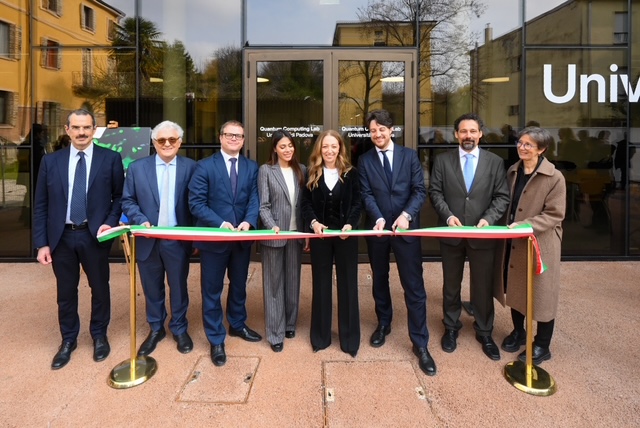
In the presence of the Rector of the University of Padua, Daniela Mapelli, the Councillor of the Municipality of Padua, Francesca Benciolini, and the President of the Veneto Region, Alberto Stefani, the Quantum Computing Lab was inaugurated today, Monday, March 2. The new University facility, located on Via Luzzati in Padua, houses spaces designed for activities involving trapped-ion quantum computers, physics of the Universe, lasers and optics, and other laboratories.

The Quantum Computing Lab represents a strategic investment in infrastructure and equipment. The laboratory will host the development of a quantum computer built using trapped-ion technology. The initiative is part of the QCSC project funded under the WCRI call, which is developing a complete quantum computing ecosystem (hardware, software, and their scientific and industrial applications), and exploring the interface between quantum computing and quantum communications. The project involves twelve Departments of the University of Padua and the Interdepartmental Center for Quantum Technologies, Padua QTech. The activities of the Quantum Computing Lab have also been supported by the National Center for HPC, Big Data and Quantum Computing – ICSC Foundation – thus contributing to the coordinated development of the Italian quantum computing ecosystem.

The program also involves several other Italian universities (Pavia, L’Aquila, Naples and Bologna…) together with a network of high-level institutions and partners, including Cineca, INFN Q@TN, TQT, NEAT, ARAKNE, and ALGORITHMS. This highlights the strongly interdisciplinary nature and the national and international scope of the initiative, which has also led to the establishment of the Italian Quantum Alliance, an association representing institutions and companies active in quantum technologies in Italy, headquartered in Padua.
The University of Padua’s strong commitment to quantum technologies also aims to contribute to the development of the Italian Strategy for Quantum Technologies and the European Quantum Strategy.

“The investment in the Quantum Computing Lab, approximately five million euros for construction alone, represents one of the most significant efforts made by our University to provide research with adequate spaces,” stated Rector Daniela Mapelli. “This figure is noteworthy not for its economic size, but for what it represents: the awareness that excellent research requires excellent infrastructure. A laboratory is not simply a container; it is an accelerator of ideas, a place that enables collaboration, an environment that makes possible what was previously impossible. Quantum technologies will indeed have a decisive impact. However, every scientific advancement carries responsibility. Our tradition, rooted in centuries of freedom of research and thought, reminds us that the role of academia is not only to produce knowledge, but to direct it toward purposes that strengthen human dignity and social cohesion. In this sense, quantum is not only a technological challenge; it is a test of our ability to govern innovation with responsibility and foresight.”

“Research and critical thinking have always characterized the city of Padua,” added Francesca Benciolini, Councillor of the Municipality of Padua. “Investments like this in research infrastructure allow our city to be enriched by people capable of embracing scientific challenges, enabling our community to feel actively involved in innovation processes.”

“With this initiative,” emphasized the President of the Veneto Region, Alberto Stefani, “the University of Padua takes a highly significant step into modernity, looks to the future, and aims to build it through research, in an environment characterized by advanced laboratories, high technology, and education. This University investment creates an innovation context at the highest levels. This is what our young people need to grow professionally, and what Veneto’s entrepreneurship needs, as innovation becomes its guiding star.”
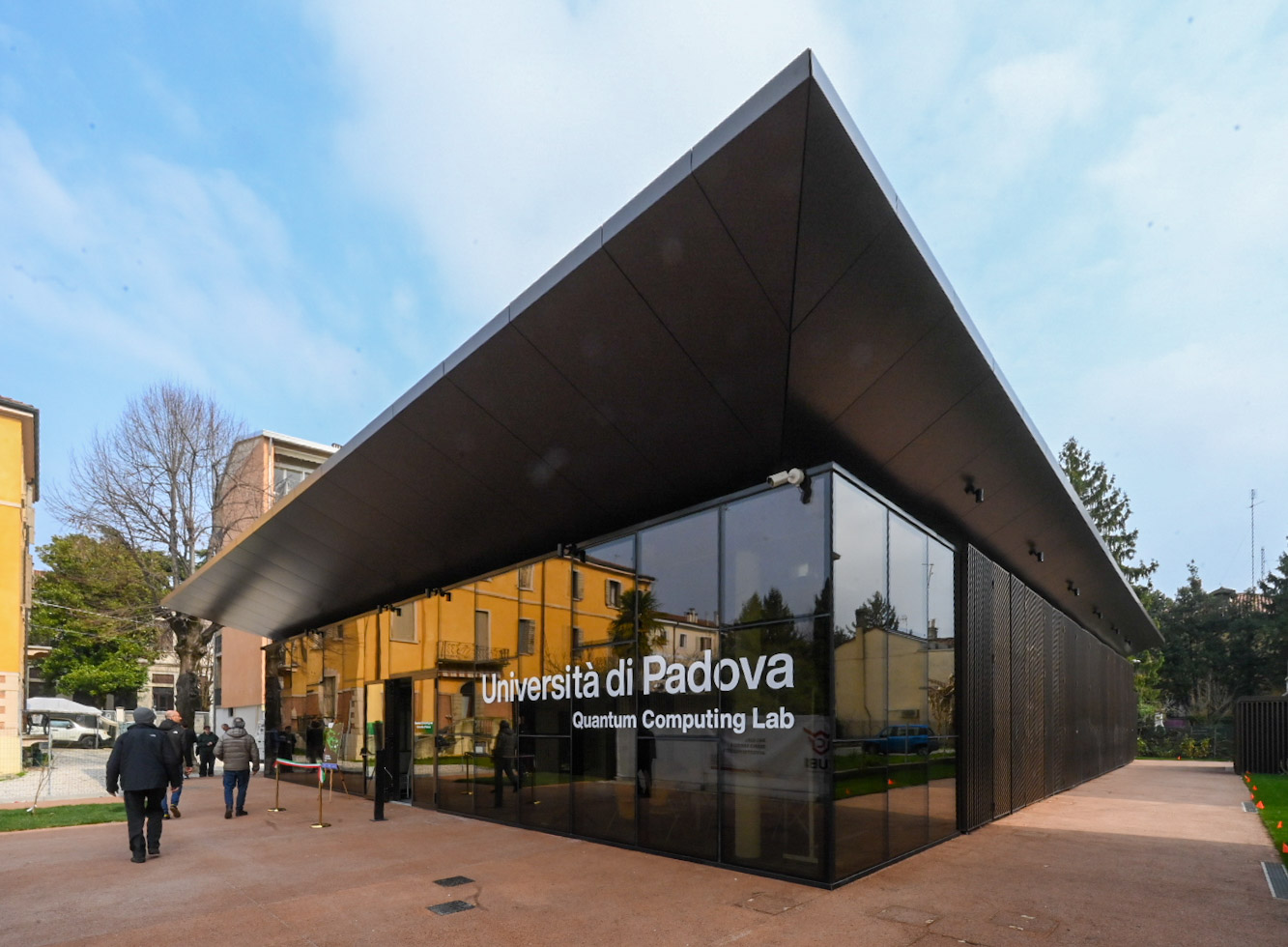
The Quantum Computing Lab

A trapped-ion quantum computer is a platform in which quantum information is “written” and manipulated using ions (electrically charged atoms) that are suspended and confined by electromagnetic fields inside a trap. The ions are controlled with extreme precision through pulses—especially lasers—which make it possible to prepare, evolve, and read quantum states. This technology is considered among the most promising for building stable and controllable quantum processors, suitable for exploring new applications in the simulation of complex systems, optimization, and the development of quantum algorithms.

The total cost of the project, including asbestos remediation works, amounts to €4,800,000. The scientific instrumentation installed totals approximately €4,500,000, of which €3,500,000 comes from WCRI funding and €1,000,000 from the PNRR – National Center 1, Spoke 10.

The WCRI project was funded through a call issued by the University of Padua, which allocated €7.5 million to promote the acquisition of “World Class Research Infrastructures” (WCRI): highly innovative research infrastructures of scientific excellence capable of serving as international reference points. Thanks to this investment, the University accelerates the development of technological platforms that provide the scientific community with resources and services for cutting-edge research and innovation. 

Spaces and Technical Requirements for Advanced Research

The building covers a gross floor area of 683.0 m², distributed between the ground floor (laboratories, 565.4 m²) and the first floor (technical rooms, 117.6 m²). The net laboratory area amounts to 386.9 m², organized into specialized areas:

  • Quantum Computer Laboratory: 104.1 m², with a dedicated control room (34.1 m²);
  • Physics of the Universe Laboratory: two rooms of 77.9 m² and 15.1 m²;
  • Laser Laboratory: 17.0 m²;
  • Modular laboratories: 7 rooms ranging from 15.3 m² to 23.0 m². 

The facility also includes a 26.8 m² meeting room and dedicated technical spaces (12.1 m² on the ground floor and 100.2 m² on the roof level).

Special attention has been given to the requirements of highly sensitive equipment: a 213.60 m² isolated slab with anti-vibration joint has been designed specifically to guarantee optimal operating conditions for the quantum computer.

From an energy and systems perspective, the building integrates a 30 kW photovoltaic system (62 panels) and a geothermal cooling system dedicated to the machinery, with one 137 m intake well and two 137 m discharge wells (authorized and scheduled for execution). Advanced systems are also installed, including technical gases, electrical distribution with busbar trunking and UPS, oxygen level detection, and a safety control system for operating lasers. A dedicated 250 kW medium-voltage/low-voltage (MV–LV) substation serves the facility.

“The new structure incorporates extremely stringent technical requirements, from anti-vibration features to support systems, to host frontier instrumentation,” concluded Flavio Seno, Director of the Department of Physics and Astronomy at the University of Padua. “It is a laboratory designed not only for research, but also for education: here students will develop advanced technological skills and experience science ‘in the field,’ in close contact with next-generation experimental equipment and methods.”

“The development of a trapped-ion quantum computer and the activities of the Quantum Computing and Simulation Center (QCSC) are based on a broad interdisciplinary network involving numerous Departments, Padua QTech, and leading national and international scientific and industrial partners,” explains Simone Montangero, Director of the Quantum Computing and Simulation Center and co-leader of quantum computing activities at the National Center for HPC, Big Data and Quantum Computing. “The goal is to build a platform that enables cutting-edge research and innovation, with significant scientific and educational impact.”
[summary] => [format] => 2 [safe_value] =>

In the presence of the Rector of the University of Padua, Daniela Mapelli, the Councillor of the Municipality of Padua, Francesca Benciolini, and the President of the Veneto Region, Alberto Stefani, the Quantum Computing Lab was inaugurated today, Monday, March 2. The new University facility, located on Via Luzzati in Padua, houses spaces designed for activities involving trapped-ion quantum computers, physics of the Universe, lasers and optics, and other laboratories.

The Quantum Computing Lab represents a strategic investment in infrastructure and equipment. The laboratory will host the development of a quantum computer built using trapped-ion technology. The initiative is part of the QCSC project funded under the WCRI call, which is developing a complete quantum computing ecosystem (hardware, software, and their scientific and industrial applications), and exploring the interface between quantum computing and quantum communications. The project involves twelve Departments of the University of Padua and the Interdepartmental Center for Quantum Technologies, Padua QTech. The activities of the Quantum Computing Lab have also been supported by the National Center for HPC, Big Data and Quantum Computing – ICSC Foundation – thus contributing to the coordinated development of the Italian quantum computing ecosystem.

The program also involves several other Italian universities (Pavia, L’Aquila, Naples and Bologna…) together with a network of high-level institutions and partners, including Cineca, INFN Q@TN, TQT, NEAT, ARAKNE, and ALGORITHMS. This highlights the strongly interdisciplinary nature and the national and international scope of the initiative, which has also led to the establishment of the Italian Quantum Alliance, an association representing institutions and companies active in quantum technologies in Italy, headquartered in Padua.
The University of Padua’s strong commitment to quantum technologies also aims to contribute to the development of the Italian Strategy for Quantum Technologies and the European Quantum Strategy.

“The investment in the Quantum Computing Lab, approximately five million euros for construction alone, represents one of the most significant efforts made by our University to provide research with adequate spaces,” stated Rector Daniela Mapelli. “This figure is noteworthy not for its economic size, but for what it represents: the awareness that excellent research requires excellent infrastructure. A laboratory is not simply a container; it is an accelerator of ideas, a place that enables collaboration, an environment that makes possible what was previously impossible. Quantum technologies will indeed have a decisive impact. However, every scientific advancement carries responsibility. Our tradition, rooted in centuries of freedom of research and thought, reminds us that the role of academia is not only to produce knowledge, but to direct it toward purposes that strengthen human dignity and social cohesion. In this sense, quantum is not only a technological challenge; it is a test of our ability to govern innovation with responsibility and foresight.”

“Research and critical thinking have always characterized the city of Padua,” added Francesca Benciolini, Councillor of the Municipality of Padua. “Investments like this in research infrastructure allow our city to be enriched by people capable of embracing scientific challenges, enabling our community to feel actively involved in innovation processes.”

“With this initiative,” emphasized the President of the Veneto Region, Alberto Stefani, “the University of Padua takes a highly significant step into modernity, looks to the future, and aims to build it through research, in an environment characterized by advanced laboratories, high technology, and education. This University investment creates an innovation context at the highest levels. This is what our young people need to grow professionally, and what Veneto’s entrepreneurship needs, as innovation becomes its guiding star.”

The Quantum Computing Lab

A trapped-ion quantum computer is a platform in which quantum information is “written” and manipulated using ions (electrically charged atoms) that are suspended and confined by electromagnetic fields inside a trap. The ions are controlled with extreme precision through pulses—especially lasers—which make it possible to prepare, evolve, and read quantum states. This technology is considered among the most promising for building stable and controllable quantum processors, suitable for exploring new applications in the simulation of complex systems, optimization, and the development of quantum algorithms.

The total cost of the project, including asbestos remediation works, amounts to €4,800,000. The scientific instrumentation installed totals approximately €4,500,000, of which €3,500,000 comes from WCRI funding and €1,000,000 from the PNRR – National Center 1, Spoke 10.

The WCRI project was funded through a call issued by the University of Padua, which allocated €7.5 million to promote the acquisition of “World Class Research Infrastructures” (WCRI): highly innovative research infrastructures of scientific excellence capable of serving as international reference points. Thanks to this investment, the University accelerates the development of technological platforms that provide the scientific community with resources and services for cutting-edge research and innovation. 

Spaces and Technical Requirements for Advanced Research

The building covers a gross floor area of 683.0 m², distributed between the ground floor (laboratories, 565.4 m²) and the first floor (technical rooms, 117.6 m²). The net laboratory area amounts to 386.9 m², organized into specialized areas:

  • Quantum Computer Laboratory: 104.1 m², with a dedicated control room (34.1 m²);
  • Physics of the Universe Laboratory: two rooms of 77.9 m² and 15.1 m²;
  • Laser Laboratory: 17.0 m²;
  • Modular laboratories: 7 rooms ranging from 15.3 m² to 23.0 m². 

The facility also includes a 26.8 m² meeting room and dedicated technical spaces (12.1 m² on the ground floor and 100.2 m² on the roof level).

Special attention has been given to the requirements of highly sensitive equipment: a 213.60 m² isolated slab with anti-vibration joint has been designed specifically to guarantee optimal operating conditions for the quantum computer.

From an energy and systems perspective, the building integrates a 30 kW photovoltaic system (62 panels) and a geothermal cooling system dedicated to the machinery, with one 137 m intake well and two 137 m discharge wells (authorized and scheduled for execution). Advanced systems are also installed, including technical gases, electrical distribution with busbar trunking and UPS, oxygen level detection, and a safety control system for operating lasers. A dedicated 250 kW medium-voltage/low-voltage (MV–LV) substation serves the facility.

“The new structure incorporates extremely stringent technical requirements, from anti-vibration features to support systems, to host frontier instrumentation,” concluded Flavio Seno, Director of the Department of Physics and Astronomy at the University of Padua. “It is a laboratory designed not only for research, but also for education: here students will develop advanced technological skills and experience science ‘in the field,’ in close contact with next-generation experimental equipment and methods.”

“The development of a trapped-ion quantum computer and the activities of the Quantum Computing and Simulation Center (QCSC) are based on a broad interdisciplinary network involving numerous Departments, Padua QTech, and leading national and international scientific and industrial partners,” explains Simone Montangero, Director of the Quantum Computing and Simulation Center and co-leader of quantum computing activities at the National Center for HPC, Big Data and Quantum Computing. “The goal is to build a platform that enables cutting-edge research and innovation, with significant scientific and educational impact.”

[safe_summary] => ) ) ) [field_date_box_lancio_news] => Array ( [und] => Array ( [0] => Array ( [value] => 2026-03-02T00:00:00 [timezone] => Europe/Paris [timezone_db] => Europe/Paris [date_type] => date ) ) ) [field_etichetta_box_lancio_news] => Array ( ) [field_img_box_lancio_news] => Array ( [und] => Array ( [0] => Array ( [fid] => 146628 [uid] => 2032 [filename] => news_bolive_1200x630.png [uri] => public://news_bolive_1200x630_4.png [filemime] => image/png [filesize] => 660589 [status] => 1 [timestamp] => 1772458353 [type] => image [field_file_image_alt_text] => Array ( ) [field_file_image_title_text] => Array ( ) [field_folder] => Array ( [und] => Array ( [0] => Array ( [tid] => 2048 ) ) ) [metadata] => Array ( [height] => 630 [width] => 1200 ) [height] => 630 [width] => 1200 [alt] => quantum [title] => ) ) ) [field_link_alla_news] => Array ( ) [field_link_esterno_news] => Array ( ) [field_pagina_associata] => Array ( ) [field_link_etichetta] => Array ( ) [field_abstract_news] => Array ( [und] => Array ( [0] => Array ( [value] => The Quantum Computing Lab has been inaugurated, a new facility of the University of Padua located on Via Luzzati, designed to host activities involving a trapped-ion quantum computer, physics of the Universe, laser and optics research, as well as additional laboratory spaces [format] => [safe_value] => The Quantum Computing Lab has been inaugurated, a new facility of the University of Padua located on Via Luzzati, designed to host activities involving a trapped-ion quantum computer, physics of the Universe, laser and optics research, as well as additional laboratory spaces ) ) ) [field_allegato_news] => Array ( ) [field_categorie_news] => Array ( [und] => Array ( [0] => Array ( [tid] => 2296 ) ) ) [field_pub_date] => Array ( [und] => Array ( [0] => Array ( [value] => 2026-03-02T00:00:00 [value2] => 2027-03-02T00:00:00 [timezone] => Europe/Paris [timezone_db] => Europe/Paris [date_type] => date ) ) ) [field_layout_news] => Array ( [und] => Array ( [0] => Array ( [value] => single ) ) ) [field_testo_opzionale_news] => Array ( ) [field_url_en_page] => Array ( [und] => Array ( [0] => Array ( [value] => /news/inaugurato-padova-nuovo-quantum-computing-lab [format] => [safe_value] => /news/inaugurato-padova-nuovo-quantum-computing-lab ) ) ) [field_url_en_page_label] => Array ( [und] => Array ( [0] => Array ( [value] => Italian version [format] => [safe_value] => Italian version ) ) ) [path] => Array ( [pathauto] => 1 ) [name] => francesca.forzan [picture] => 0 [data] => b:0; [num_revisions] => 7 [current_revision_id] => 519800 [is_current] => 1 [is_pending] => [revision_moderation] => [entity_view_prepared] => 1 ) [#items] => Array ( [0] => Array ( [value] =>

In the presence of the Rector of the University of Padua, Daniela Mapelli, the Councillor of the Municipality of Padua, Francesca Benciolini, and the President of the Veneto Region, Alberto Stefani, the Quantum Computing Lab was inaugurated today, Monday, March 2. The new University facility, located on Via Luzzati in Padua, houses spaces designed for activities involving trapped-ion quantum computers, physics of the Universe, lasers and optics, and other laboratories.

The Quantum Computing Lab represents a strategic investment in infrastructure and equipment. The laboratory will host the development of a quantum computer built using trapped-ion technology. The initiative is part of the QCSC project funded under the WCRI call, which is developing a complete quantum computing ecosystem (hardware, software, and their scientific and industrial applications), and exploring the interface between quantum computing and quantum communications. The project involves twelve Departments of the University of Padua and the Interdepartmental Center for Quantum Technologies, Padua QTech. The activities of the Quantum Computing Lab have also been supported by the National Center for HPC, Big Data and Quantum Computing – ICSC Foundation – thus contributing to the coordinated development of the Italian quantum computing ecosystem.

The program also involves several other Italian universities (Pavia, L’Aquila, Naples and Bologna…) together with a network of high-level institutions and partners, including Cineca, INFN Q@TN, TQT, NEAT, ARAKNE, and ALGORITHMS. This highlights the strongly interdisciplinary nature and the national and international scope of the initiative, which has also led to the establishment of the Italian Quantum Alliance, an association representing institutions and companies active in quantum technologies in Italy, headquartered in Padua.
The University of Padua’s strong commitment to quantum technologies also aims to contribute to the development of the Italian Strategy for Quantum Technologies and the European Quantum Strategy.

“The investment in the Quantum Computing Lab, approximately five million euros for construction alone, represents one of the most significant efforts made by our University to provide research with adequate spaces,” stated Rector Daniela Mapelli. “This figure is noteworthy not for its economic size, but for what it represents: the awareness that excellent research requires excellent infrastructure. A laboratory is not simply a container; it is an accelerator of ideas, a place that enables collaboration, an environment that makes possible what was previously impossible. Quantum technologies will indeed have a decisive impact. However, every scientific advancement carries responsibility. Our tradition, rooted in centuries of freedom of research and thought, reminds us that the role of academia is not only to produce knowledge, but to direct it toward purposes that strengthen human dignity and social cohesion. In this sense, quantum is not only a technological challenge; it is a test of our ability to govern innovation with responsibility and foresight.”

“Research and critical thinking have always characterized the city of Padua,” added Francesca Benciolini, Councillor of the Municipality of Padua. “Investments like this in research infrastructure allow our city to be enriched by people capable of embracing scientific challenges, enabling our community to feel actively involved in innovation processes.”

“With this initiative,” emphasized the President of the Veneto Region, Alberto Stefani, “the University of Padua takes a highly significant step into modernity, looks to the future, and aims to build it through research, in an environment characterized by advanced laboratories, high technology, and education. This University investment creates an innovation context at the highest levels. This is what our young people need to grow professionally, and what Veneto’s entrepreneurship needs, as innovation becomes its guiding star.”

The Quantum Computing Lab

A trapped-ion quantum computer is a platform in which quantum information is “written” and manipulated using ions (electrically charged atoms) that are suspended and confined by electromagnetic fields inside a trap. The ions are controlled with extreme precision through pulses—especially lasers—which make it possible to prepare, evolve, and read quantum states. This technology is considered among the most promising for building stable and controllable quantum processors, suitable for exploring new applications in the simulation of complex systems, optimization, and the development of quantum algorithms.

The total cost of the project, including asbestos remediation works, amounts to €4,800,000. The scientific instrumentation installed totals approximately €4,500,000, of which €3,500,000 comes from WCRI funding and €1,000,000 from the PNRR – National Center 1, Spoke 10.

The WCRI project was funded through a call issued by the University of Padua, which allocated €7.5 million to promote the acquisition of “World Class Research Infrastructures” (WCRI): highly innovative research infrastructures of scientific excellence capable of serving as international reference points. Thanks to this investment, the University accelerates the development of technological platforms that provide the scientific community with resources and services for cutting-edge research and innovation. 

Spaces and Technical Requirements for Advanced Research

The building covers a gross floor area of 683.0 m², distributed between the ground floor (laboratories, 565.4 m²) and the first floor (technical rooms, 117.6 m²). The net laboratory area amounts to 386.9 m², organized into specialized areas:

  • Quantum Computer Laboratory: 104.1 m², with a dedicated control room (34.1 m²);
  • Physics of the Universe Laboratory: two rooms of 77.9 m² and 15.1 m²;
  • Laser Laboratory: 17.0 m²;
  • Modular laboratories: 7 rooms ranging from 15.3 m² to 23.0 m². 

The facility also includes a 26.8 m² meeting room and dedicated technical spaces (12.1 m² on the ground floor and 100.2 m² on the roof level).

Special attention has been given to the requirements of highly sensitive equipment: a 213.60 m² isolated slab with anti-vibration joint has been designed specifically to guarantee optimal operating conditions for the quantum computer.

From an energy and systems perspective, the building integrates a 30 kW photovoltaic system (62 panels) and a geothermal cooling system dedicated to the machinery, with one 137 m intake well and two 137 m discharge wells (authorized and scheduled for execution). Advanced systems are also installed, including technical gases, electrical distribution with busbar trunking and UPS, oxygen level detection, and a safety control system for operating lasers. A dedicated 250 kW medium-voltage/low-voltage (MV–LV) substation serves the facility.

“The new structure incorporates extremely stringent technical requirements, from anti-vibration features to support systems, to host frontier instrumentation,” concluded Flavio Seno, Director of the Department of Physics and Astronomy at the University of Padua. “It is a laboratory designed not only for research, but also for education: here students will develop advanced technological skills and experience science ‘in the field,’ in close contact with next-generation experimental equipment and methods.”

“The development of a trapped-ion quantum computer and the activities of the Quantum Computing and Simulation Center (QCSC) are based on a broad interdisciplinary network involving numerous Departments, Padua QTech, and leading national and international scientific and industrial partners,” explains Simone Montangero, Director of the Quantum Computing and Simulation Center and co-leader of quantum computing activities at the National Center for HPC, Big Data and Quantum Computing. “The goal is to build a platform that enables cutting-edge research and innovation, with significant scientific and educational impact.”

[summary] => [format] => 2 [safe_value] =>

In the presence of the Rector of the University of Padua, Daniela Mapelli, the Councillor of the Municipality of Padua, Francesca Benciolini, and the President of the Veneto Region, Alberto Stefani, the Quantum Computing Lab was inaugurated today, Monday, March 2. The new University facility, located on Via Luzzati in Padua, houses spaces designed for activities involving trapped-ion quantum computers, physics of the Universe, lasers and optics, and other laboratories.

The Quantum Computing Lab represents a strategic investment in infrastructure and equipment. The laboratory will host the development of a quantum computer built using trapped-ion technology. The initiative is part of the QCSC project funded under the WCRI call, which is developing a complete quantum computing ecosystem (hardware, software, and their scientific and industrial applications), and exploring the interface between quantum computing and quantum communications. The project involves twelve Departments of the University of Padua and the Interdepartmental Center for Quantum Technologies, Padua QTech. The activities of the Quantum Computing Lab have also been supported by the National Center for HPC, Big Data and Quantum Computing – ICSC Foundation – thus contributing to the coordinated development of the Italian quantum computing ecosystem.

The program also involves several other Italian universities (Pavia, L’Aquila, Naples and Bologna…) together with a network of high-level institutions and partners, including Cineca, INFN Q@TN, TQT, NEAT, ARAKNE, and ALGORITHMS. This highlights the strongly interdisciplinary nature and the national and international scope of the initiative, which has also led to the establishment of the Italian Quantum Alliance, an association representing institutions and companies active in quantum technologies in Italy, headquartered in Padua.
The University of Padua’s strong commitment to quantum technologies also aims to contribute to the development of the Italian Strategy for Quantum Technologies and the European Quantum Strategy.

“The investment in the Quantum Computing Lab, approximately five million euros for construction alone, represents one of the most significant efforts made by our University to provide research with adequate spaces,” stated Rector Daniela Mapelli. “This figure is noteworthy not for its economic size, but for what it represents: the awareness that excellent research requires excellent infrastructure. A laboratory is not simply a container; it is an accelerator of ideas, a place that enables collaboration, an environment that makes possible what was previously impossible. Quantum technologies will indeed have a decisive impact. However, every scientific advancement carries responsibility. Our tradition, rooted in centuries of freedom of research and thought, reminds us that the role of academia is not only to produce knowledge, but to direct it toward purposes that strengthen human dignity and social cohesion. In this sense, quantum is not only a technological challenge; it is a test of our ability to govern innovation with responsibility and foresight.”

“Research and critical thinking have always characterized the city of Padua,” added Francesca Benciolini, Councillor of the Municipality of Padua. “Investments like this in research infrastructure allow our city to be enriched by people capable of embracing scientific challenges, enabling our community to feel actively involved in innovation processes.”

“With this initiative,” emphasized the President of the Veneto Region, Alberto Stefani, “the University of Padua takes a highly significant step into modernity, looks to the future, and aims to build it through research, in an environment characterized by advanced laboratories, high technology, and education. This University investment creates an innovation context at the highest levels. This is what our young people need to grow professionally, and what Veneto’s entrepreneurship needs, as innovation becomes its guiding star.”

The Quantum Computing Lab

A trapped-ion quantum computer is a platform in which quantum information is “written” and manipulated using ions (electrically charged atoms) that are suspended and confined by electromagnetic fields inside a trap. The ions are controlled with extreme precision through pulses—especially lasers—which make it possible to prepare, evolve, and read quantum states. This technology is considered among the most promising for building stable and controllable quantum processors, suitable for exploring new applications in the simulation of complex systems, optimization, and the development of quantum algorithms.

The total cost of the project, including asbestos remediation works, amounts to €4,800,000. The scientific instrumentation installed totals approximately €4,500,000, of which €3,500,000 comes from WCRI funding and €1,000,000 from the PNRR – National Center 1, Spoke 10.

The WCRI project was funded through a call issued by the University of Padua, which allocated €7.5 million to promote the acquisition of “World Class Research Infrastructures” (WCRI): highly innovative research infrastructures of scientific excellence capable of serving as international reference points. Thanks to this investment, the University accelerates the development of technological platforms that provide the scientific community with resources and services for cutting-edge research and innovation. 

Spaces and Technical Requirements for Advanced Research

The building covers a gross floor area of 683.0 m², distributed between the ground floor (laboratories, 565.4 m²) and the first floor (technical rooms, 117.6 m²). The net laboratory area amounts to 386.9 m², organized into specialized areas:

  • Quantum Computer Laboratory: 104.1 m², with a dedicated control room (34.1 m²);
  • Physics of the Universe Laboratory: two rooms of 77.9 m² and 15.1 m²;
  • Laser Laboratory: 17.0 m²;
  • Modular laboratories: 7 rooms ranging from 15.3 m² to 23.0 m². 

The facility also includes a 26.8 m² meeting room and dedicated technical spaces (12.1 m² on the ground floor and 100.2 m² on the roof level).

Special attention has been given to the requirements of highly sensitive equipment: a 213.60 m² isolated slab with anti-vibration joint has been designed specifically to guarantee optimal operating conditions for the quantum computer.

From an energy and systems perspective, the building integrates a 30 kW photovoltaic system (62 panels) and a geothermal cooling system dedicated to the machinery, with one 137 m intake well and two 137 m discharge wells (authorized and scheduled for execution). Advanced systems are also installed, including technical gases, electrical distribution with busbar trunking and UPS, oxygen level detection, and a safety control system for operating lasers. A dedicated 250 kW medium-voltage/low-voltage (MV–LV) substation serves the facility.

“The new structure incorporates extremely stringent technical requirements, from anti-vibration features to support systems, to host frontier instrumentation,” concluded Flavio Seno, Director of the Department of Physics and Astronomy at the University of Padua. “It is a laboratory designed not only for research, but also for education: here students will develop advanced technological skills and experience science ‘in the field,’ in close contact with next-generation experimental equipment and methods.”

“The development of a trapped-ion quantum computer and the activities of the Quantum Computing and Simulation Center (QCSC) are based on a broad interdisciplinary network involving numerous Departments, Padua QTech, and leading national and international scientific and industrial partners,” explains Simone Montangero, Director of the Quantum Computing and Simulation Center and co-leader of quantum computing activities at the National Center for HPC, Big Data and Quantum Computing. “The goal is to build a platform that enables cutting-edge research and innovation, with significant scientific and educational impact.”

[safe_summary] => ) ) [#formatter] => text_summary_or_trimmed [0] => Array ( [#markup] =>

In the presence of the Rector of the University of Padua, Daniela Mapelli, the Councillor of the Municipality of Padua, Francesca Benciolini, and the President of the Veneto Region, Alberto Stefani, the Quantum Computing Lab was inaugurated today, Monday, March 2. The new University facility, located on Via Luzzati in Padua, houses spaces designed for activities involving trapped-ion quantum computers, physics of the Universe, lasers and optics, and other laboratories.

) ) [field_img_box_lancio_news] => Array ( [#theme] => field [#weight] => 0 [#title] => Immagine [#access] => 1 [#label_display] => above [#view_mode] => teaser [#language] => und [#field_name] => field_img_box_lancio_news [#field_type] => image [#field_translatable] => 0 [#entity_type] => node [#bundle] => box_lancio_news [#object] => stdClass Object ( [vid] => 519800 [uid] => 2032 [title] => Inaugurated in Padua the New Quantum Computing Lab [log] => [status] => 1 [comment] => 0 [promote] => 1 [sticky] => 0 [nid] => 127824 [type] => box_lancio_news [language] => it [created] => 1772458353 [changed] => 1772462656 [tnid] => 0 [translate] => 0 [revision_timestamp] => 1772462656 [revision_uid] => 2032 [body] => Array ( [und] => Array ( [0] => Array ( [value] =>

In the presence of the Rector of the University of Padua, Daniela Mapelli, the Councillor of the Municipality of Padua, Francesca Benciolini, and the President of the Veneto Region, Alberto Stefani, the Quantum Computing Lab was inaugurated today, Monday, March 2. The new University facility, located on Via Luzzati in Padua, houses spaces designed for activities involving trapped-ion quantum computers, physics of the Universe, lasers and optics, and other laboratories.

The Quantum Computing Lab represents a strategic investment in infrastructure and equipment. The laboratory will host the development of a quantum computer built using trapped-ion technology. The initiative is part of the QCSC project funded under the WCRI call, which is developing a complete quantum computing ecosystem (hardware, software, and their scientific and industrial applications), and exploring the interface between quantum computing and quantum communications. The project involves twelve Departments of the University of Padua and the Interdepartmental Center for Quantum Technologies, Padua QTech. The activities of the Quantum Computing Lab have also been supported by the National Center for HPC, Big Data and Quantum Computing – ICSC Foundation – thus contributing to the coordinated development of the Italian quantum computing ecosystem.

The program also involves several other Italian universities (Pavia, L’Aquila, Naples and Bologna…) together with a network of high-level institutions and partners, including Cineca, INFN Q@TN, TQT, NEAT, ARAKNE, and ALGORITHMS. This highlights the strongly interdisciplinary nature and the national and international scope of the initiative, which has also led to the establishment of the Italian Quantum Alliance, an association representing institutions and companies active in quantum technologies in Italy, headquartered in Padua.
The University of Padua’s strong commitment to quantum technologies also aims to contribute to the development of the Italian Strategy for Quantum Technologies and the European Quantum Strategy.

“The investment in the Quantum Computing Lab, approximately five million euros for construction alone, represents one of the most significant efforts made by our University to provide research with adequate spaces,” stated Rector Daniela Mapelli. “This figure is noteworthy not for its economic size, but for what it represents: the awareness that excellent research requires excellent infrastructure. A laboratory is not simply a container; it is an accelerator of ideas, a place that enables collaboration, an environment that makes possible what was previously impossible. Quantum technologies will indeed have a decisive impact. However, every scientific advancement carries responsibility. Our tradition, rooted in centuries of freedom of research and thought, reminds us that the role of academia is not only to produce knowledge, but to direct it toward purposes that strengthen human dignity and social cohesion. In this sense, quantum is not only a technological challenge; it is a test of our ability to govern innovation with responsibility and foresight.”

“Research and critical thinking have always characterized the city of Padua,” added Francesca Benciolini, Councillor of the Municipality of Padua. “Investments like this in research infrastructure allow our city to be enriched by people capable of embracing scientific challenges, enabling our community to feel actively involved in innovation processes.”

“With this initiative,” emphasized the President of the Veneto Region, Alberto Stefani, “the University of Padua takes a highly significant step into modernity, looks to the future, and aims to build it through research, in an environment characterized by advanced laboratories, high technology, and education. This University investment creates an innovation context at the highest levels. This is what our young people need to grow professionally, and what Veneto’s entrepreneurship needs, as innovation becomes its guiding star.”

The Quantum Computing Lab

A trapped-ion quantum computer is a platform in which quantum information is “written” and manipulated using ions (electrically charged atoms) that are suspended and confined by electromagnetic fields inside a trap. The ions are controlled with extreme precision through pulses—especially lasers—which make it possible to prepare, evolve, and read quantum states. This technology is considered among the most promising for building stable and controllable quantum processors, suitable for exploring new applications in the simulation of complex systems, optimization, and the development of quantum algorithms.

The total cost of the project, including asbestos remediation works, amounts to €4,800,000. The scientific instrumentation installed totals approximately €4,500,000, of which €3,500,000 comes from WCRI funding and €1,000,000 from the PNRR – National Center 1, Spoke 10.

The WCRI project was funded through a call issued by the University of Padua, which allocated €7.5 million to promote the acquisition of “World Class Research Infrastructures” (WCRI): highly innovative research infrastructures of scientific excellence capable of serving as international reference points. Thanks to this investment, the University accelerates the development of technological platforms that provide the scientific community with resources and services for cutting-edge research and innovation. 

Spaces and Technical Requirements for Advanced Research

The building covers a gross floor area of 683.0 m², distributed between the ground floor (laboratories, 565.4 m²) and the first floor (technical rooms, 117.6 m²). The net laboratory area amounts to 386.9 m², organized into specialized areas:

  • Quantum Computer Laboratory: 104.1 m², with a dedicated control room (34.1 m²);
  • Physics of the Universe Laboratory: two rooms of 77.9 m² and 15.1 m²;
  • Laser Laboratory: 17.0 m²;
  • Modular laboratories: 7 rooms ranging from 15.3 m² to 23.0 m². 

The facility also includes a 26.8 m² meeting room and dedicated technical spaces (12.1 m² on the ground floor and 100.2 m² on the roof level).

Special attention has been given to the requirements of highly sensitive equipment: a 213.60 m² isolated slab with anti-vibration joint has been designed specifically to guarantee optimal operating conditions for the quantum computer.

From an energy and systems perspective, the building integrates a 30 kW photovoltaic system (62 panels) and a geothermal cooling system dedicated to the machinery, with one 137 m intake well and two 137 m discharge wells (authorized and scheduled for execution). Advanced systems are also installed, including technical gases, electrical distribution with busbar trunking and UPS, oxygen level detection, and a safety control system for operating lasers. A dedicated 250 kW medium-voltage/low-voltage (MV–LV) substation serves the facility.

“The new structure incorporates extremely stringent technical requirements, from anti-vibration features to support systems, to host frontier instrumentation,” concluded Flavio Seno, Director of the Department of Physics and Astronomy at the University of Padua. “It is a laboratory designed not only for research, but also for education: here students will develop advanced technological skills and experience science ‘in the field,’ in close contact with next-generation experimental equipment and methods.”

“The development of a trapped-ion quantum computer and the activities of the Quantum Computing and Simulation Center (QCSC) are based on a broad interdisciplinary network involving numerous Departments, Padua QTech, and leading national and international scientific and industrial partners,” explains Simone Montangero, Director of the Quantum Computing and Simulation Center and co-leader of quantum computing activities at the National Center for HPC, Big Data and Quantum Computing. “The goal is to build a platform that enables cutting-edge research and innovation, with significant scientific and educational impact.”

[summary] => [format] => 2 [safe_value] =>

In the presence of the Rector of the University of Padua, Daniela Mapelli, the Councillor of the Municipality of Padua, Francesca Benciolini, and the President of the Veneto Region, Alberto Stefani, the Quantum Computing Lab was inaugurated today, Monday, March 2. The new University facility, located on Via Luzzati in Padua, houses spaces designed for activities involving trapped-ion quantum computers, physics of the Universe, lasers and optics, and other laboratories.

The Quantum Computing Lab represents a strategic investment in infrastructure and equipment. The laboratory will host the development of a quantum computer built using trapped-ion technology. The initiative is part of the QCSC project funded under the WCRI call, which is developing a complete quantum computing ecosystem (hardware, software, and their scientific and industrial applications), and exploring the interface between quantum computing and quantum communications. The project involves twelve Departments of the University of Padua and the Interdepartmental Center for Quantum Technologies, Padua QTech. The activities of the Quantum Computing Lab have also been supported by the National Center for HPC, Big Data and Quantum Computing – ICSC Foundation – thus contributing to the coordinated development of the Italian quantum computing ecosystem.

The program also involves several other Italian universities (Pavia, L’Aquila, Naples and Bologna…) together with a network of high-level institutions and partners, including Cineca, INFN Q@TN, TQT, NEAT, ARAKNE, and ALGORITHMS. This highlights the strongly interdisciplinary nature and the national and international scope of the initiative, which has also led to the establishment of the Italian Quantum Alliance, an association representing institutions and companies active in quantum technologies in Italy, headquartered in Padua.
The University of Padua’s strong commitment to quantum technologies also aims to contribute to the development of the Italian Strategy for Quantum Technologies and the European Quantum Strategy.

“The investment in the Quantum Computing Lab, approximately five million euros for construction alone, represents one of the most significant efforts made by our University to provide research with adequate spaces,” stated Rector Daniela Mapelli. “This figure is noteworthy not for its economic size, but for what it represents: the awareness that excellent research requires excellent infrastructure. A laboratory is not simply a container; it is an accelerator of ideas, a place that enables collaboration, an environment that makes possible what was previously impossible. Quantum technologies will indeed have a decisive impact. However, every scientific advancement carries responsibility. Our tradition, rooted in centuries of freedom of research and thought, reminds us that the role of academia is not only to produce knowledge, but to direct it toward purposes that strengthen human dignity and social cohesion. In this sense, quantum is not only a technological challenge; it is a test of our ability to govern innovation with responsibility and foresight.”

“Research and critical thinking have always characterized the city of Padua,” added Francesca Benciolini, Councillor of the Municipality of Padua. “Investments like this in research infrastructure allow our city to be enriched by people capable of embracing scientific challenges, enabling our community to feel actively involved in innovation processes.”

“With this initiative,” emphasized the President of the Veneto Region, Alberto Stefani, “the University of Padua takes a highly significant step into modernity, looks to the future, and aims to build it through research, in an environment characterized by advanced laboratories, high technology, and education. This University investment creates an innovation context at the highest levels. This is what our young people need to grow professionally, and what Veneto’s entrepreneurship needs, as innovation becomes its guiding star.”

The Quantum Computing Lab

A trapped-ion quantum computer is a platform in which quantum information is “written” and manipulated using ions (electrically charged atoms) that are suspended and confined by electromagnetic fields inside a trap. The ions are controlled with extreme precision through pulses—especially lasers—which make it possible to prepare, evolve, and read quantum states. This technology is considered among the most promising for building stable and controllable quantum processors, suitable for exploring new applications in the simulation of complex systems, optimization, and the development of quantum algorithms.

The total cost of the project, including asbestos remediation works, amounts to €4,800,000. The scientific instrumentation installed totals approximately €4,500,000, of which €3,500,000 comes from WCRI funding and €1,000,000 from the PNRR – National Center 1, Spoke 10.

The WCRI project was funded through a call issued by the University of Padua, which allocated €7.5 million to promote the acquisition of “World Class Research Infrastructures” (WCRI): highly innovative research infrastructures of scientific excellence capable of serving as international reference points. Thanks to this investment, the University accelerates the development of technological platforms that provide the scientific community with resources and services for cutting-edge research and innovation. 

Spaces and Technical Requirements for Advanced Research

The building covers a gross floor area of 683.0 m², distributed between the ground floor (laboratories, 565.4 m²) and the first floor (technical rooms, 117.6 m²). The net laboratory area amounts to 386.9 m², organized into specialized areas:

  • Quantum Computer Laboratory: 104.1 m², with a dedicated control room (34.1 m²);
  • Physics of the Universe Laboratory: two rooms of 77.9 m² and 15.1 m²;
  • Laser Laboratory: 17.0 m²;
  • Modular laboratories: 7 rooms ranging from 15.3 m² to 23.0 m². 

The facility also includes a 26.8 m² meeting room and dedicated technical spaces (12.1 m² on the ground floor and 100.2 m² on the roof level).

Special attention has been given to the requirements of highly sensitive equipment: a 213.60 m² isolated slab with anti-vibration joint has been designed specifically to guarantee optimal operating conditions for the quantum computer.

From an energy and systems perspective, the building integrates a 30 kW photovoltaic system (62 panels) and a geothermal cooling system dedicated to the machinery, with one 137 m intake well and two 137 m discharge wells (authorized and scheduled for execution). Advanced systems are also installed, including technical gases, electrical distribution with busbar trunking and UPS, oxygen level detection, and a safety control system for operating lasers. A dedicated 250 kW medium-voltage/low-voltage (MV–LV) substation serves the facility.

“The new structure incorporates extremely stringent technical requirements, from anti-vibration features to support systems, to host frontier instrumentation,” concluded Flavio Seno, Director of the Department of Physics and Astronomy at the University of Padua. “It is a laboratory designed not only for research, but also for education: here students will develop advanced technological skills and experience science ‘in the field,’ in close contact with next-generation experimental equipment and methods.”

“The development of a trapped-ion quantum computer and the activities of the Quantum Computing and Simulation Center (QCSC) are based on a broad interdisciplinary network involving numerous Departments, Padua QTech, and leading national and international scientific and industrial partners,” explains Simone Montangero, Director of the Quantum Computing and Simulation Center and co-leader of quantum computing activities at the National Center for HPC, Big Data and Quantum Computing. “The goal is to build a platform that enables cutting-edge research and innovation, with significant scientific and educational impact.”

[safe_summary] => ) ) ) [field_date_box_lancio_news] => Array ( [und] => Array ( [0] => Array ( [value] => 2026-03-02T00:00:00 [timezone] => Europe/Paris [timezone_db] => Europe/Paris [date_type] => date ) ) ) [field_etichetta_box_lancio_news] => Array ( ) [field_img_box_lancio_news] => Array ( [und] => Array ( [0] => Array ( [fid] => 146628 [uid] => 2032 [filename] => news_bolive_1200x630.png [uri] => public://news_bolive_1200x630_4.png [filemime] => image/png [filesize] => 660589 [status] => 1 [timestamp] => 1772458353 [type] => image [field_file_image_alt_text] => Array ( ) [field_file_image_title_text] => Array ( ) [field_folder] => Array ( [und] => Array ( [0] => Array ( [tid] => 2048 ) ) ) [metadata] => Array ( [height] => 630 [width] => 1200 ) [height] => 630 [width] => 1200 [alt] => quantum [title] => ) ) ) [field_link_alla_news] => Array ( ) [field_link_esterno_news] => Array ( ) [field_pagina_associata] => Array ( ) [field_link_etichetta] => Array ( ) [field_abstract_news] => Array ( [und] => Array ( [0] => Array ( [value] => The Quantum Computing Lab has been inaugurated, a new facility of the University of Padua located on Via Luzzati, designed to host activities involving a trapped-ion quantum computer, physics of the Universe, laser and optics research, as well as additional laboratory spaces [format] => [safe_value] => The Quantum Computing Lab has been inaugurated, a new facility of the University of Padua located on Via Luzzati, designed to host activities involving a trapped-ion quantum computer, physics of the Universe, laser and optics research, as well as additional laboratory spaces ) ) ) [field_allegato_news] => Array ( ) [field_categorie_news] => Array ( [und] => Array ( [0] => Array ( [tid] => 2296 ) ) ) [field_pub_date] => Array ( [und] => Array ( [0] => Array ( [value] => 2026-03-02T00:00:00 [value2] => 2027-03-02T00:00:00 [timezone] => Europe/Paris [timezone_db] => Europe/Paris [date_type] => date ) ) ) [field_layout_news] => Array ( [und] => Array ( [0] => Array ( [value] => single ) ) ) [field_testo_opzionale_news] => Array ( ) [field_url_en_page] => Array ( [und] => Array ( [0] => Array ( [value] => /news/inaugurato-padova-nuovo-quantum-computing-lab [format] => [safe_value] => /news/inaugurato-padova-nuovo-quantum-computing-lab ) ) ) [field_url_en_page_label] => Array ( [und] => Array ( [0] => Array ( [value] => Italian version [format] => [safe_value] => Italian version ) ) ) [path] => Array ( [pathauto] => 1 ) [name] => francesca.forzan [picture] => 0 [data] => b:0; [num_revisions] => 7 [current_revision_id] => 519800 [is_current] => 1 [is_pending] => [revision_moderation] => [entity_view_prepared] => 1 ) [#items] => Array ( [0] => Array ( [fid] => 146628 [uid] => 2032 [filename] => news_bolive_1200x630.png [uri] => public://news_bolive_1200x630_4.png [filemime] => image/png [filesize] => 660589 [status] => 1 [timestamp] => 1772458353 [type] => image [field_file_image_alt_text] => Array ( ) [field_file_image_title_text] => Array ( ) [field_folder] => Array ( [und] => Array ( [0] => Array ( [tid] => 2048 ) ) ) [metadata] => Array ( [height] => 630 [width] => 1200 ) [height] => 630 [width] => 1200 [alt] => quantum [title] => ) ) [#formatter] => image [0] => Array ( [#theme] => image_formatter [#item] => Array ( [fid] => 146628 [uid] => 2032 [filename] => news_bolive_1200x630.png [uri] => public://news_bolive_1200x630_4.png [filemime] => image/png [filesize] => 660589 [status] => 1 [timestamp] => 1772458353 [type] => image [field_file_image_alt_text] => Array ( ) [field_file_image_title_text] => Array ( ) [field_folder] => Array ( [und] => Array ( [0] => Array ( [tid] => 2048 ) ) ) [metadata] => Array ( [height] => 630 [width] => 1200 ) [height] => 630 [width] => 1200 [alt] => quantum [title] => ) [#image_style] => [#path] => ) ) [field_abstract_news] => Array ( [#theme] => field [#weight] => 0 [#title] => Abstract [#access] => 1 [#label_display] => above [#view_mode] => teaser [#language] => und [#field_name] => field_abstract_news [#field_type] => text_long [#field_translatable] => 0 [#entity_type] => node [#bundle] => box_lancio_news [#object] => stdClass Object ( [vid] => 519800 [uid] => 2032 [title] => Inaugurated in Padua the New Quantum Computing Lab [log] => [status] => 1 [comment] => 0 [promote] => 1 [sticky] => 0 [nid] => 127824 [type] => box_lancio_news [language] => it [created] => 1772458353 [changed] => 1772462656 [tnid] => 0 [translate] => 0 [revision_timestamp] => 1772462656 [revision_uid] => 2032 [body] => Array ( [und] => Array ( [0] => Array ( [value] =>

In the presence of the Rector of the University of Padua, Daniela Mapelli, the Councillor of the Municipality of Padua, Francesca Benciolini, and the President of the Veneto Region, Alberto Stefani, the Quantum Computing Lab was inaugurated today, Monday, March 2. The new University facility, located on Via Luzzati in Padua, houses spaces designed for activities involving trapped-ion quantum computers, physics of the Universe, lasers and optics, and other laboratories.

The Quantum Computing Lab represents a strategic investment in infrastructure and equipment. The laboratory will host the development of a quantum computer built using trapped-ion technology. The initiative is part of the QCSC project funded under the WCRI call, which is developing a complete quantum computing ecosystem (hardware, software, and their scientific and industrial applications), and exploring the interface between quantum computing and quantum communications. The project involves twelve Departments of the University of Padua and the Interdepartmental Center for Quantum Technologies, Padua QTech. The activities of the Quantum Computing Lab have also been supported by the National Center for HPC, Big Data and Quantum Computing – ICSC Foundation – thus contributing to the coordinated development of the Italian quantum computing ecosystem.

The program also involves several other Italian universities (Pavia, L’Aquila, Naples and Bologna…) together with a network of high-level institutions and partners, including Cineca, INFN Q@TN, TQT, NEAT, ARAKNE, and ALGORITHMS. This highlights the strongly interdisciplinary nature and the national and international scope of the initiative, which has also led to the establishment of the Italian Quantum Alliance, an association representing institutions and companies active in quantum technologies in Italy, headquartered in Padua.
The University of Padua’s strong commitment to quantum technologies also aims to contribute to the development of the Italian Strategy for Quantum Technologies and the European Quantum Strategy.

“The investment in the Quantum Computing Lab, approximately five million euros for construction alone, represents one of the most significant efforts made by our University to provide research with adequate spaces,” stated Rector Daniela Mapelli. “This figure is noteworthy not for its economic size, but for what it represents: the awareness that excellent research requires excellent infrastructure. A laboratory is not simply a container; it is an accelerator of ideas, a place that enables collaboration, an environment that makes possible what was previously impossible. Quantum technologies will indeed have a decisive impact. However, every scientific advancement carries responsibility. Our tradition, rooted in centuries of freedom of research and thought, reminds us that the role of academia is not only to produce knowledge, but to direct it toward purposes that strengthen human dignity and social cohesion. In this sense, quantum is not only a technological challenge; it is a test of our ability to govern innovation with responsibility and foresight.”

“Research and critical thinking have always characterized the city of Padua,” added Francesca Benciolini, Councillor of the Municipality of Padua. “Investments like this in research infrastructure allow our city to be enriched by people capable of embracing scientific challenges, enabling our community to feel actively involved in innovation processes.”

“With this initiative,” emphasized the President of the Veneto Region, Alberto Stefani, “the University of Padua takes a highly significant step into modernity, looks to the future, and aims to build it through research, in an environment characterized by advanced laboratories, high technology, and education. This University investment creates an innovation context at the highest levels. This is what our young people need to grow professionally, and what Veneto’s entrepreneurship needs, as innovation becomes its guiding star.”

The Quantum Computing Lab

A trapped-ion quantum computer is a platform in which quantum information is “written” and manipulated using ions (electrically charged atoms) that are suspended and confined by electromagnetic fields inside a trap. The ions are controlled with extreme precision through pulses—especially lasers—which make it possible to prepare, evolve, and read quantum states. This technology is considered among the most promising for building stable and controllable quantum processors, suitable for exploring new applications in the simulation of complex systems, optimization, and the development of quantum algorithms.

The total cost of the project, including asbestos remediation works, amounts to €4,800,000. The scientific instrumentation installed totals approximately €4,500,000, of which €3,500,000 comes from WCRI funding and €1,000,000 from the PNRR – National Center 1, Spoke 10.

The WCRI project was funded through a call issued by the University of Padua, which allocated €7.5 million to promote the acquisition of “World Class Research Infrastructures” (WCRI): highly innovative research infrastructures of scientific excellence capable of serving as international reference points. Thanks to this investment, the University accelerates the development of technological platforms that provide the scientific community with resources and services for cutting-edge research and innovation. 

Spaces and Technical Requirements for Advanced Research

The building covers a gross floor area of 683.0 m², distributed between the ground floor (laboratories, 565.4 m²) and the first floor (technical rooms, 117.6 m²). The net laboratory area amounts to 386.9 m², organized into specialized areas:

  • Quantum Computer Laboratory: 104.1 m², with a dedicated control room (34.1 m²);
  • Physics of the Universe Laboratory: two rooms of 77.9 m² and 15.1 m²;
  • Laser Laboratory: 17.0 m²;
  • Modular laboratories: 7 rooms ranging from 15.3 m² to 23.0 m². 

The facility also includes a 26.8 m² meeting room and dedicated technical spaces (12.1 m² on the ground floor and 100.2 m² on the roof level).

Special attention has been given to the requirements of highly sensitive equipment: a 213.60 m² isolated slab with anti-vibration joint has been designed specifically to guarantee optimal operating conditions for the quantum computer.

From an energy and systems perspective, the building integrates a 30 kW photovoltaic system (62 panels) and a geothermal cooling system dedicated to the machinery, with one 137 m intake well and two 137 m discharge wells (authorized and scheduled for execution). Advanced systems are also installed, including technical gases, electrical distribution with busbar trunking and UPS, oxygen level detection, and a safety control system for operating lasers. A dedicated 250 kW medium-voltage/low-voltage (MV–LV) substation serves the facility.

“The new structure incorporates extremely stringent technical requirements, from anti-vibration features to support systems, to host frontier instrumentation,” concluded Flavio Seno, Director of the Department of Physics and Astronomy at the University of Padua. “It is a laboratory designed not only for research, but also for education: here students will develop advanced technological skills and experience science ‘in the field,’ in close contact with next-generation experimental equipment and methods.”

“The development of a trapped-ion quantum computer and the activities of the Quantum Computing and Simulation Center (QCSC) are based on a broad interdisciplinary network involving numerous Departments, Padua QTech, and leading national and international scientific and industrial partners,” explains Simone Montangero, Director of the Quantum Computing and Simulation Center and co-leader of quantum computing activities at the National Center for HPC, Big Data and Quantum Computing. “The goal is to build a platform that enables cutting-edge research and innovation, with significant scientific and educational impact.”

[summary] => [format] => 2 [safe_value] =>

In the presence of the Rector of the University of Padua, Daniela Mapelli, the Councillor of the Municipality of Padua, Francesca Benciolini, and the President of the Veneto Region, Alberto Stefani, the Quantum Computing Lab was inaugurated today, Monday, March 2. The new University facility, located on Via Luzzati in Padua, houses spaces designed for activities involving trapped-ion quantum computers, physics of the Universe, lasers and optics, and other laboratories.

The Quantum Computing Lab represents a strategic investment in infrastructure and equipment. The laboratory will host the development of a quantum computer built using trapped-ion technology. The initiative is part of the QCSC project funded under the WCRI call, which is developing a complete quantum computing ecosystem (hardware, software, and their scientific and industrial applications), and exploring the interface between quantum computing and quantum communications. The project involves twelve Departments of the University of Padua and the Interdepartmental Center for Quantum Technologies, Padua QTech. The activities of the Quantum Computing Lab have also been supported by the National Center for HPC, Big Data and Quantum Computing – ICSC Foundation – thus contributing to the coordinated development of the Italian quantum computing ecosystem.

The program also involves several other Italian universities (Pavia, L’Aquila, Naples and Bologna…) together with a network of high-level institutions and partners, including Cineca, INFN Q@TN, TQT, NEAT, ARAKNE, and ALGORITHMS. This highlights the strongly interdisciplinary nature and the national and international scope of the initiative, which has also led to the establishment of the Italian Quantum Alliance, an association representing institutions and companies active in quantum technologies in Italy, headquartered in Padua.
The University of Padua’s strong commitment to quantum technologies also aims to contribute to the development of the Italian Strategy for Quantum Technologies and the European Quantum Strategy.

“The investment in the Quantum Computing Lab, approximately five million euros for construction alone, represents one of the most significant efforts made by our University to provide research with adequate spaces,” stated Rector Daniela Mapelli. “This figure is noteworthy not for its economic size, but for what it represents: the awareness that excellent research requires excellent infrastructure. A laboratory is not simply a container; it is an accelerator of ideas, a place that enables collaboration, an environment that makes possible what was previously impossible. Quantum technologies will indeed have a decisive impact. However, every scientific advancement carries responsibility. Our tradition, rooted in centuries of freedom of research and thought, reminds us that the role of academia is not only to produce knowledge, but to direct it toward purposes that strengthen human dignity and social cohesion. In this sense, quantum is not only a technological challenge; it is a test of our ability to govern innovation with responsibility and foresight.”

“Research and critical thinking have always characterized the city of Padua,” added Francesca Benciolini, Councillor of the Municipality of Padua. “Investments like this in research infrastructure allow our city to be enriched by people capable of embracing scientific challenges, enabling our community to feel actively involved in innovation processes.”

“With this initiative,” emphasized the President of the Veneto Region, Alberto Stefani, “the University of Padua takes a highly significant step into modernity, looks to the future, and aims to build it through research, in an environment characterized by advanced laboratories, high technology, and education. This University investment creates an innovation context at the highest levels. This is what our young people need to grow professionally, and what Veneto’s entrepreneurship needs, as innovation becomes its guiding star.”

The Quantum Computing Lab

A trapped-ion quantum computer is a platform in which quantum information is “written” and manipulated using ions (electrically charged atoms) that are suspended and confined by electromagnetic fields inside a trap. The ions are controlled with extreme precision through pulses—especially lasers—which make it possible to prepare, evolve, and read quantum states. This technology is considered among the most promising for building stable and controllable quantum processors, suitable for exploring new applications in the simulation of complex systems, optimization, and the development of quantum algorithms.

The total cost of the project, including asbestos remediation works, amounts to €4,800,000. The scientific instrumentation installed totals approximately €4,500,000, of which €3,500,000 comes from WCRI funding and €1,000,000 from the PNRR – National Center 1, Spoke 10.

The WCRI project was funded through a call issued by the University of Padua, which allocated €7.5 million to promote the acquisition of “World Class Research Infrastructures” (WCRI): highly innovative research infrastructures of scientific excellence capable of serving as international reference points. Thanks to this investment, the University accelerates the development of technological platforms that provide the scientific community with resources and services for cutting-edge research and innovation. 

Spaces and Technical Requirements for Advanced Research

The building covers a gross floor area of 683.0 m², distributed between the ground floor (laboratories, 565.4 m²) and the first floor (technical rooms, 117.6 m²). The net laboratory area amounts to 386.9 m², organized into specialized areas:

  • Quantum Computer Laboratory: 104.1 m², with a dedicated control room (34.1 m²);
  • Physics of the Universe Laboratory: two rooms of 77.9 m² and 15.1 m²;
  • Laser Laboratory: 17.0 m²;
  • Modular laboratories: 7 rooms ranging from 15.3 m² to 23.0 m². 

The facility also includes a 26.8 m² meeting room and dedicated technical spaces (12.1 m² on the ground floor and 100.2 m² on the roof level).

Special attention has been given to the requirements of highly sensitive equipment: a 213.60 m² isolated slab with anti-vibration joint has been designed specifically to guarantee optimal operating conditions for the quantum computer.

From an energy and systems perspective, the building integrates a 30 kW photovoltaic system (62 panels) and a geothermal cooling system dedicated to the machinery, with one 137 m intake well and two 137 m discharge wells (authorized and scheduled for execution). Advanced systems are also installed, including technical gases, electrical distribution with busbar trunking and UPS, oxygen level detection, and a safety control system for operating lasers. A dedicated 250 kW medium-voltage/low-voltage (MV–LV) substation serves the facility.

“The new structure incorporates extremely stringent technical requirements, from anti-vibration features to support systems, to host frontier instrumentation,” concluded Flavio Seno, Director of the Department of Physics and Astronomy at the University of Padua. “It is a laboratory designed not only for research, but also for education: here students will develop advanced technological skills and experience science ‘in the field,’ in close contact with next-generation experimental equipment and methods.”

“The development of a trapped-ion quantum computer and the activities of the Quantum Computing and Simulation Center (QCSC) are based on a broad interdisciplinary network involving numerous Departments, Padua QTech, and leading national and international scientific and industrial partners,” explains Simone Montangero, Director of the Quantum Computing and Simulation Center and co-leader of quantum computing activities at the National Center for HPC, Big Data and Quantum Computing. “The goal is to build a platform that enables cutting-edge research and innovation, with significant scientific and educational impact.”

[safe_summary] => ) ) ) [field_date_box_lancio_news] => Array ( [und] => Array ( [0] => Array ( [value] => 2026-03-02T00:00:00 [timezone] => Europe/Paris [timezone_db] => Europe/Paris [date_type] => date ) ) ) [field_etichetta_box_lancio_news] => Array ( ) [field_img_box_lancio_news] => Array ( [und] => Array ( [0] => Array ( [fid] => 146628 [uid] => 2032 [filename] => news_bolive_1200x630.png [uri] => public://news_bolive_1200x630_4.png [filemime] => image/png [filesize] => 660589 [status] => 1 [timestamp] => 1772458353 [type] => image [field_file_image_alt_text] => Array ( ) [field_file_image_title_text] => Array ( ) [field_folder] => Array ( [und] => Array ( [0] => Array ( [tid] => 2048 ) ) ) [metadata] => Array ( [height] => 630 [width] => 1200 ) [height] => 630 [width] => 1200 [alt] => quantum [title] => ) ) ) [field_link_alla_news] => Array ( ) [field_link_esterno_news] => Array ( ) [field_pagina_associata] => Array ( ) [field_link_etichetta] => Array ( ) [field_abstract_news] => Array ( [und] => Array ( [0] => Array ( [value] => The Quantum Computing Lab has been inaugurated, a new facility of the University of Padua located on Via Luzzati, designed to host activities involving a trapped-ion quantum computer, physics of the Universe, laser and optics research, as well as additional laboratory spaces [format] => [safe_value] => The Quantum Computing Lab has been inaugurated, a new facility of the University of Padua located on Via Luzzati, designed to host activities involving a trapped-ion quantum computer, physics of the Universe, laser and optics research, as well as additional laboratory spaces ) ) ) [field_allegato_news] => Array ( ) [field_categorie_news] => Array ( [und] => Array ( [0] => Array ( [tid] => 2296 ) ) ) [field_pub_date] => Array ( [und] => Array ( [0] => Array ( [value] => 2026-03-02T00:00:00 [value2] => 2027-03-02T00:00:00 [timezone] => Europe/Paris [timezone_db] => Europe/Paris [date_type] => date ) ) ) [field_layout_news] => Array ( [und] => Array ( [0] => Array ( [value] => single ) ) ) [field_testo_opzionale_news] => Array ( ) [field_url_en_page] => Array ( [und] => Array ( [0] => Array ( [value] => /news/inaugurato-padova-nuovo-quantum-computing-lab [format] => [safe_value] => /news/inaugurato-padova-nuovo-quantum-computing-lab ) ) ) [field_url_en_page_label] => Array ( [und] => Array ( [0] => Array ( [value] => Italian version [format] => [safe_value] => Italian version ) ) ) [path] => Array ( [pathauto] => 1 ) [name] => francesca.forzan [picture] => 0 [data] => b:0; [num_revisions] => 7 [current_revision_id] => 519800 [is_current] => 1 [is_pending] => [revision_moderation] => [entity_view_prepared] => 1 ) [#items] => Array ( [0] => Array ( [value] => The Quantum Computing Lab has been inaugurated, a new facility of the University of Padua located on Via Luzzati, designed to host activities involving a trapped-ion quantum computer, physics of the Universe, laser and optics research, as well as additional laboratory spaces [format] => [safe_value] => The Quantum Computing Lab has been inaugurated, a new facility of the University of Padua located on Via Luzzati, designed to host activities involving a trapped-ion quantum computer, physics of the Universe, laser and optics research, as well as additional laboratory spaces ) ) [#formatter] => text_default [0] => Array ( [#markup] => The Quantum Computing Lab has been inaugurated, a new facility of the University of Padua located on Via Luzzati, designed to host activities involving a trapped-ion quantum computer, physics of the Universe, laser and optics research, as well as additional laboratory spaces ) ) [links] => Array ( [#theme] => links__node [#pre_render] => Array ( [0] => drupal_pre_render_links ) [#attributes] => Array ( [class] => Array ( [0] => links [1] => inline ) ) [node] => Array ( [#theme] => links__node__node [#links] => Array ( [node-readmore] => Array ( [title] => Read more about Inaugurated in Padua the New Quantum Computing Lab [href] => node/127824 [html] => 1 [attributes] => Array ( [rel] => tag [title] => Inaugurated in Padua the New Quantum Computing Lab ) ) ) [#attributes] => Array ( [class] => Array ( [0] => links [1] => inline ) ) ) ) [field_date_box_lancio_news] => Array ( [#theme] => field [#weight] => 1 [#title] => Data [#access] => 1 [#label_display] => above [#view_mode] => teaser [#language] => und [#field_name] => field_date_box_lancio_news [#field_type] => date [#field_translatable] => 0 [#entity_type] => node [#bundle] => box_lancio_news [#object] => stdClass Object ( [vid] => 519800 [uid] => 2032 [title] => Inaugurated in Padua the New Quantum Computing Lab [log] => [status] => 1 [comment] => 0 [promote] => 1 [sticky] => 0 [nid] => 127824 [type] => box_lancio_news [language] => it [created] => 1772458353 [changed] => 1772462656 [tnid] => 0 [translate] => 0 [revision_timestamp] => 1772462656 [revision_uid] => 2032 [body] => Array ( [und] => Array ( [0] => Array ( [value] =>

In the presence of the Rector of the University of Padua, Daniela Mapelli, the Councillor of the Municipality of Padua, Francesca Benciolini, and the President of the Veneto Region, Alberto Stefani, the Quantum Computing Lab was inaugurated today, Monday, March 2. The new University facility, located on Via Luzzati in Padua, houses spaces designed for activities involving trapped-ion quantum computers, physics of the Universe, lasers and optics, and other laboratories.

The Quantum Computing Lab represents a strategic investment in infrastructure and equipment. The laboratory will host the development of a quantum computer built using trapped-ion technology. The initiative is part of the QCSC project funded under the WCRI call, which is developing a complete quantum computing ecosystem (hardware, software, and their scientific and industrial applications), and exploring the interface between quantum computing and quantum communications. The project involves twelve Departments of the University of Padua and the Interdepartmental Center for Quantum Technologies, Padua QTech. The activities of the Quantum Computing Lab have also been supported by the National Center for HPC, Big Data and Quantum Computing – ICSC Foundation – thus contributing to the coordinated development of the Italian quantum computing ecosystem.

The program also involves several other Italian universities (Pavia, L’Aquila, Naples and Bologna…) together with a network of high-level institutions and partners, including Cineca, INFN Q@TN, TQT, NEAT, ARAKNE, and ALGORITHMS. This highlights the strongly interdisciplinary nature and the national and international scope of the initiative, which has also led to the establishment of the Italian Quantum Alliance, an association representing institutions and companies active in quantum technologies in Italy, headquartered in Padua.
The University of Padua’s strong commitment to quantum technologies also aims to contribute to the development of the Italian Strategy for Quantum Technologies and the European Quantum Strategy.

“The investment in the Quantum Computing Lab, approximately five million euros for construction alone, represents one of the most significant efforts made by our University to provide research with adequate spaces,” stated Rector Daniela Mapelli. “This figure is noteworthy not for its economic size, but for what it represents: the awareness that excellent research requires excellent infrastructure. A laboratory is not simply a container; it is an accelerator of ideas, a place that enables collaboration, an environment that makes possible what was previously impossible. Quantum technologies will indeed have a decisive impact. However, every scientific advancement carries responsibility. Our tradition, rooted in centuries of freedom of research and thought, reminds us that the role of academia is not only to produce knowledge, but to direct it toward purposes that strengthen human dignity and social cohesion. In this sense, quantum is not only a technological challenge; it is a test of our ability to govern innovation with responsibility and foresight.”

“Research and critical thinking have always characterized the city of Padua,” added Francesca Benciolini, Councillor of the Municipality of Padua. “Investments like this in research infrastructure allow our city to be enriched by people capable of embracing scientific challenges, enabling our community to feel actively involved in innovation processes.”

“With this initiative,” emphasized the President of the Veneto Region, Alberto Stefani, “the University of Padua takes a highly significant step into modernity, looks to the future, and aims to build it through research, in an environment characterized by advanced laboratories, high technology, and education. This University investment creates an innovation context at the highest levels. This is what our young people need to grow professionally, and what Veneto’s entrepreneurship needs, as innovation becomes its guiding star.”

The Quantum Computing Lab

A trapped-ion quantum computer is a platform in which quantum information is “written” and manipulated using ions (electrically charged atoms) that are suspended and confined by electromagnetic fields inside a trap. The ions are controlled with extreme precision through pulses—especially lasers—which make it possible to prepare, evolve, and read quantum states. This technology is considered among the most promising for building stable and controllable quantum processors, suitable for exploring new applications in the simulation of complex systems, optimization, and the development of quantum algorithms.

The total cost of the project, including asbestos remediation works, amounts to €4,800,000. The scientific instrumentation installed totals approximately €4,500,000, of which €3,500,000 comes from WCRI funding and €1,000,000 from the PNRR – National Center 1, Spoke 10.

The WCRI project was funded through a call issued by the University of Padua, which allocated €7.5 million to promote the acquisition of “World Class Research Infrastructures” (WCRI): highly innovative research infrastructures of scientific excellence capable of serving as international reference points. Thanks to this investment, the University accelerates the development of technological platforms that provide the scientific community with resources and services for cutting-edge research and innovation. 

Spaces and Technical Requirements for Advanced Research

The building covers a gross floor area of 683.0 m², distributed between the ground floor (laboratories, 565.4 m²) and the first floor (technical rooms, 117.6 m²). The net laboratory area amounts to 386.9 m², organized into specialized areas:

  • Quantum Computer Laboratory: 104.1 m², with a dedicated control room (34.1 m²);
  • Physics of the Universe Laboratory: two rooms of 77.9 m² and 15.1 m²;
  • Laser Laboratory: 17.0 m²;
  • Modular laboratories: 7 rooms ranging from 15.3 m² to 23.0 m². 

The facility also includes a 26.8 m² meeting room and dedicated technical spaces (12.1 m² on the ground floor and 100.2 m² on the roof level).

Special attention has been given to the requirements of highly sensitive equipment: a 213.60 m² isolated slab with anti-vibration joint has been designed specifically to guarantee optimal operating conditions for the quantum computer.

From an energy and systems perspective, the building integrates a 30 kW photovoltaic system (62 panels) and a geothermal cooling system dedicated to the machinery, with one 137 m intake well and two 137 m discharge wells (authorized and scheduled for execution). Advanced systems are also installed, including technical gases, electrical distribution with busbar trunking and UPS, oxygen level detection, and a safety control system for operating lasers. A dedicated 250 kW medium-voltage/low-voltage (MV–LV) substation serves the facility.

“The new structure incorporates extremely stringent technical requirements, from anti-vibration features to support systems, to host frontier instrumentation,” concluded Flavio Seno, Director of the Department of Physics and Astronomy at the University of Padua. “It is a laboratory designed not only for research, but also for education: here students will develop advanced technological skills and experience science ‘in the field,’ in close contact with next-generation experimental equipment and methods.”

“The development of a trapped-ion quantum computer and the activities of the Quantum Computing and Simulation Center (QCSC) are based on a broad interdisciplinary network involving numerous Departments, Padua QTech, and leading national and international scientific and industrial partners,” explains Simone Montangero, Director of the Quantum Computing and Simulation Center and co-leader of quantum computing activities at the National Center for HPC, Big Data and Quantum Computing. “The goal is to build a platform that enables cutting-edge research and innovation, with significant scientific and educational impact.”

[summary] => [format] => 2 [safe_value] =>

In the presence of the Rector of the University of Padua, Daniela Mapelli, the Councillor of the Municipality of Padua, Francesca Benciolini, and the President of the Veneto Region, Alberto Stefani, the Quantum Computing Lab was inaugurated today, Monday, March 2. The new University facility, located on Via Luzzati in Padua, houses spaces designed for activities involving trapped-ion quantum computers, physics of the Universe, lasers and optics, and other laboratories.

The Quantum Computing Lab represents a strategic investment in infrastructure and equipment. The laboratory will host the development of a quantum computer built using trapped-ion technology. The initiative is part of the QCSC project funded under the WCRI call, which is developing a complete quantum computing ecosystem (hardware, software, and their scientific and industrial applications), and exploring the interface between quantum computing and quantum communications. The project involves twelve Departments of the University of Padua and the Interdepartmental Center for Quantum Technologies, Padua QTech. The activities of the Quantum Computing Lab have also been supported by the National Center for HPC, Big Data and Quantum Computing – ICSC Foundation – thus contributing to the coordinated development of the Italian quantum computing ecosystem.

The program also involves several other Italian universities (Pavia, L’Aquila, Naples and Bologna…) together with a network of high-level institutions and partners, including Cineca, INFN Q@TN, TQT, NEAT, ARAKNE, and ALGORITHMS. This highlights the strongly interdisciplinary nature and the national and international scope of the initiative, which has also led to the establishment of the Italian Quantum Alliance, an association representing institutions and companies active in quantum technologies in Italy, headquartered in Padua.
The University of Padua’s strong commitment to quantum technologies also aims to contribute to the development of the Italian Strategy for Quantum Technologies and the European Quantum Strategy.

“The investment in the Quantum Computing Lab, approximately five million euros for construction alone, represents one of the most significant efforts made by our University to provide research with adequate spaces,” stated Rector Daniela Mapelli. “This figure is noteworthy not for its economic size, but for what it represents: the awareness that excellent research requires excellent infrastructure. A laboratory is not simply a container; it is an accelerator of ideas, a place that enables collaboration, an environment that makes possible what was previously impossible. Quantum technologies will indeed have a decisive impact. However, every scientific advancement carries responsibility. Our tradition, rooted in centuries of freedom of research and thought, reminds us that the role of academia is not only to produce knowledge, but to direct it toward purposes that strengthen human dignity and social cohesion. In this sense, quantum is not only a technological challenge; it is a test of our ability to govern innovation with responsibility and foresight.”

“Research and critical thinking have always characterized the city of Padua,” added Francesca Benciolini, Councillor of the Municipality of Padua. “Investments like this in research infrastructure allow our city to be enriched by people capable of embracing scientific challenges, enabling our community to feel actively involved in innovation processes.”

“With this initiative,” emphasized the President of the Veneto Region, Alberto Stefani, “the University of Padua takes a highly significant step into modernity, looks to the future, and aims to build it through research, in an environment characterized by advanced laboratories, high technology, and education. This University investment creates an innovation context at the highest levels. This is what our young people need to grow professionally, and what Veneto’s entrepreneurship needs, as innovation becomes its guiding star.”

The Quantum Computing Lab

A trapped-ion quantum computer is a platform in which quantum information is “written” and manipulated using ions (electrically charged atoms) that are suspended and confined by electromagnetic fields inside a trap. The ions are controlled with extreme precision through pulses—especially lasers—which make it possible to prepare, evolve, and read quantum states. This technology is considered among the most promising for building stable and controllable quantum processors, suitable for exploring new applications in the simulation of complex systems, optimization, and the development of quantum algorithms.

The total cost of the project, including asbestos remediation works, amounts to €4,800,000. The scientific instrumentation installed totals approximately €4,500,000, of which €3,500,000 comes from WCRI funding and €1,000,000 from the PNRR – National Center 1, Spoke 10.

The WCRI project was funded through a call issued by the University of Padua, which allocated €7.5 million to promote the acquisition of “World Class Research Infrastructures” (WCRI): highly innovative research infrastructures of scientific excellence capable of serving as international reference points. Thanks to this investment, the University accelerates the development of technological platforms that provide the scientific community with resources and services for cutting-edge research and innovation. 

Spaces and Technical Requirements for Advanced Research

The building covers a gross floor area of 683.0 m², distributed between the ground floor (laboratories, 565.4 m²) and the first floor (technical rooms, 117.6 m²). The net laboratory area amounts to 386.9 m², organized into specialized areas:

  • Quantum Computer Laboratory: 104.1 m², with a dedicated control room (34.1 m²);
  • Physics of the Universe Laboratory: two rooms of 77.9 m² and 15.1 m²;
  • Laser Laboratory: 17.0 m²;
  • Modular laboratories: 7 rooms ranging from 15.3 m² to 23.0 m². 

The facility also includes a 26.8 m² meeting room and dedicated technical spaces (12.1 m² on the ground floor and 100.2 m² on the roof level).

Special attention has been given to the requirements of highly sensitive equipment: a 213.60 m² isolated slab with anti-vibration joint has been designed specifically to guarantee optimal operating conditions for the quantum computer.

From an energy and systems perspective, the building integrates a 30 kW photovoltaic system (62 panels) and a geothermal cooling system dedicated to the machinery, with one 137 m intake well and two 137 m discharge wells (authorized and scheduled for execution). Advanced systems are also installed, including technical gases, electrical distribution with busbar trunking and UPS, oxygen level detection, and a safety control system for operating lasers. A dedicated 250 kW medium-voltage/low-voltage (MV–LV) substation serves the facility.

“The new structure incorporates extremely stringent technical requirements, from anti-vibration features to support systems, to host frontier instrumentation,” concluded Flavio Seno, Director of the Department of Physics and Astronomy at the University of Padua. “It is a laboratory designed not only for research, but also for education: here students will develop advanced technological skills and experience science ‘in the field,’ in close contact with next-generation experimental equipment and methods.”

“The development of a trapped-ion quantum computer and the activities of the Quantum Computing and Simulation Center (QCSC) are based on a broad interdisciplinary network involving numerous Departments, Padua QTech, and leading national and international scientific and industrial partners,” explains Simone Montangero, Director of the Quantum Computing and Simulation Center and co-leader of quantum computing activities at the National Center for HPC, Big Data and Quantum Computing. “The goal is to build a platform that enables cutting-edge research and innovation, with significant scientific and educational impact.”

[safe_summary] => ) ) ) [field_date_box_lancio_news] => Array ( [und] => Array ( [0] => Array ( [value] => 2026-03-02T00:00:00 [timezone] => Europe/Paris [timezone_db] => Europe/Paris [date_type] => date ) ) ) [field_etichetta_box_lancio_news] => Array ( ) [field_img_box_lancio_news] => Array ( [und] => Array ( [0] => Array ( [fid] => 146628 [uid] => 2032 [filename] => news_bolive_1200x630.png [uri] => public://news_bolive_1200x630_4.png [filemime] => image/png [filesize] => 660589 [status] => 1 [timestamp] => 1772458353 [type] => image [field_file_image_alt_text] => Array ( ) [field_file_image_title_text] => Array ( ) [field_folder] => Array ( [und] => Array ( [0] => Array ( [tid] => 2048 ) ) ) [metadata] => Array ( [height] => 630 [width] => 1200 ) [height] => 630 [width] => 1200 [alt] => quantum [title] => ) ) ) [field_link_alla_news] => Array ( ) [field_link_esterno_news] => Array ( ) [field_pagina_associata] => Array ( ) [field_link_etichetta] => Array ( ) [field_abstract_news] => Array ( [und] => Array ( [0] => Array ( [value] => The Quantum Computing Lab has been inaugurated, a new facility of the University of Padua located on Via Luzzati, designed to host activities involving a trapped-ion quantum computer, physics of the Universe, laser and optics research, as well as additional laboratory spaces [format] => [safe_value] => The Quantum Computing Lab has been inaugurated, a new facility of the University of Padua located on Via Luzzati, designed to host activities involving a trapped-ion quantum computer, physics of the Universe, laser and optics research, as well as additional laboratory spaces ) ) ) [field_allegato_news] => Array ( ) [field_categorie_news] => Array ( [und] => Array ( [0] => Array ( [tid] => 2296 ) ) ) [field_pub_date] => Array ( [und] => Array ( [0] => Array ( [value] => 2026-03-02T00:00:00 [value2] => 2027-03-02T00:00:00 [timezone] => Europe/Paris [timezone_db] => Europe/Paris [date_type] => date ) ) ) [field_layout_news] => Array ( [und] => Array ( [0] => Array ( [value] => single ) ) ) [field_testo_opzionale_news] => Array ( ) [field_url_en_page] => Array ( [und] => Array ( [0] => Array ( [value] => /news/inaugurato-padova-nuovo-quantum-computing-lab [format] => [safe_value] => /news/inaugurato-padova-nuovo-quantum-computing-lab ) ) ) [field_url_en_page_label] => Array ( [und] => Array ( [0] => Array ( [value] => Italian version [format] => [safe_value] => Italian version ) ) ) [path] => Array ( [pathauto] => 1 ) [name] => francesca.forzan [picture] => 0 [data] => b:0; [num_revisions] => 7 [current_revision_id] => 519800 [is_current] => 1 [is_pending] => [revision_moderation] => [entity_view_prepared] => 1 ) [#items] => Array ( [0] => Array ( [value] => 2026-03-02T00:00:00 [timezone] => Europe/Paris [timezone_db] => Europe/Paris [date_type] => date ) ) [#formatter] => date_default [0] => Array ( [#markup] => Lun, 02/03/2026 ) ) )
2025N63 - Comunicazione calendario e sede colloquio

Array ( [field_titolo_frontend_all] => Array ( [#theme] => field [#weight] => -4 [#title] => Titolo frontend [#access] => 1 [#label_display] => above [#view_mode] => teaser [#language] => und [#field_name] => field_titolo_frontend_all [#field_type] => text_long [#field_translatable] => 0 [#entity_type] => node [#bundle] => allegato [#object] => stdClass Object ( [vid] => 519702 [uid] => 32 [title] => 2025N63 - Comunicazione calendario e sede colloquio [log] => [status] => 1 [comment] => 0 [promote] => 1 [sticky] => 0 [nid] => 127823 [type] => allegato [language] => it [created] => 1772456248 [changed] => 1772456248 [tnid] => 0 [translate] => 0 [revision_timestamp] => 1772456248 [revision_uid] => 32 [taxonomy_vocabulary_2] => Array ( ) [taxonomy_vocabulary_8] => Array ( ) [body] => Array ( ) [field_titolo_frontend_all] => Array ( [und] => Array ( [0] => Array ( [value] => Comunicazione calendario e sede colloquio [format] => [safe_value] => Comunicazione calendario e sede colloquio ) ) ) [field_allegato_file] => Array ( [und] => Array ( [0] => Array ( [fid] => 146622 [uid] => 32 [filename] => 27 calendario colloquio 2025N63 signed.pdf [uri] => public://2026/27 calendario colloquio 2025N63 signed_0.pdf [filemime] => application/pdf [filesize] => 211377 [status] => 1 [timestamp] => 1772456242 [type] => document [field_folder] => Array ( [und] => Array ( [0] => Array ( [tid] => 2690 ) ) ) [metadata] => Array ( ) [display] => 1 [description] => ) ) ) [name] => stefano.zampieri [picture] => 0 [data] => a:2:{s:13:"form_build_id";s:48:"form-WsCySmos4vAVlyFhG6gU5T7knfAyqco8LxlocSU_yIA";s:14:"wysiwyg_status";a:1:{i:1;i:1;}} [num_revisions] => 1 [current_revision_id] => 519702 [is_current] => 1 [is_pending] => [revision_moderation] => [entity_view_prepared] => 1 ) [#items] => Array ( [0] => Array ( [value] => Comunicazione calendario e sede colloquio [format] => [safe_value] => Comunicazione calendario e sede colloquio ) ) [#formatter] => text_default [0] => Array ( [#markup] => Comunicazione calendario e sede colloquio ) ) [field_allegato_file] => Array ( [#theme] => field [#weight] => -3 [#title] => File [#access] => 1 [#label_display] => above [#view_mode] => teaser [#language] => und [#field_name] => field_allegato_file [#field_type] => file [#field_translatable] => 0 [#entity_type] => node [#bundle] => allegato [#object] => stdClass Object ( [vid] => 519702 [uid] => 32 [title] => 2025N63 - Comunicazione calendario e sede colloquio [log] => [status] => 1 [comment] => 0 [promote] => 1 [sticky] => 0 [nid] => 127823 [type] => allegato [language] => it [created] => 1772456248 [changed] => 1772456248 [tnid] => 0 [translate] => 0 [revision_timestamp] => 1772456248 [revision_uid] => 32 [taxonomy_vocabulary_2] => Array ( ) [taxonomy_vocabulary_8] => Array ( ) [body] => Array ( ) [field_titolo_frontend_all] => Array ( [und] => Array ( [0] => Array ( [value] => Comunicazione calendario e sede colloquio [format] => [safe_value] => Comunicazione calendario e sede colloquio ) ) ) [field_allegato_file] => Array ( [und] => Array ( [0] => Array ( [fid] => 146622 [uid] => 32 [filename] => 27 calendario colloquio 2025N63 signed.pdf [uri] => public://2026/27 calendario colloquio 2025N63 signed_0.pdf [filemime] => application/pdf [filesize] => 211377 [status] => 1 [timestamp] => 1772456242 [type] => document [field_folder] => Array ( [und] => Array ( [0] => Array ( [tid] => 2690 ) ) ) [metadata] => Array ( ) [display] => 1 [description] => ) ) ) [name] => stefano.zampieri [picture] => 0 [data] => a:2:{s:13:"form_build_id";s:48:"form-WsCySmos4vAVlyFhG6gU5T7knfAyqco8LxlocSU_yIA";s:14:"wysiwyg_status";a:1:{i:1;i:1;}} [num_revisions] => 1 [current_revision_id] => 519702 [is_current] => 1 [is_pending] => [revision_moderation] => [entity_view_prepared] => 1 ) [#items] => Array ( [0] => Array ( [fid] => 146622 [uid] => 32 [filename] => 27 calendario colloquio 2025N63 signed.pdf [uri] => public://2026/27 calendario colloquio 2025N63 signed_0.pdf [filemime] => application/pdf [filesize] => 211377 [status] => 1 [timestamp] => 1772456242 [type] => document [field_folder] => Array ( [und] => Array ( [0] => Array ( [tid] => 2690 ) ) ) [metadata] => Array ( ) [display] => 1 [description] => ) ) [#formatter] => file_default [0] => Array ( [#theme] => file_link [#file] => stdClass Object ( [fid] => 146622 [uid] => 32 [filename] => 27 calendario colloquio 2025N63 signed.pdf [uri] => public://2026/27 calendario colloquio 2025N63 signed_0.pdf [filemime] => application/pdf [filesize] => 211377 [status] => 1 [timestamp] => 1772456242 [type] => document [field_folder] => Array ( [und] => Array ( [0] => Array ( [tid] => 2690 ) ) ) [metadata] => Array ( ) [display] => 1 [description] => ) ) ) [links] => Array ( [#theme] => links__node [#pre_render] => Array ( [0] => drupal_pre_render_links ) [#attributes] => Array ( [class] => Array ( [0] => links [1] => inline ) ) [node] => Array ( [#theme] => links__node__node [#links] => Array ( [node-readmore] => Array ( [title] => Read more about 2025N63 - Comunicazione calendario e sede colloquio [href] => node/127823 [html] => 1 [attributes] => Array ( [rel] => tag [title] => 2025N63 - Comunicazione calendario e sede colloquio ) ) ) [#attributes] => Array ( [class] => Array ( [0] => links [1] => inline ) ) ) ) )

Dolomites: walking through the geology of wonder

Array ( [body] => Array ( [#theme] => field [#weight] => 0 [#title] => Body [#access] => 1 [#label_display] => hidden [#view_mode] => teaser [#language] => und [#field_name] => body [#field_type] => text_with_summary [#field_translatable] => 0 [#entity_type] => node [#bundle] => box_lancio_news [#object] => stdClass Object ( [vid] => 520438 [uid] => 2032 [title] => Dolomites: walking through the geology of wonder [log] => [status] => 1 [comment] => 0 [promote] => 1 [sticky] => 0 [nid] => 127822 [type] => box_lancio_news [language] => it [created] => 1772456012 [changed] => 1772785078 [tnid] => 0 [translate] => 0 [revision_timestamp] => 1772785078 [revision_uid] => 2032 [body] => Array ( [und] => Array ( [0] => Array ( [value] =>

Photo by Matteo Visintainer, Archive of the Fondazione Dolomiti UNESCO

The Department of Geosciences at the University of Padua (Via Giovanni Gradenigo, 6 - Padova) will host from March 6 to April 18, 2026, the traveling exhibition Dolomites: walking through the geology of wonder, an interactive and trilingual exhibition dedicated to the geological landscapes of the Dolomites, a UNESCO World Heritage Site.

The opening is scheduled for Saturday, March 7 at 10:00 a.m.

Conceived as an immersive experience between science and nature, the exhibition transforms the hiker’s trail into a true journey through time, guiding visitors across 270 million years of geological history. It is a narrative that reveals the deep forces that have shaped these extraordinary mountains and the natural processes that continue to influence their evolution today.

The project, promoted by the Fondazione Dolomiti UNESCO, has been hosted since 2025 in the cities of Trento, Belluno, and Pordenone—territories that share the Dolomites serial site. Its arrival in Padua highlights the historic role of the Department of Geosciences, long a key player in scientific research in the Dolomites area and a fundamental contributor to the development of the exhibition within the Foundation’s Functional Network of Geological Heritage.

Through installations, narrative panels, and interactive modules from the Dolomites World Heritage Geotrail, visitors will be able to explore the distinctive features, transformations, and phenomena characterizing the nine Systems that make up the Dolomites World Heritage Site. Guides specially provided by the Department will accompany visitors with clear and engaging explanations, making scientific content accessible to audiences of all ages.

To complete the exhibition experience, a selection of representative samples of Dolomite rocks, minerals, and fossils will be on display, offering visitors the opportunity to observe original geological materials firsthand and connect directly and concretely with the natural history of the region.

The exhibition is free of charge and requires booking. Visiting hours are as follows:
Friday: 5:00–6:00 p.m. and 6:00–7:00 p.m.
Saturday: 9:30–10:30 a.m., 10:00–11:00 a.m., 11:00 a.m.–12:00 p.m.

[summary] => [format] => 2 [safe_value] =>

Photo by Matteo Visintainer, Archive of the Fondazione Dolomiti UNESCO

The Department of Geosciences at the University of Padua (Via Giovanni Gradenigo, 6 - Padova) will host from March 6 to April 18, 2026, the traveling exhibition Dolomites: walking through the geology of wonder, an interactive and trilingual exhibition dedicated to the geological landscapes of the Dolomites, a UNESCO World Heritage Site.

The opening is scheduled for Saturday, March 7 at 10:00 a.m.

Conceived as an immersive experience between science and nature, the exhibition transforms the hiker’s trail into a true journey through time, guiding visitors across 270 million years of geological history. It is a narrative that reveals the deep forces that have shaped these extraordinary mountains and the natural processes that continue to influence their evolution today.

The project, promoted by the Fondazione Dolomiti UNESCO, has been hosted since 2025 in the cities of Trento, Belluno, and Pordenone—territories that share the Dolomites serial site. Its arrival in Padua highlights the historic role of the Department of Geosciences, long a key player in scientific research in the Dolomites area and a fundamental contributor to the development of the exhibition within the Foundation’s Functional Network of Geological Heritage.

Through installations, narrative panels, and interactive modules from the Dolomites World Heritage Geotrail, visitors will be able to explore the distinctive features, transformations, and phenomena characterizing the nine Systems that make up the Dolomites World Heritage Site. Guides specially provided by the Department will accompany visitors with clear and engaging explanations, making scientific content accessible to audiences of all ages.

To complete the exhibition experience, a selection of representative samples of Dolomite rocks, minerals, and fossils will be on display, offering visitors the opportunity to observe original geological materials firsthand and connect directly and concretely with the natural history of the region.

The exhibition is free of charge and requires booking. Visiting hours are as follows:
Friday: 5:00–6:00 p.m. and 6:00–7:00 p.m.
Saturday: 9:30–10:30 a.m., 10:00–11:00 a.m., 11:00 a.m.–12:00 p.m.

[safe_summary] => ) ) ) [field_date_box_lancio_news] => Array ( [und] => Array ( [0] => Array ( [value] => 2026-03-02T00:00:00 [timezone] => Europe/Paris [timezone_db] => Europe/Paris [date_type] => date ) ) ) [field_etichetta_box_lancio_news] => Array ( ) [field_img_box_lancio_news] => Array ( [und] => Array ( [0] => Array ( [fid] => 146621 [uid] => 2032 [filename] => screenshot_2026-03-02_alle_12.00.47.png [uri] => public://screenshot_2026-03-02_alle_12.00.47.png [filemime] => image/png [filesize] => 515896 [status] => 1 [timestamp] => 1772456012 [type] => image [field_file_image_alt_text] => Array ( ) [field_file_image_title_text] => Array ( ) [field_folder] => Array ( [und] => Array ( [0] => Array ( [tid] => 2048 ) ) ) [metadata] => Array ( [height] => 409 [width] => 779 ) [height] => 409 [width] => 779 [alt] => dolomiti [title] => ) ) ) [field_link_alla_news] => Array ( ) [field_link_esterno_news] => Array ( ) [field_pagina_associata] => Array ( ) [field_link_etichetta] => Array ( ) [field_abstract_news] => Array ( [und] => Array ( [0] => Array ( [value] => The Department of Geosciences at the University of Padua will host from March 6 to April 18, 2026, the traveling exhibition Dolomites: walking through the geology of wonder, an interactive and trilingual exhibition dedicated to the geological landscapes of the Dolomite [format] => [safe_value] => The Department of Geosciences at the University of Padua will host from March 6 to April 18, 2026, the traveling exhibition Dolomites: walking through the geology of wonder, an interactive and trilingual exhibition dedicated to the geological landscapes of the Dolomite ) ) ) [field_allegato_news] => Array ( ) [field_categorie_news] => Array ( [und] => Array ( [0] => Array ( [tid] => 2261 ) [1] => Array ( [tid] => 2296 ) ) ) [field_pub_date] => Array ( [und] => Array ( [0] => Array ( [value] => 2026-03-02T00:00:00 [value2] => 2026-08-02T00:00:00 [timezone] => Europe/Paris [timezone_db] => Europe/Paris [date_type] => date ) ) ) [field_layout_news] => Array ( [und] => Array ( [0] => Array ( [value] => single ) ) ) [field_testo_opzionale_news] => Array ( ) [field_url_en_page] => Array ( ) [field_url_en_page_label] => Array ( [und] => Array ( [0] => Array ( [value] => English version [format] => [safe_value] => English version ) ) ) [path] => Array ( [pathauto] => 1 ) [name] => francesca.forzan [picture] => 0 [data] => b:0; [num_revisions] => 2 [current_revision_id] => 520438 [is_current] => 1 [is_pending] => [revision_moderation] => [entity_view_prepared] => 1 ) [#items] => Array ( [0] => Array ( [value] =>

Photo by Matteo Visintainer, Archive of the Fondazione Dolomiti UNESCO

The Department of Geosciences at the University of Padua (Via Giovanni Gradenigo, 6 - Padova) will host from March 6 to April 18, 2026, the traveling exhibition Dolomites: walking through the geology of wonder, an interactive and trilingual exhibition dedicated to the geological landscapes of the Dolomites, a UNESCO World Heritage Site.

The opening is scheduled for Saturday, March 7 at 10:00 a.m.

Conceived as an immersive experience between science and nature, the exhibition transforms the hiker’s trail into a true journey through time, guiding visitors across 270 million years of geological history. It is a narrative that reveals the deep forces that have shaped these extraordinary mountains and the natural processes that continue to influence their evolution today.

The project, promoted by the Fondazione Dolomiti UNESCO, has been hosted since 2025 in the cities of Trento, Belluno, and Pordenone—territories that share the Dolomites serial site. Its arrival in Padua highlights the historic role of the Department of Geosciences, long a key player in scientific research in the Dolomites area and a fundamental contributor to the development of the exhibition within the Foundation’s Functional Network of Geological Heritage.

Through installations, narrative panels, and interactive modules from the Dolomites World Heritage Geotrail, visitors will be able to explore the distinctive features, transformations, and phenomena characterizing the nine Systems that make up the Dolomites World Heritage Site. Guides specially provided by the Department will accompany visitors with clear and engaging explanations, making scientific content accessible to audiences of all ages.

To complete the exhibition experience, a selection of representative samples of Dolomite rocks, minerals, and fossils will be on display, offering visitors the opportunity to observe original geological materials firsthand and connect directly and concretely with the natural history of the region.

The exhibition is free of charge and requires booking. Visiting hours are as follows:
Friday: 5:00–6:00 p.m. and 6:00–7:00 p.m.
Saturday: 9:30–10:30 a.m., 10:00–11:00 a.m., 11:00 a.m.–12:00 p.m.

[summary] => [format] => 2 [safe_value] =>

Photo by Matteo Visintainer, Archive of the Fondazione Dolomiti UNESCO

The Department of Geosciences at the University of Padua (Via Giovanni Gradenigo, 6 - Padova) will host from March 6 to April 18, 2026, the traveling exhibition Dolomites: walking through the geology of wonder, an interactive and trilingual exhibition dedicated to the geological landscapes of the Dolomites, a UNESCO World Heritage Site.

The opening is scheduled for Saturday, March 7 at 10:00 a.m.

Conceived as an immersive experience between science and nature, the exhibition transforms the hiker’s trail into a true journey through time, guiding visitors across 270 million years of geological history. It is a narrative that reveals the deep forces that have shaped these extraordinary mountains and the natural processes that continue to influence their evolution today.

The project, promoted by the Fondazione Dolomiti UNESCO, has been hosted since 2025 in the cities of Trento, Belluno, and Pordenone—territories that share the Dolomites serial site. Its arrival in Padua highlights the historic role of the Department of Geosciences, long a key player in scientific research in the Dolomites area and a fundamental contributor to the development of the exhibition within the Foundation’s Functional Network of Geological Heritage.

Through installations, narrative panels, and interactive modules from the Dolomites World Heritage Geotrail, visitors will be able to explore the distinctive features, transformations, and phenomena characterizing the nine Systems that make up the Dolomites World Heritage Site. Guides specially provided by the Department will accompany visitors with clear and engaging explanations, making scientific content accessible to audiences of all ages.

To complete the exhibition experience, a selection of representative samples of Dolomite rocks, minerals, and fossils will be on display, offering visitors the opportunity to observe original geological materials firsthand and connect directly and concretely with the natural history of the region.

The exhibition is free of charge and requires booking. Visiting hours are as follows:
Friday: 5:00–6:00 p.m. and 6:00–7:00 p.m.
Saturday: 9:30–10:30 a.m., 10:00–11:00 a.m., 11:00 a.m.–12:00 p.m.

[safe_summary] => ) ) [#formatter] => text_summary_or_trimmed [0] => Array ( [#markup] =>

Photo by Matteo Visintainer, Archive of the Fondazione Dolomiti UNESCO

The Department of Geosciences at the University of Padua (Via Giovanni Gradenigo, 6 - Padova) will host from March 6 to April 18, 2026, the traveling exhibition Dolomites: walking through the geology of wonder, an interactive and trilingual exhibition dedicated to the geological landscapes of the Dolomites, a UNESCO World Heritage Site.

) ) [field_img_box_lancio_news] => Array ( [#theme] => field [#weight] => 0 [#title] => Immagine [#access] => 1 [#label_display] => above [#view_mode] => teaser [#language] => und [#field_name] => field_img_box_lancio_news [#field_type] => image [#field_translatable] => 0 [#entity_type] => node [#bundle] => box_lancio_news [#object] => stdClass Object ( [vid] => 520438 [uid] => 2032 [title] => Dolomites: walking through the geology of wonder [log] => [status] => 1 [comment] => 0 [promote] => 1 [sticky] => 0 [nid] => 127822 [type] => box_lancio_news [language] => it [created] => 1772456012 [changed] => 1772785078 [tnid] => 0 [translate] => 0 [revision_timestamp] => 1772785078 [revision_uid] => 2032 [body] => Array ( [und] => Array ( [0] => Array ( [value] =>

Photo by Matteo Visintainer, Archive of the Fondazione Dolomiti UNESCO

The Department of Geosciences at the University of Padua (Via Giovanni Gradenigo, 6 - Padova) will host from March 6 to April 18, 2026, the traveling exhibition Dolomites: walking through the geology of wonder, an interactive and trilingual exhibition dedicated to the geological landscapes of the Dolomites, a UNESCO World Heritage Site.

The opening is scheduled for Saturday, March 7 at 10:00 a.m.

Conceived as an immersive experience between science and nature, the exhibition transforms the hiker’s trail into a true journey through time, guiding visitors across 270 million years of geological history. It is a narrative that reveals the deep forces that have shaped these extraordinary mountains and the natural processes that continue to influence their evolution today.

The project, promoted by the Fondazione Dolomiti UNESCO, has been hosted since 2025 in the cities of Trento, Belluno, and Pordenone—territories that share the Dolomites serial site. Its arrival in Padua highlights the historic role of the Department of Geosciences, long a key player in scientific research in the Dolomites area and a fundamental contributor to the development of the exhibition within the Foundation’s Functional Network of Geological Heritage.

Through installations, narrative panels, and interactive modules from the Dolomites World Heritage Geotrail, visitors will be able to explore the distinctive features, transformations, and phenomena characterizing the nine Systems that make up the Dolomites World Heritage Site. Guides specially provided by the Department will accompany visitors with clear and engaging explanations, making scientific content accessible to audiences of all ages.

To complete the exhibition experience, a selection of representative samples of Dolomite rocks, minerals, and fossils will be on display, offering visitors the opportunity to observe original geological materials firsthand and connect directly and concretely with the natural history of the region.

The exhibition is free of charge and requires booking. Visiting hours are as follows:
Friday: 5:00–6:00 p.m. and 6:00–7:00 p.m.
Saturday: 9:30–10:30 a.m., 10:00–11:00 a.m., 11:00 a.m.–12:00 p.m.

[summary] => [format] => 2 [safe_value] =>

Photo by Matteo Visintainer, Archive of the Fondazione Dolomiti UNESCO

The Department of Geosciences at the University of Padua (Via Giovanni Gradenigo, 6 - Padova) will host from March 6 to April 18, 2026, the traveling exhibition Dolomites: walking through the geology of wonder, an interactive and trilingual exhibition dedicated to the geological landscapes of the Dolomites, a UNESCO World Heritage Site.

The opening is scheduled for Saturday, March 7 at 10:00 a.m.

Conceived as an immersive experience between science and nature, the exhibition transforms the hiker’s trail into a true journey through time, guiding visitors across 270 million years of geological history. It is a narrative that reveals the deep forces that have shaped these extraordinary mountains and the natural processes that continue to influence their evolution today.

The project, promoted by the Fondazione Dolomiti UNESCO, has been hosted since 2025 in the cities of Trento, Belluno, and Pordenone—territories that share the Dolomites serial site. Its arrival in Padua highlights the historic role of the Department of Geosciences, long a key player in scientific research in the Dolomites area and a fundamental contributor to the development of the exhibition within the Foundation’s Functional Network of Geological Heritage.

Through installations, narrative panels, and interactive modules from the Dolomites World Heritage Geotrail, visitors will be able to explore the distinctive features, transformations, and phenomena characterizing the nine Systems that make up the Dolomites World Heritage Site. Guides specially provided by the Department will accompany visitors with clear and engaging explanations, making scientific content accessible to audiences of all ages.

To complete the exhibition experience, a selection of representative samples of Dolomite rocks, minerals, and fossils will be on display, offering visitors the opportunity to observe original geological materials firsthand and connect directly and concretely with the natural history of the region.

The exhibition is free of charge and requires booking. Visiting hours are as follows:
Friday: 5:00–6:00 p.m. and 6:00–7:00 p.m.
Saturday: 9:30–10:30 a.m., 10:00–11:00 a.m., 11:00 a.m.–12:00 p.m.

[safe_summary] => ) ) ) [field_date_box_lancio_news] => Array ( [und] => Array ( [0] => Array ( [value] => 2026-03-02T00:00:00 [timezone] => Europe/Paris [timezone_db] => Europe/Paris [date_type] => date ) ) ) [field_etichetta_box_lancio_news] => Array ( ) [field_img_box_lancio_news] => Array ( [und] => Array ( [0] => Array ( [fid] => 146621 [uid] => 2032 [filename] => screenshot_2026-03-02_alle_12.00.47.png [uri] => public://screenshot_2026-03-02_alle_12.00.47.png [filemime] => image/png [filesize] => 515896 [status] => 1 [timestamp] => 1772456012 [type] => image [field_file_image_alt_text] => Array ( ) [field_file_image_title_text] => Array ( ) [field_folder] => Array ( [und] => Array ( [0] => Array ( [tid] => 2048 ) ) ) [metadata] => Array ( [height] => 409 [width] => 779 ) [height] => 409 [width] => 779 [alt] => dolomiti [title] => ) ) ) [field_link_alla_news] => Array ( ) [field_link_esterno_news] => Array ( ) [field_pagina_associata] => Array ( ) [field_link_etichetta] => Array ( ) [field_abstract_news] => Array ( [und] => Array ( [0] => Array ( [value] => The Department of Geosciences at the University of Padua will host from March 6 to April 18, 2026, the traveling exhibition Dolomites: walking through the geology of wonder, an interactive and trilingual exhibition dedicated to the geological landscapes of the Dolomite [format] => [safe_value] => The Department of Geosciences at the University of Padua will host from March 6 to April 18, 2026, the traveling exhibition Dolomites: walking through the geology of wonder, an interactive and trilingual exhibition dedicated to the geological landscapes of the Dolomite ) ) ) [field_allegato_news] => Array ( ) [field_categorie_news] => Array ( [und] => Array ( [0] => Array ( [tid] => 2261 ) [1] => Array ( [tid] => 2296 ) ) ) [field_pub_date] => Array ( [und] => Array ( [0] => Array ( [value] => 2026-03-02T00:00:00 [value2] => 2026-08-02T00:00:00 [timezone] => Europe/Paris [timezone_db] => Europe/Paris [date_type] => date ) ) ) [field_layout_news] => Array ( [und] => Array ( [0] => Array ( [value] => single ) ) ) [field_testo_opzionale_news] => Array ( ) [field_url_en_page] => Array ( ) [field_url_en_page_label] => Array ( [und] => Array ( [0] => Array ( [value] => English version [format] => [safe_value] => English version ) ) ) [path] => Array ( [pathauto] => 1 ) [name] => francesca.forzan [picture] => 0 [data] => b:0; [num_revisions] => 2 [current_revision_id] => 520438 [is_current] => 1 [is_pending] => [revision_moderation] => [entity_view_prepared] => 1 ) [#items] => Array ( [0] => Array ( [fid] => 146621 [uid] => 2032 [filename] => screenshot_2026-03-02_alle_12.00.47.png [uri] => public://screenshot_2026-03-02_alle_12.00.47.png [filemime] => image/png [filesize] => 515896 [status] => 1 [timestamp] => 1772456012 [type] => image [field_file_image_alt_text] => Array ( ) [field_file_image_title_text] => Array ( ) [field_folder] => Array ( [und] => Array ( [0] => Array ( [tid] => 2048 ) ) ) [metadata] => Array ( [height] => 409 [width] => 779 ) [height] => 409 [width] => 779 [alt] => dolomiti [title] => ) ) [#formatter] => image [0] => Array ( [#theme] => image_formatter [#item] => Array ( [fid] => 146621 [uid] => 2032 [filename] => screenshot_2026-03-02_alle_12.00.47.png [uri] => public://screenshot_2026-03-02_alle_12.00.47.png [filemime] => image/png [filesize] => 515896 [status] => 1 [timestamp] => 1772456012 [type] => image [field_file_image_alt_text] => Array ( ) [field_file_image_title_text] => Array ( ) [field_folder] => Array ( [und] => Array ( [0] => Array ( [tid] => 2048 ) ) ) [metadata] => Array ( [height] => 409 [width] => 779 ) [height] => 409 [width] => 779 [alt] => dolomiti [title] => ) [#image_style] => [#path] => ) ) [field_abstract_news] => Array ( [#theme] => field [#weight] => 0 [#title] => Abstract [#access] => 1 [#label_display] => above [#view_mode] => teaser [#language] => und [#field_name] => field_abstract_news [#field_type] => text_long [#field_translatable] => 0 [#entity_type] => node [#bundle] => box_lancio_news [#object] => stdClass Object ( [vid] => 520438 [uid] => 2032 [title] => Dolomites: walking through the geology of wonder [log] => [status] => 1 [comment] => 0 [promote] => 1 [sticky] => 0 [nid] => 127822 [type] => box_lancio_news [language] => it [created] => 1772456012 [changed] => 1772785078 [tnid] => 0 [translate] => 0 [revision_timestamp] => 1772785078 [revision_uid] => 2032 [body] => Array ( [und] => Array ( [0] => Array ( [value] =>

Photo by Matteo Visintainer, Archive of the Fondazione Dolomiti UNESCO

The Department of Geosciences at the University of Padua (Via Giovanni Gradenigo, 6 - Padova) will host from March 6 to April 18, 2026, the traveling exhibition Dolomites: walking through the geology of wonder, an interactive and trilingual exhibition dedicated to the geological landscapes of the Dolomites, a UNESCO World Heritage Site.

The opening is scheduled for Saturday, March 7 at 10:00 a.m.

Conceived as an immersive experience between science and nature, the exhibition transforms the hiker’s trail into a true journey through time, guiding visitors across 270 million years of geological history. It is a narrative that reveals the deep forces that have shaped these extraordinary mountains and the natural processes that continue to influence their evolution today.

The project, promoted by the Fondazione Dolomiti UNESCO, has been hosted since 2025 in the cities of Trento, Belluno, and Pordenone—territories that share the Dolomites serial site. Its arrival in Padua highlights the historic role of the Department of Geosciences, long a key player in scientific research in the Dolomites area and a fundamental contributor to the development of the exhibition within the Foundation’s Functional Network of Geological Heritage.

Through installations, narrative panels, and interactive modules from the Dolomites World Heritage Geotrail, visitors will be able to explore the distinctive features, transformations, and phenomena characterizing the nine Systems that make up the Dolomites World Heritage Site. Guides specially provided by the Department will accompany visitors with clear and engaging explanations, making scientific content accessible to audiences of all ages.

To complete the exhibition experience, a selection of representative samples of Dolomite rocks, minerals, and fossils will be on display, offering visitors the opportunity to observe original geological materials firsthand and connect directly and concretely with the natural history of the region.

The exhibition is free of charge and requires booking. Visiting hours are as follows:
Friday: 5:00–6:00 p.m. and 6:00–7:00 p.m.
Saturday: 9:30–10:30 a.m., 10:00–11:00 a.m., 11:00 a.m.–12:00 p.m.

[summary] => [format] => 2 [safe_value] =>

Photo by Matteo Visintainer, Archive of the Fondazione Dolomiti UNESCO

The Department of Geosciences at the University of Padua (Via Giovanni Gradenigo, 6 - Padova) will host from March 6 to April 18, 2026, the traveling exhibition Dolomites: walking through the geology of wonder, an interactive and trilingual exhibition dedicated to the geological landscapes of the Dolomites, a UNESCO World Heritage Site.

The opening is scheduled for Saturday, March 7 at 10:00 a.m.

Conceived as an immersive experience between science and nature, the exhibition transforms the hiker’s trail into a true journey through time, guiding visitors across 270 million years of geological history. It is a narrative that reveals the deep forces that have shaped these extraordinary mountains and the natural processes that continue to influence their evolution today.

The project, promoted by the Fondazione Dolomiti UNESCO, has been hosted since 2025 in the cities of Trento, Belluno, and Pordenone—territories that share the Dolomites serial site. Its arrival in Padua highlights the historic role of the Department of Geosciences, long a key player in scientific research in the Dolomites area and a fundamental contributor to the development of the exhibition within the Foundation’s Functional Network of Geological Heritage.

Through installations, narrative panels, and interactive modules from the Dolomites World Heritage Geotrail, visitors will be able to explore the distinctive features, transformations, and phenomena characterizing the nine Systems that make up the Dolomites World Heritage Site. Guides specially provided by the Department will accompany visitors with clear and engaging explanations, making scientific content accessible to audiences of all ages.

To complete the exhibition experience, a selection of representative samples of Dolomite rocks, minerals, and fossils will be on display, offering visitors the opportunity to observe original geological materials firsthand and connect directly and concretely with the natural history of the region.

The exhibition is free of charge and requires booking. Visiting hours are as follows:
Friday: 5:00–6:00 p.m. and 6:00–7:00 p.m.
Saturday: 9:30–10:30 a.m., 10:00–11:00 a.m., 11:00 a.m.–12:00 p.m.

[safe_summary] => ) ) ) [field_date_box_lancio_news] => Array ( [und] => Array ( [0] => Array ( [value] => 2026-03-02T00:00:00 [timezone] => Europe/Paris [timezone_db] => Europe/Paris [date_type] => date ) ) ) [field_etichetta_box_lancio_news] => Array ( ) [field_img_box_lancio_news] => Array ( [und] => Array ( [0] => Array ( [fid] => 146621 [uid] => 2032 [filename] => screenshot_2026-03-02_alle_12.00.47.png [uri] => public://screenshot_2026-03-02_alle_12.00.47.png [filemime] => image/png [filesize] => 515896 [status] => 1 [timestamp] => 1772456012 [type] => image [field_file_image_alt_text] => Array ( ) [field_file_image_title_text] => Array ( ) [field_folder] => Array ( [und] => Array ( [0] => Array ( [tid] => 2048 ) ) ) [metadata] => Array ( [height] => 409 [width] => 779 ) [height] => 409 [width] => 779 [alt] => dolomiti [title] => ) ) ) [field_link_alla_news] => Array ( ) [field_link_esterno_news] => Array ( ) [field_pagina_associata] => Array ( ) [field_link_etichetta] => Array ( ) [field_abstract_news] => Array ( [und] => Array ( [0] => Array ( [value] => The Department of Geosciences at the University of Padua will host from March 6 to April 18, 2026, the traveling exhibition Dolomites: walking through the geology of wonder, an interactive and trilingual exhibition dedicated to the geological landscapes of the Dolomite [format] => [safe_value] => The Department of Geosciences at the University of Padua will host from March 6 to April 18, 2026, the traveling exhibition Dolomites: walking through the geology of wonder, an interactive and trilingual exhibition dedicated to the geological landscapes of the Dolomite ) ) ) [field_allegato_news] => Array ( ) [field_categorie_news] => Array ( [und] => Array ( [0] => Array ( [tid] => 2261 ) [1] => Array ( [tid] => 2296 ) ) ) [field_pub_date] => Array ( [und] => Array ( [0] => Array ( [value] => 2026-03-02T00:00:00 [value2] => 2026-08-02T00:00:00 [timezone] => Europe/Paris [timezone_db] => Europe/Paris [date_type] => date ) ) ) [field_layout_news] => Array ( [und] => Array ( [0] => Array ( [value] => single ) ) ) [field_testo_opzionale_news] => Array ( ) [field_url_en_page] => Array ( ) [field_url_en_page_label] => Array ( [und] => Array ( [0] => Array ( [value] => English version [format] => [safe_value] => English version ) ) ) [path] => Array ( [pathauto] => 1 ) [name] => francesca.forzan [picture] => 0 [data] => b:0; [num_revisions] => 2 [current_revision_id] => 520438 [is_current] => 1 [is_pending] => [revision_moderation] => [entity_view_prepared] => 1 ) [#items] => Array ( [0] => Array ( [value] => The Department of Geosciences at the University of Padua will host from March 6 to April 18, 2026, the traveling exhibition Dolomites: walking through the geology of wonder, an interactive and trilingual exhibition dedicated to the geological landscapes of the Dolomite [format] => [safe_value] => The Department of Geosciences at the University of Padua will host from March 6 to April 18, 2026, the traveling exhibition Dolomites: walking through the geology of wonder, an interactive and trilingual exhibition dedicated to the geological landscapes of the Dolomite ) ) [#formatter] => text_default [0] => Array ( [#markup] => The Department of Geosciences at the University of Padua will host from March 6 to April 18, 2026, the traveling exhibition Dolomites: walking through the geology of wonder, an interactive and trilingual exhibition dedicated to the geological landscapes of the Dolomite ) ) [links] => Array ( [#theme] => links__node [#pre_render] => Array ( [0] => drupal_pre_render_links ) [#attributes] => Array ( [class] => Array ( [0] => links [1] => inline ) ) [node] => Array ( [#theme] => links__node__node [#links] => Array ( [node-readmore] => Array ( [title] => Read more about Dolomites: walking through the geology of wonder [href] => node/127822 [html] => 1 [attributes] => Array ( [rel] => tag [title] => Dolomites: walking through the geology of wonder ) ) ) [#attributes] => Array ( [class] => Array ( [0] => links [1] => inline ) ) ) ) [field_date_box_lancio_news] => Array ( [#theme] => field [#weight] => 1 [#title] => Data [#access] => 1 [#label_display] => above [#view_mode] => teaser [#language] => und [#field_name] => field_date_box_lancio_news [#field_type] => date [#field_translatable] => 0 [#entity_type] => node [#bundle] => box_lancio_news [#object] => stdClass Object ( [vid] => 520438 [uid] => 2032 [title] => Dolomites: walking through the geology of wonder [log] => [status] => 1 [comment] => 0 [promote] => 1 [sticky] => 0 [nid] => 127822 [type] => box_lancio_news [language] => it [created] => 1772456012 [changed] => 1772785078 [tnid] => 0 [translate] => 0 [revision_timestamp] => 1772785078 [revision_uid] => 2032 [body] => Array ( [und] => Array ( [0] => Array ( [value] =>

Photo by Matteo Visintainer, Archive of the Fondazione Dolomiti UNESCO

The Department of Geosciences at the University of Padua (Via Giovanni Gradenigo, 6 - Padova) will host from March 6 to April 18, 2026, the traveling exhibition Dolomites: walking through the geology of wonder, an interactive and trilingual exhibition dedicated to the geological landscapes of the Dolomites, a UNESCO World Heritage Site.

The opening is scheduled for Saturday, March 7 at 10:00 a.m.

Conceived as an immersive experience between science and nature, the exhibition transforms the hiker’s trail into a true journey through time, guiding visitors across 270 million years of geological history. It is a narrative that reveals the deep forces that have shaped these extraordinary mountains and the natural processes that continue to influence their evolution today.

The project, promoted by the Fondazione Dolomiti UNESCO, has been hosted since 2025 in the cities of Trento, Belluno, and Pordenone—territories that share the Dolomites serial site. Its arrival in Padua highlights the historic role of the Department of Geosciences, long a key player in scientific research in the Dolomites area and a fundamental contributor to the development of the exhibition within the Foundation’s Functional Network of Geological Heritage.

Through installations, narrative panels, and interactive modules from the Dolomites World Heritage Geotrail, visitors will be able to explore the distinctive features, transformations, and phenomena characterizing the nine Systems that make up the Dolomites World Heritage Site. Guides specially provided by the Department will accompany visitors with clear and engaging explanations, making scientific content accessible to audiences of all ages.

To complete the exhibition experience, a selection of representative samples of Dolomite rocks, minerals, and fossils will be on display, offering visitors the opportunity to observe original geological materials firsthand and connect directly and concretely with the natural history of the region.

The exhibition is free of charge and requires booking. Visiting hours are as follows:
Friday: 5:00–6:00 p.m. and 6:00–7:00 p.m.
Saturday: 9:30–10:30 a.m., 10:00–11:00 a.m., 11:00 a.m.–12:00 p.m.

[summary] => [format] => 2 [safe_value] =>

Photo by Matteo Visintainer, Archive of the Fondazione Dolomiti UNESCO

The Department of Geosciences at the University of Padua (Via Giovanni Gradenigo, 6 - Padova) will host from March 6 to April 18, 2026, the traveling exhibition Dolomites: walking through the geology of wonder, an interactive and trilingual exhibition dedicated to the geological landscapes of the Dolomites, a UNESCO World Heritage Site.

The opening is scheduled for Saturday, March 7 at 10:00 a.m.

Conceived as an immersive experience between science and nature, the exhibition transforms the hiker’s trail into a true journey through time, guiding visitors across 270 million years of geological history. It is a narrative that reveals the deep forces that have shaped these extraordinary mountains and the natural processes that continue to influence their evolution today.

The project, promoted by the Fondazione Dolomiti UNESCO, has been hosted since 2025 in the cities of Trento, Belluno, and Pordenone—territories that share the Dolomites serial site. Its arrival in Padua highlights the historic role of the Department of Geosciences, long a key player in scientific research in the Dolomites area and a fundamental contributor to the development of the exhibition within the Foundation’s Functional Network of Geological Heritage.

Through installations, narrative panels, and interactive modules from the Dolomites World Heritage Geotrail, visitors will be able to explore the distinctive features, transformations, and phenomena characterizing the nine Systems that make up the Dolomites World Heritage Site. Guides specially provided by the Department will accompany visitors with clear and engaging explanations, making scientific content accessible to audiences of all ages.

To complete the exhibition experience, a selection of representative samples of Dolomite rocks, minerals, and fossils will be on display, offering visitors the opportunity to observe original geological materials firsthand and connect directly and concretely with the natural history of the region.

The exhibition is free of charge and requires booking. Visiting hours are as follows:
Friday: 5:00–6:00 p.m. and 6:00–7:00 p.m.
Saturday: 9:30–10:30 a.m., 10:00–11:00 a.m., 11:00 a.m.–12:00 p.m.

[safe_summary] => ) ) ) [field_date_box_lancio_news] => Array ( [und] => Array ( [0] => Array ( [value] => 2026-03-02T00:00:00 [timezone] => Europe/Paris [timezone_db] => Europe/Paris [date_type] => date ) ) ) [field_etichetta_box_lancio_news] => Array ( ) [field_img_box_lancio_news] => Array ( [und] => Array ( [0] => Array ( [fid] => 146621 [uid] => 2032 [filename] => screenshot_2026-03-02_alle_12.00.47.png [uri] => public://screenshot_2026-03-02_alle_12.00.47.png [filemime] => image/png [filesize] => 515896 [status] => 1 [timestamp] => 1772456012 [type] => image [field_file_image_alt_text] => Array ( ) [field_file_image_title_text] => Array ( ) [field_folder] => Array ( [und] => Array ( [0] => Array ( [tid] => 2048 ) ) ) [metadata] => Array ( [height] => 409 [width] => 779 ) [height] => 409 [width] => 779 [alt] => dolomiti [title] => ) ) ) [field_link_alla_news] => Array ( ) [field_link_esterno_news] => Array ( ) [field_pagina_associata] => Array ( ) [field_link_etichetta] => Array ( ) [field_abstract_news] => Array ( [und] => Array ( [0] => Array ( [value] => The Department of Geosciences at the University of Padua will host from March 6 to April 18, 2026, the traveling exhibition Dolomites: walking through the geology of wonder, an interactive and trilingual exhibition dedicated to the geological landscapes of the Dolomite [format] => [safe_value] => The Department of Geosciences at the University of Padua will host from March 6 to April 18, 2026, the traveling exhibition Dolomites: walking through the geology of wonder, an interactive and trilingual exhibition dedicated to the geological landscapes of the Dolomite ) ) ) [field_allegato_news] => Array ( ) [field_categorie_news] => Array ( [und] => Array ( [0] => Array ( [tid] => 2261 ) [1] => Array ( [tid] => 2296 ) ) ) [field_pub_date] => Array ( [und] => Array ( [0] => Array ( [value] => 2026-03-02T00:00:00 [value2] => 2026-08-02T00:00:00 [timezone] => Europe/Paris [timezone_db] => Europe/Paris [date_type] => date ) ) ) [field_layout_news] => Array ( [und] => Array ( [0] => Array ( [value] => single ) ) ) [field_testo_opzionale_news] => Array ( ) [field_url_en_page] => Array ( ) [field_url_en_page_label] => Array ( [und] => Array ( [0] => Array ( [value] => English version [format] => [safe_value] => English version ) ) ) [path] => Array ( [pathauto] => 1 ) [name] => francesca.forzan [picture] => 0 [data] => b:0; [num_revisions] => 2 [current_revision_id] => 520438 [is_current] => 1 [is_pending] => [revision_moderation] => [entity_view_prepared] => 1 ) [#items] => Array ( [0] => Array ( [value] => 2026-03-02T00:00:00 [timezone] => Europe/Paris [timezone_db] => Europe/Paris [date_type] => date ) ) [#formatter] => date_default [0] => Array ( [#markup] => Lun, 02/03/2026 ) ) )

Premi di studio Nestlé - Scadenza 30 marzo 2026

Array ( [field_titolo_frontend] => Array ( [#theme] => field [#weight] => -4 [#title] => Titolo frontend [#access] => 1 [#label_display] => above [#view_mode] => teaser [#language] => und [#field_name] => field_titolo_frontend [#field_type] => text_long [#field_translatable] => 0 [#entity_type] => node [#bundle] => elemento_accordion [#object] => stdClass Object ( [vid] => 519679 [uid] => 29556 [title] => Premi di studio Nestlé - Scadenza 30 marzo 2026 [log] => [status] => 1 [comment] => 0 [promote] => 1 [sticky] => 0 [nid] => 127821 [type] => elemento_accordion [language] => it [created] => 1772452201 [changed] => 1772452201 [tnid] => 0 [translate] => 0 [revision_timestamp] => 1772452201 [revision_uid] => 29556 [taxonomy_vocabulary_8] => Array ( ) [body] => Array ( [und] => Array ( [0] => Array ( [value] =>

A chi è rivolto: studentesse iscritte per la prima volta al primo anno di una Laurea di primo livello in ambito STEM per l’a.a. 2025/26.

Tipologia: un premio di studio del valore di 7.050,00 Euro, erogato in tre rate annuali per gli a.a. 2025/26, 2026/27 e 2027/28

Domanda di partecipazione in Moodle

[summary] => [format] => 2 [safe_value] =>

A chi è rivolto: studentesse iscritte per la prima volta al primo anno di una Laurea di primo livello in ambito STEM per l’a.a. 2025/26.

Tipologia: un premio di studio del valore di 7.050,00 Euro, erogato in tre rate annuali per gli a.a. 2025/26, 2026/27 e 2027/28

Domanda di partecipazione in Moodle

[safe_summary] => ) ) ) [field_accordion_state] => Array ( [und] => Array ( [0] => Array ( [value] => chiuso ) ) ) [field_allegato_element] => Array ( [und] => Array ( [0] => Array ( [nid] => 127820 [access] => 1 [node] => stdClass Object ( [vid] => 519678 [uid] => 29556 [title] => Premi di studio Nestlé - Bando [log] => [status] => 1 [comment] => 0 [promote] => 1 [sticky] => 0 [nid] => 127820 [type] => allegato [language] => it [created] => 1772452195 [changed] => 1772452195 [tnid] => 0 [translate] => 0 [revision_timestamp] => 1772452195 [revision_uid] => 29556 [taxonomy_vocabulary_2] => Array ( ) [taxonomy_vocabulary_8] => Array ( ) [body] => Array ( ) [field_titolo_frontend_all] => Array ( [und] => Array ( [0] => Array ( [value] => Bando [format] => [safe_value] => Bando ) ) ) [field_allegato_file] => Array ( [und] => Array ( [0] => Array ( [fid] => 146616 [uid] => 29556 [filename] => Bando Nestlé 2026.pdf [uri] => public://2026/Bando Nestlé 2026_0.pdf [filemime] => application/pdf [filesize] => 233343 [status] => 1 [timestamp] => 1772452190 [type] => document [field_folder] => Array ( [und] => Array ( [0] => Array ( [tid] => 2690 ) ) ) [metadata] => Array ( ) [display] => 1 [description] => ) ) ) [name] => jessica.russo [picture] => 0 [data] => b:0; [num_revisions] => 1 [current_revision_id] => 519678 [is_current] => 1 [is_pending] => [revision_moderation] => [entity_view_prepared] => 1 ) ) ) ) [field_outline_level] => Array ( [und] => Array ( [0] => Array ( [value] => h3 ) ) ) [field_titolo_frontend] => Array ( [und] => Array ( [0] => Array ( [value] => Premi di studio Nestlé - Scadenza 30 marzo 2026 [format] => [safe_value] => Premi di studio Nestlé - Scadenza 30 marzo 2026 ) ) ) [name] => jessica.russo [picture] => 0 [data] => b:0; [num_revisions] => 1 [current_revision_id] => 519679 [is_current] => 1 [is_pending] => [revision_moderation] => [entity_view_prepared] => 1 ) [#items] => Array ( [0] => Array ( [value] => Premi di studio Nestlé - Scadenza 30 marzo 2026 [format] => [safe_value] => Premi di studio Nestlé - Scadenza 30 marzo 2026 ) ) [#formatter] => text_default [0] => Array ( [#markup] => Premi di studio Nestlé - Scadenza 30 marzo 2026 ) ) [body] => Array ( [#theme] => field [#weight] => -3 [#title] => Body [#access] => 1 [#label_display] => hidden [#view_mode] => teaser [#language] => und [#field_name] => body [#field_type] => text_with_summary [#field_translatable] => 0 [#entity_type] => node [#bundle] => elemento_accordion [#object] => stdClass Object ( [vid] => 519679 [uid] => 29556 [title] => Premi di studio Nestlé - Scadenza 30 marzo 2026 [log] => [status] => 1 [comment] => 0 [promote] => 1 [sticky] => 0 [nid] => 127821 [type] => elemento_accordion [language] => it [created] => 1772452201 [changed] => 1772452201 [tnid] => 0 [translate] => 0 [revision_timestamp] => 1772452201 [revision_uid] => 29556 [taxonomy_vocabulary_8] => Array ( ) [body] => Array ( [und] => Array ( [0] => Array ( [value] =>

A chi è rivolto: studentesse iscritte per la prima volta al primo anno di una Laurea di primo livello in ambito STEM per l’a.a. 2025/26.

Tipologia: un premio di studio del valore di 7.050,00 Euro, erogato in tre rate annuali per gli a.a. 2025/26, 2026/27 e 2027/28

Domanda di partecipazione in Moodle

[summary] => [format] => 2 [safe_value] =>

A chi è rivolto: studentesse iscritte per la prima volta al primo anno di una Laurea di primo livello in ambito STEM per l’a.a. 2025/26.

Tipologia: un premio di studio del valore di 7.050,00 Euro, erogato in tre rate annuali per gli a.a. 2025/26, 2026/27 e 2027/28

Domanda di partecipazione in Moodle

[safe_summary] => ) ) ) [field_accordion_state] => Array ( [und] => Array ( [0] => Array ( [value] => chiuso ) ) ) [field_allegato_element] => Array ( [und] => Array ( [0] => Array ( [nid] => 127820 [access] => 1 [node] => stdClass Object ( [vid] => 519678 [uid] => 29556 [title] => Premi di studio Nestlé - Bando [log] => [status] => 1 [comment] => 0 [promote] => 1 [sticky] => 0 [nid] => 127820 [type] => allegato [language] => it [created] => 1772452195 [changed] => 1772452195 [tnid] => 0 [translate] => 0 [revision_timestamp] => 1772452195 [revision_uid] => 29556 [taxonomy_vocabulary_2] => Array ( ) [taxonomy_vocabulary_8] => Array ( ) [body] => Array ( ) [field_titolo_frontend_all] => Array ( [und] => Array ( [0] => Array ( [value] => Bando [format] => [safe_value] => Bando ) ) ) [field_allegato_file] => Array ( [und] => Array ( [0] => Array ( [fid] => 146616 [uid] => 29556 [filename] => Bando Nestlé 2026.pdf [uri] => public://2026/Bando Nestlé 2026_0.pdf [filemime] => application/pdf [filesize] => 233343 [status] => 1 [timestamp] => 1772452190 [type] => document [field_folder] => Array ( [und] => Array ( [0] => Array ( [tid] => 2690 ) ) ) [metadata] => Array ( ) [display] => 1 [description] => ) ) ) [name] => jessica.russo [picture] => 0 [data] => b:0; [num_revisions] => 1 [current_revision_id] => 519678 [is_current] => 1 [is_pending] => [revision_moderation] => [entity_view_prepared] => 1 ) ) ) ) [field_outline_level] => Array ( [und] => Array ( [0] => Array ( [value] => h3 ) ) ) [field_titolo_frontend] => Array ( [und] => Array ( [0] => Array ( [value] => Premi di studio Nestlé - Scadenza 30 marzo 2026 [format] => [safe_value] => Premi di studio Nestlé - Scadenza 30 marzo 2026 ) ) ) [name] => jessica.russo [picture] => 0 [data] => b:0; [num_revisions] => 1 [current_revision_id] => 519679 [is_current] => 1 [is_pending] => [revision_moderation] => [entity_view_prepared] => 1 ) [#items] => Array ( [0] => Array ( [value] =>

A chi è rivolto: studentesse iscritte per la prima volta al primo anno di una Laurea di primo livello in ambito STEM per l’a.a. 2025/26.

Tipologia: un premio di studio del valore di 7.050,00 Euro, erogato in tre rate annuali per gli a.a. 2025/26, 2026/27 e 2027/28

Domanda di partecipazione in Moodle

[summary] => [format] => 2 [safe_value] =>

A chi è rivolto: studentesse iscritte per la prima volta al primo anno di una Laurea di primo livello in ambito STEM per l’a.a. 2025/26.

Tipologia: un premio di studio del valore di 7.050,00 Euro, erogato in tre rate annuali per gli a.a. 2025/26, 2026/27 e 2027/28

Domanda di partecipazione in Moodle

[safe_summary] => ) ) [#formatter] => text_summary_or_trimmed [0] => Array ( [#markup] =>

A chi è rivolto: studentesse iscritte per la prima volta al primo anno di una Laurea di primo livello in ambito STEM per l’a.a. 2025/26.

Tipologia: un premio di studio del valore di 7.050,00 Euro, erogato in tre rate annuali per gli a.a. 2025/26, 2026/27 e 2027/28

Domanda di partecipazione in Moodle

) ) [field_allegato_element] => Array ( [#theme] => field [#weight] => -2 [#title] => Elemento allegato [#access] => 1 [#label_display] => above [#view_mode] => teaser [#language] => und [#field_name] => field_allegato_element [#field_type] => node_reference [#field_translatable] => 0 [#entity_type] => node [#bundle] => elemento_accordion [#object] => stdClass Object ( [vid] => 519679 [uid] => 29556 [title] => Premi di studio Nestlé - Scadenza 30 marzo 2026 [log] => [status] => 1 [comment] => 0 [promote] => 1 [sticky] => 0 [nid] => 127821 [type] => elemento_accordion [language] => it [created] => 1772452201 [changed] => 1772452201 [tnid] => 0 [translate] => 0 [revision_timestamp] => 1772452201 [revision_uid] => 29556 [taxonomy_vocabulary_8] => Array ( ) [body] => Array ( [und] => Array ( [0] => Array ( [value] =>

A chi è rivolto: studentesse iscritte per la prima volta al primo anno di una Laurea di primo livello in ambito STEM per l’a.a. 2025/26.

Tipologia: un premio di studio del valore di 7.050,00 Euro, erogato in tre rate annuali per gli a.a. 2025/26, 2026/27 e 2027/28

Domanda di partecipazione in Moodle

[summary] => [format] => 2 [safe_value] =>

A chi è rivolto: studentesse iscritte per la prima volta al primo anno di una Laurea di primo livello in ambito STEM per l’a.a. 2025/26.

Tipologia: un premio di studio del valore di 7.050,00 Euro, erogato in tre rate annuali per gli a.a. 2025/26, 2026/27 e 2027/28

Domanda di partecipazione in Moodle

[safe_summary] => ) ) ) [field_accordion_state] => Array ( [und] => Array ( [0] => Array ( [value] => chiuso ) ) ) [field_allegato_element] => Array ( [und] => Array ( [0] => Array ( [nid] => 127820 [access] => 1 [node] => stdClass Object ( [vid] => 519678 [uid] => 29556 [title] => Premi di studio Nestlé - Bando [log] => [status] => 1 [comment] => 0 [promote] => 1 [sticky] => 0 [nid] => 127820 [type] => allegato [language] => it [created] => 1772452195 [changed] => 1772452195 [tnid] => 0 [translate] => 0 [revision_timestamp] => 1772452195 [revision_uid] => 29556 [taxonomy_vocabulary_2] => Array ( ) [taxonomy_vocabulary_8] => Array ( ) [body] => Array ( ) [field_titolo_frontend_all] => Array ( [und] => Array ( [0] => Array ( [value] => Bando [format] => [safe_value] => Bando ) ) ) [field_allegato_file] => Array ( [und] => Array ( [0] => Array ( [fid] => 146616 [uid] => 29556 [filename] => Bando Nestlé 2026.pdf [uri] => public://2026/Bando Nestlé 2026_0.pdf [filemime] => application/pdf [filesize] => 233343 [status] => 1 [timestamp] => 1772452190 [type] => document [field_folder] => Array ( [und] => Array ( [0] => Array ( [tid] => 2690 ) ) ) [metadata] => Array ( ) [display] => 1 [description] => ) ) ) [name] => jessica.russo [picture] => 0 [data] => b:0; [num_revisions] => 1 [current_revision_id] => 519678 [is_current] => 1 [is_pending] => [revision_moderation] => [entity_view_prepared] => 1 ) ) ) ) [field_outline_level] => Array ( [und] => Array ( [0] => Array ( [value] => h3 ) ) ) [field_titolo_frontend] => Array ( [und] => Array ( [0] => Array ( [value] => Premi di studio Nestlé - Scadenza 30 marzo 2026 [format] => [safe_value] => Premi di studio Nestlé - Scadenza 30 marzo 2026 ) ) ) [name] => jessica.russo [picture] => 0 [data] => b:0; [num_revisions] => 1 [current_revision_id] => 519679 [is_current] => 1 [is_pending] => [revision_moderation] => [entity_view_prepared] => 1 ) [#items] => Array ( [0] => Array ( [nid] => 127820 [access] => 1 [node] => stdClass Object ( [vid] => 519678 [uid] => 29556 [title] => Premi di studio Nestlé - Bando [log] => [status] => 1 [comment] => 0 [promote] => 1 [sticky] => 0 [nid] => 127820 [type] => allegato [language] => it [created] => 1772452195 [changed] => 1772452195 [tnid] => 0 [translate] => 0 [revision_timestamp] => 1772452195 [revision_uid] => 29556 [taxonomy_vocabulary_2] => Array ( ) [taxonomy_vocabulary_8] => Array ( ) [body] => Array ( ) [field_titolo_frontend_all] => Array ( [und] => Array ( [0] => Array ( [value] => Bando [format] => [safe_value] => Bando ) ) ) [field_allegato_file] => Array ( [und] => Array ( [0] => Array ( [fid] => 146616 [uid] => 29556 [filename] => Bando Nestlé 2026.pdf [uri] => public://2026/Bando Nestlé 2026_0.pdf [filemime] => application/pdf [filesize] => 233343 [status] => 1 [timestamp] => 1772452190 [type] => document [field_folder] => Array ( [und] => Array ( [0] => Array ( [tid] => 2690 ) ) ) [metadata] => Array ( ) [display] => 1 [description] => ) ) ) [name] => jessica.russo [picture] => 0 [data] => b:0; [num_revisions] => 1 [current_revision_id] => 519678 [is_current] => 1 [is_pending] => [revision_moderation] => [entity_view_prepared] => 1 ) ) ) [#formatter] => node_reference_default [0] => Array ( [#type] => link [#title] => Premi di studio Nestlé - Bando [#href] => node/127820 [#options] => Array ( [entity_type] => node [entity] => stdClass Object ( [vid] => 519678 [uid] => 29556 [title] => Premi di studio Nestlé - Bando [log] => [status] => 1 [comment] => 0 [promote] => 1 [sticky] => 0 [nid] => 127820 [type] => allegato [language] => it [created] => 1772452195 [changed] => 1772452195 [tnid] => 0 [translate] => 0 [revision_timestamp] => 1772452195 [revision_uid] => 29556 [taxonomy_vocabulary_2] => Array ( ) [taxonomy_vocabulary_8] => Array ( ) [body] => Array ( ) [field_titolo_frontend_all] => Array ( [und] => Array ( [0] => Array ( [value] => Bando [format] => [safe_value] => Bando ) ) ) [field_allegato_file] => Array ( [und] => Array ( [0] => Array ( [fid] => 146616 [uid] => 29556 [filename] => Bando Nestlé 2026.pdf [uri] => public://2026/Bando Nestlé 2026_0.pdf [filemime] => application/pdf [filesize] => 233343 [status] => 1 [timestamp] => 1772452190 [type] => document [field_folder] => Array ( [und] => Array ( [0] => Array ( [tid] => 2690 ) ) ) [metadata] => Array ( ) [display] => 1 [description] => ) ) ) [name] => jessica.russo [picture] => 0 [data] => b:0; [num_revisions] => 1 [current_revision_id] => 519678 [is_current] => 1 [is_pending] => [revision_moderation] => [entity_view_prepared] => 1 ) ) ) ) [field_accordion_state] => Array ( [#theme] => field [#weight] => -1 [#title] => Aperto/Chiuso [#access] => 1 [#label_display] => above [#view_mode] => teaser [#language] => und [#field_name] => field_accordion_state [#field_type] => list_text [#field_translatable] => 0 [#entity_type] => node [#bundle] => elemento_accordion [#object] => stdClass Object ( [vid] => 519679 [uid] => 29556 [title] => Premi di studio Nestlé - Scadenza 30 marzo 2026 [log] => [status] => 1 [comment] => 0 [promote] => 1 [sticky] => 0 [nid] => 127821 [type] => elemento_accordion [language] => it [created] => 1772452201 [changed] => 1772452201 [tnid] => 0 [translate] => 0 [revision_timestamp] => 1772452201 [revision_uid] => 29556 [taxonomy_vocabulary_8] => Array ( ) [body] => Array ( [und] => Array ( [0] => Array ( [value] =>

A chi è rivolto: studentesse iscritte per la prima volta al primo anno di una Laurea di primo livello in ambito STEM per l’a.a. 2025/26.

Tipologia: un premio di studio del valore di 7.050,00 Euro, erogato in tre rate annuali per gli a.a. 2025/26, 2026/27 e 2027/28

Domanda di partecipazione in Moodle

[summary] => [format] => 2 [safe_value] =>

A chi è rivolto: studentesse iscritte per la prima volta al primo anno di una Laurea di primo livello in ambito STEM per l’a.a. 2025/26.

Tipologia: un premio di studio del valore di 7.050,00 Euro, erogato in tre rate annuali per gli a.a. 2025/26, 2026/27 e 2027/28

Domanda di partecipazione in Moodle

[safe_summary] => ) ) ) [field_accordion_state] => Array ( [und] => Array ( [0] => Array ( [value] => chiuso ) ) ) [field_allegato_element] => Array ( [und] => Array ( [0] => Array ( [nid] => 127820 [access] => 1 [node] => stdClass Object ( [vid] => 519678 [uid] => 29556 [title] => Premi di studio Nestlé - Bando [log] => [status] => 1 [comment] => 0 [promote] => 1 [sticky] => 0 [nid] => 127820 [type] => allegato [language] => it [created] => 1772452195 [changed] => 1772452195 [tnid] => 0 [translate] => 0 [revision_timestamp] => 1772452195 [revision_uid] => 29556 [taxonomy_vocabulary_2] => Array ( ) [taxonomy_vocabulary_8] => Array ( ) [body] => Array ( ) [field_titolo_frontend_all] => Array ( [und] => Array ( [0] => Array ( [value] => Bando [format] => [safe_value] => Bando ) ) ) [field_allegato_file] => Array ( [und] => Array ( [0] => Array ( [fid] => 146616 [uid] => 29556 [filename] => Bando Nestlé 2026.pdf [uri] => public://2026/Bando Nestlé 2026_0.pdf [filemime] => application/pdf [filesize] => 233343 [status] => 1 [timestamp] => 1772452190 [type] => document [field_folder] => Array ( [und] => Array ( [0] => Array ( [tid] => 2690 ) ) ) [metadata] => Array ( ) [display] => 1 [description] => ) ) ) [name] => jessica.russo [picture] => 0 [data] => b:0; [num_revisions] => 1 [current_revision_id] => 519678 [is_current] => 1 [is_pending] => [revision_moderation] => [entity_view_prepared] => 1 ) ) ) ) [field_outline_level] => Array ( [und] => Array ( [0] => Array ( [value] => h3 ) ) ) [field_titolo_frontend] => Array ( [und] => Array ( [0] => Array ( [value] => Premi di studio Nestlé - Scadenza 30 marzo 2026 [format] => [safe_value] => Premi di studio Nestlé - Scadenza 30 marzo 2026 ) ) ) [name] => jessica.russo [picture] => 0 [data] => b:0; [num_revisions] => 1 [current_revision_id] => 519679 [is_current] => 1 [is_pending] => [revision_moderation] => [entity_view_prepared] => 1 ) [#items] => Array ( [0] => Array ( [value] => chiuso ) ) [#formatter] => text_default [0] => Array ( [#markup] => chiuso ) ) [links] => Array ( [#theme] => links__node [#pre_render] => Array ( [0] => drupal_pre_render_links ) [#attributes] => Array ( [class] => Array ( [0] => links [1] => inline ) ) [node] => Array ( [#theme] => links__node__node [#links] => Array ( [node-readmore] => Array ( [title] => Read more about Premi di studio Nestlé - Scadenza 30 marzo 2026 [href] => node/127821 [html] => 1 [attributes] => Array ( [rel] => tag [title] => Premi di studio Nestlé - Scadenza 30 marzo 2026 ) ) ) [#attributes] => Array ( [class] => Array ( [0] => links [1] => inline ) ) ) ) [field_outline_level] => Array ( [#theme] => field [#weight] => 31 [#title] => Livello outline [#access] => 1 [#label_display] => above [#view_mode] => teaser [#language] => und [#field_name] => field_outline_level [#field_type] => list_text [#field_translatable] => 0 [#entity_type] => node [#bundle] => elemento_accordion [#object] => stdClass Object ( [vid] => 519679 [uid] => 29556 [title] => Premi di studio Nestlé - Scadenza 30 marzo 2026 [log] => [status] => 1 [comment] => 0 [promote] => 1 [sticky] => 0 [nid] => 127821 [type] => elemento_accordion [language] => it [created] => 1772452201 [changed] => 1772452201 [tnid] => 0 [translate] => 0 [revision_timestamp] => 1772452201 [revision_uid] => 29556 [taxonomy_vocabulary_8] => Array ( ) [body] => Array ( [und] => Array ( [0] => Array ( [value] =>

A chi è rivolto: studentesse iscritte per la prima volta al primo anno di una Laurea di primo livello in ambito STEM per l’a.a. 2025/26.

Tipologia: un premio di studio del valore di 7.050,00 Euro, erogato in tre rate annuali per gli a.a. 2025/26, 2026/27 e 2027/28

Domanda di partecipazione in Moodle

[summary] => [format] => 2 [safe_value] =>

A chi è rivolto: studentesse iscritte per la prima volta al primo anno di una Laurea di primo livello in ambito STEM per l’a.a. 2025/26.

Tipologia: un premio di studio del valore di 7.050,00 Euro, erogato in tre rate annuali per gli a.a. 2025/26, 2026/27 e 2027/28

Domanda di partecipazione in Moodle

[safe_summary] => ) ) ) [field_accordion_state] => Array ( [und] => Array ( [0] => Array ( [value] => chiuso ) ) ) [field_allegato_element] => Array ( [und] => Array ( [0] => Array ( [nid] => 127820 [access] => 1 [node] => stdClass Object ( [vid] => 519678 [uid] => 29556 [title] => Premi di studio Nestlé - Bando [log] => [status] => 1 [comment] => 0 [promote] => 1 [sticky] => 0 [nid] => 127820 [type] => allegato [language] => it [created] => 1772452195 [changed] => 1772452195 [tnid] => 0 [translate] => 0 [revision_timestamp] => 1772452195 [revision_uid] => 29556 [taxonomy_vocabulary_2] => Array ( ) [taxonomy_vocabulary_8] => Array ( ) [body] => Array ( ) [field_titolo_frontend_all] => Array ( [und] => Array ( [0] => Array ( [value] => Bando [format] => [safe_value] => Bando ) ) ) [field_allegato_file] => Array ( [und] => Array ( [0] => Array ( [fid] => 146616 [uid] => 29556 [filename] => Bando Nestlé 2026.pdf [uri] => public://2026/Bando Nestlé 2026_0.pdf [filemime] => application/pdf [filesize] => 233343 [status] => 1 [timestamp] => 1772452190 [type] => document [field_folder] => Array ( [und] => Array ( [0] => Array ( [tid] => 2690 ) ) ) [metadata] => Array ( ) [display] => 1 [description] => ) ) ) [name] => jessica.russo [picture] => 0 [data] => b:0; [num_revisions] => 1 [current_revision_id] => 519678 [is_current] => 1 [is_pending] => [revision_moderation] => [entity_view_prepared] => 1 ) ) ) ) [field_outline_level] => Array ( [und] => Array ( [0] => Array ( [value] => h3 ) ) ) [field_titolo_frontend] => Array ( [und] => Array ( [0] => Array ( [value] => Premi di studio Nestlé - Scadenza 30 marzo 2026 [format] => [safe_value] => Premi di studio Nestlé - Scadenza 30 marzo 2026 ) ) ) [name] => jessica.russo [picture] => 0 [data] => b:0; [num_revisions] => 1 [current_revision_id] => 519679 [is_current] => 1 [is_pending] => [revision_moderation] => [entity_view_prepared] => 1 ) [#items] => Array ( [0] => Array ( [value] => h3 ) ) [#formatter] => text_default [0] => Array ( [#markup] => h3 ) ) )

Premi di studio Nestlé - Bando

Array ( [field_titolo_frontend_all] => Array ( [#theme] => field [#weight] => -4 [#title] => Titolo frontend [#access] => 1 [#label_display] => above [#view_mode] => teaser [#language] => und [#field_name] => field_titolo_frontend_all [#field_type] => text_long [#field_translatable] => 0 [#entity_type] => node [#bundle] => allegato [#object] => stdClass Object ( [vid] => 519678 [uid] => 29556 [title] => Premi di studio Nestlé - Bando [log] => [status] => 1 [comment] => 0 [promote] => 1 [sticky] => 0 [nid] => 127820 [type] => allegato [language] => it [created] => 1772452195 [changed] => 1772452195 [tnid] => 0 [translate] => 0 [revision_timestamp] => 1772452195 [revision_uid] => 29556 [taxonomy_vocabulary_2] => Array ( ) [taxonomy_vocabulary_8] => Array ( ) [body] => Array ( ) [field_titolo_frontend_all] => Array ( [und] => Array ( [0] => Array ( [value] => Bando [format] => [safe_value] => Bando ) ) ) [field_allegato_file] => Array ( [und] => Array ( [0] => Array ( [fid] => 146616 [uid] => 29556 [filename] => Bando Nestlé 2026.pdf [uri] => public://2026/Bando Nestlé 2026_0.pdf [filemime] => application/pdf [filesize] => 233343 [status] => 1 [timestamp] => 1772452190 [type] => document [field_folder] => Array ( [und] => Array ( [0] => Array ( [tid] => 2690 ) ) ) [metadata] => Array ( ) [display] => 1 [description] => ) ) ) [name] => jessica.russo [picture] => 0 [data] => b:0; [num_revisions] => 1 [current_revision_id] => 519678 [is_current] => 1 [is_pending] => [revision_moderation] => [entity_view_prepared] => 1 ) [#items] => Array ( [0] => Array ( [value] => Bando [format] => [safe_value] => Bando ) ) [#formatter] => text_default [0] => Array ( [#markup] => Bando ) ) [field_allegato_file] => Array ( [#theme] => field [#weight] => -3 [#title] => File [#access] => 1 [#label_display] => above [#view_mode] => teaser [#language] => und [#field_name] => field_allegato_file [#field_type] => file [#field_translatable] => 0 [#entity_type] => node [#bundle] => allegato [#object] => stdClass Object ( [vid] => 519678 [uid] => 29556 [title] => Premi di studio Nestlé - Bando [log] => [status] => 1 [comment] => 0 [promote] => 1 [sticky] => 0 [nid] => 127820 [type] => allegato [language] => it [created] => 1772452195 [changed] => 1772452195 [tnid] => 0 [translate] => 0 [revision_timestamp] => 1772452195 [revision_uid] => 29556 [taxonomy_vocabulary_2] => Array ( ) [taxonomy_vocabulary_8] => Array ( ) [body] => Array ( ) [field_titolo_frontend_all] => Array ( [und] => Array ( [0] => Array ( [value] => Bando [format] => [safe_value] => Bando ) ) ) [field_allegato_file] => Array ( [und] => Array ( [0] => Array ( [fid] => 146616 [uid] => 29556 [filename] => Bando Nestlé 2026.pdf [uri] => public://2026/Bando Nestlé 2026_0.pdf [filemime] => application/pdf [filesize] => 233343 [status] => 1 [timestamp] => 1772452190 [type] => document [field_folder] => Array ( [und] => Array ( [0] => Array ( [tid] => 2690 ) ) ) [metadata] => Array ( ) [display] => 1 [description] => ) ) ) [name] => jessica.russo [picture] => 0 [data] => b:0; [num_revisions] => 1 [current_revision_id] => 519678 [is_current] => 1 [is_pending] => [revision_moderation] => [entity_view_prepared] => 1 ) [#items] => Array ( [0] => Array ( [fid] => 146616 [uid] => 29556 [filename] => Bando Nestlé 2026.pdf [uri] => public://2026/Bando Nestlé 2026_0.pdf [filemime] => application/pdf [filesize] => 233343 [status] => 1 [timestamp] => 1772452190 [type] => document [field_folder] => Array ( [und] => Array ( [0] => Array ( [tid] => 2690 ) ) ) [metadata] => Array ( ) [display] => 1 [description] => ) ) [#formatter] => file_default [0] => Array ( [#theme] => file_link [#file] => stdClass Object ( [fid] => 146616 [uid] => 29556 [filename] => Bando Nestlé 2026.pdf [uri] => public://2026/Bando Nestlé 2026_0.pdf [filemime] => application/pdf [filesize] => 233343 [status] => 1 [timestamp] => 1772452190 [type] => document [field_folder] => Array ( [und] => Array ( [0] => Array ( [tid] => 2690 ) ) ) [metadata] => Array ( ) [display] => 1 [description] => ) ) ) [links] => Array ( [#theme] => links__node [#pre_render] => Array ( [0] => drupal_pre_render_links ) [#attributes] => Array ( [class] => Array ( [0] => links [1] => inline ) ) [node] => Array ( [#theme] => links__node__node [#links] => Array ( [node-readmore] => Array ( [title] => Read more about Premi di studio Nestlé - Bando [href] => node/127820 [html] => 1 [attributes] => Array ( [rel] => tag [title] => Premi di studio Nestlé - Bando ) ) ) [#attributes] => Array ( [class] => Array ( [0] => links [1] => inline ) ) ) ) )

Corsi di laurea magistrale - Open day 2025/2026 - Scuola di Psicologia

Array ( [field_titolo_frontend] => Array ( [#theme] => field [#weight] => -4 [#title] => Titolo frontend [#access] => 1 [#label_display] => above [#view_mode] => teaser [#language] => und [#field_name] => field_titolo_frontend [#field_type] => text_long [#field_translatable] => 0 [#entity_type] => node [#bundle] => elemento_accordion [#object] => stdClass Object ( [vid] => 519666 [uid] => 32 [title] => Corsi di laurea magistrale - Open day 2025/2026 - Scuola di Psicologia [log] => [status] => 1 [comment] => 0 [promote] => 1 [sticky] => 0 [nid] => 127819 [type] => elemento_accordion [language] => it [created] => 1772448350 [changed] => 1772449964 [tnid] => 0 [translate] => 0 [revision_timestamp] => 1772449964 [revision_uid] => 32 [taxonomy_vocabulary_8] => Array ( ) [body] => Array ( [und] => Array ( [0] => Array ( [value] =>
  • Applied Child and Adolescent Psychology
  • Clinical, social and intercultural psychology
  • Cognitive neuroscience and clinical neuropsychology
  • Cognitive science for human-centric technologies
  • Neuroscienze e riabilitazione neuropsicologica
  • Psicologia clinica
  • Psicologia clinico-dinamica
  • Psicologia clinica dello sviluppo
  • Psicologia cognitiva applicata
  • Psicologia dello sviluppo e dell'educazione
  • Psicologia di comunità, della promozione del benessere e del cambiamento sociale
  • Psicologia forense e criminologia clinica
  • Psicologia sociale, del lavoro e della comunicazione


Data: 17 aprile 2026, dalle 14.30 alle 17.30

Luogo: Scuola di Psicologia, Via Venezia, 12, Padova

Per partecipare è necessario iscriversi seguendo le istruzioni disponibili in questa pagina informativa.

[summary] => [format] => 2 [safe_value] =>
  • Applied Child and Adolescent Psychology
  • Clinical, social and intercultural psychology
  • Cognitive neuroscience and clinical neuropsychology
  • Cognitive science for human-centric technologies
  • Neuroscienze e riabilitazione neuropsicologica
  • Psicologia clinica
  • Psicologia clinico-dinamica
  • Psicologia clinica dello sviluppo
  • Psicologia cognitiva applicata
  • Psicologia dello sviluppo e dell'educazione
  • Psicologia di comunità, della promozione del benessere e del cambiamento sociale
  • Psicologia forense e criminologia clinica
  • Psicologia sociale, del lavoro e della comunicazione

Data: 17 aprile 2026, dalle 14.30 alle 17.30

Luogo: Scuola di Psicologia, Via Venezia, 12, Padova

Per partecipare è necessario iscriversi seguendo le istruzioni disponibili in questa pagina informativa.

[safe_summary] => ) ) ) [field_accordion_state] => Array ( [und] => Array ( [0] => Array ( [value] => chiuso ) ) ) [field_allegato_element] => Array ( ) [field_outline_level] => Array ( [und] => Array ( [0] => Array ( [value] => h3 ) ) ) [field_titolo_frontend] => Array ( [und] => Array ( [0] => Array ( [value] => Corsi di laurea magistrale [format] => [safe_value] => Corsi di laurea magistrale ) ) ) [name] => stefano.zampieri [picture] => 0 [data] => a:2:{s:13:"form_build_id";s:48:"form-WsCySmos4vAVlyFhG6gU5T7knfAyqco8LxlocSU_yIA";s:14:"wysiwyg_status";a:1:{i:1;i:1;}} [num_revisions] => 1 [current_revision_id] => 519666 [is_current] => 1 [is_pending] => [revision_moderation] => [entity_view_prepared] => 1 ) [#items] => Array ( [0] => Array ( [value] => Corsi di laurea magistrale [format] => [safe_value] => Corsi di laurea magistrale ) ) [#formatter] => text_default [0] => Array ( [#markup] => Corsi di laurea magistrale ) ) [body] => Array ( [#theme] => field [#weight] => -3 [#title] => Body [#access] => 1 [#label_display] => hidden [#view_mode] => teaser [#language] => und [#field_name] => body [#field_type] => text_with_summary [#field_translatable] => 0 [#entity_type] => node [#bundle] => elemento_accordion [#object] => stdClass Object ( [vid] => 519666 [uid] => 32 [title] => Corsi di laurea magistrale - Open day 2025/2026 - Scuola di Psicologia [log] => [status] => 1 [comment] => 0 [promote] => 1 [sticky] => 0 [nid] => 127819 [type] => elemento_accordion [language] => it [created] => 1772448350 [changed] => 1772449964 [tnid] => 0 [translate] => 0 [revision_timestamp] => 1772449964 [revision_uid] => 32 [taxonomy_vocabulary_8] => Array ( ) [body] => Array ( [und] => Array ( [0] => Array ( [value] =>
  • Applied Child and Adolescent Psychology
  • Clinical, social and intercultural psychology
  • Cognitive neuroscience and clinical neuropsychology
  • Cognitive science for human-centric technologies
  • Neuroscienze e riabilitazione neuropsicologica
  • Psicologia clinica
  • Psicologia clinico-dinamica
  • Psicologia clinica dello sviluppo
  • Psicologia cognitiva applicata
  • Psicologia dello sviluppo e dell'educazione
  • Psicologia di comunità, della promozione del benessere e del cambiamento sociale
  • Psicologia forense e criminologia clinica
  • Psicologia sociale, del lavoro e della comunicazione


Data: 17 aprile 2026, dalle 14.30 alle 17.30

Luogo: Scuola di Psicologia, Via Venezia, 12, Padova

Per partecipare è necessario iscriversi seguendo le istruzioni disponibili in questa pagina informativa.

[summary] => [format] => 2 [safe_value] =>
  • Applied Child and Adolescent Psychology
  • Clinical, social and intercultural psychology
  • Cognitive neuroscience and clinical neuropsychology
  • Cognitive science for human-centric technologies
  • Neuroscienze e riabilitazione neuropsicologica
  • Psicologia clinica
  • Psicologia clinico-dinamica
  • Psicologia clinica dello sviluppo
  • Psicologia cognitiva applicata
  • Psicologia dello sviluppo e dell'educazione
  • Psicologia di comunità, della promozione del benessere e del cambiamento sociale
  • Psicologia forense e criminologia clinica
  • Psicologia sociale, del lavoro e della comunicazione

Data: 17 aprile 2026, dalle 14.30 alle 17.30

Luogo: Scuola di Psicologia, Via Venezia, 12, Padova

Per partecipare è necessario iscriversi seguendo le istruzioni disponibili in questa pagina informativa.

[safe_summary] => ) ) ) [field_accordion_state] => Array ( [und] => Array ( [0] => Array ( [value] => chiuso ) ) ) [field_allegato_element] => Array ( ) [field_outline_level] => Array ( [und] => Array ( [0] => Array ( [value] => h3 ) ) ) [field_titolo_frontend] => Array ( [und] => Array ( [0] => Array ( [value] => Corsi di laurea magistrale [format] => [safe_value] => Corsi di laurea magistrale ) ) ) [name] => stefano.zampieri [picture] => 0 [data] => a:2:{s:13:"form_build_id";s:48:"form-WsCySmos4vAVlyFhG6gU5T7knfAyqco8LxlocSU_yIA";s:14:"wysiwyg_status";a:1:{i:1;i:1;}} [num_revisions] => 1 [current_revision_id] => 519666 [is_current] => 1 [is_pending] => [revision_moderation] => [entity_view_prepared] => 1 ) [#items] => Array ( [0] => Array ( [value] =>
  • Applied Child and Adolescent Psychology
  • Clinical, social and intercultural psychology
  • Cognitive neuroscience and clinical neuropsychology
  • Cognitive science for human-centric technologies
  • Neuroscienze e riabilitazione neuropsicologica
  • Psicologia clinica
  • Psicologia clinico-dinamica
  • Psicologia clinica dello sviluppo
  • Psicologia cognitiva applicata
  • Psicologia dello sviluppo e dell'educazione
  • Psicologia di comunità, della promozione del benessere e del cambiamento sociale
  • Psicologia forense e criminologia clinica
  • Psicologia sociale, del lavoro e della comunicazione


Data: 17 aprile 2026, dalle 14.30 alle 17.30

Luogo: Scuola di Psicologia, Via Venezia, 12, Padova

Per partecipare è necessario iscriversi seguendo le istruzioni disponibili in questa pagina informativa.

[summary] => [format] => 2 [safe_value] =>
  • Applied Child and Adolescent Psychology
  • Clinical, social and intercultural psychology
  • Cognitive neuroscience and clinical neuropsychology
  • Cognitive science for human-centric technologies
  • Neuroscienze e riabilitazione neuropsicologica
  • Psicologia clinica
  • Psicologia clinico-dinamica
  • Psicologia clinica dello sviluppo
  • Psicologia cognitiva applicata
  • Psicologia dello sviluppo e dell'educazione
  • Psicologia di comunità, della promozione del benessere e del cambiamento sociale
  • Psicologia forense e criminologia clinica
  • Psicologia sociale, del lavoro e della comunicazione

Data: 17 aprile 2026, dalle 14.30 alle 17.30

Luogo: Scuola di Psicologia, Via Venezia, 12, Padova

Per partecipare è necessario iscriversi seguendo le istruzioni disponibili in questa pagina informativa.

[safe_summary] => ) ) [#formatter] => text_summary_or_trimmed [0] => Array ( [#markup] =>
  • Applied Child and Adolescent Psychology
  • Clinical, social and intercultural psychology
  • Cognitive neuroscience and clinical neuropsychology
  • Cognitive science for human-centric technologies
  • Neuroscienze e riabilitazione neuropsicologica
  • Psicologia clinica
  • Psicologia clinico-dinamica
  • Psicologia clinica dello sviluppo
  • Psicologia cognitiva applicata
) ) [field_accordion_state] => Array ( [#theme] => field [#weight] => -1 [#title] => Aperto/Chiuso [#access] => 1 [#label_display] => above [#view_mode] => teaser [#language] => und [#field_name] => field_accordion_state [#field_type] => list_text [#field_translatable] => 0 [#entity_type] => node [#bundle] => elemento_accordion [#object] => stdClass Object ( [vid] => 519666 [uid] => 32 [title] => Corsi di laurea magistrale - Open day 2025/2026 - Scuola di Psicologia [log] => [status] => 1 [comment] => 0 [promote] => 1 [sticky] => 0 [nid] => 127819 [type] => elemento_accordion [language] => it [created] => 1772448350 [changed] => 1772449964 [tnid] => 0 [translate] => 0 [revision_timestamp] => 1772449964 [revision_uid] => 32 [taxonomy_vocabulary_8] => Array ( ) [body] => Array ( [und] => Array ( [0] => Array ( [value] =>
  • Applied Child and Adolescent Psychology
  • Clinical, social and intercultural psychology
  • Cognitive neuroscience and clinical neuropsychology
  • Cognitive science for human-centric technologies
  • Neuroscienze e riabilitazione neuropsicologica
  • Psicologia clinica
  • Psicologia clinico-dinamica
  • Psicologia clinica dello sviluppo
  • Psicologia cognitiva applicata
  • Psicologia dello sviluppo e dell'educazione
  • Psicologia di comunità, della promozione del benessere e del cambiamento sociale
  • Psicologia forense e criminologia clinica
  • Psicologia sociale, del lavoro e della comunicazione


Data: 17 aprile 2026, dalle 14.30 alle 17.30

Luogo: Scuola di Psicologia, Via Venezia, 12, Padova

Per partecipare è necessario iscriversi seguendo le istruzioni disponibili in questa pagina informativa.

[summary] => [format] => 2 [safe_value] =>
  • Applied Child and Adolescent Psychology
  • Clinical, social and intercultural psychology
  • Cognitive neuroscience and clinical neuropsychology
  • Cognitive science for human-centric technologies
  • Neuroscienze e riabilitazione neuropsicologica
  • Psicologia clinica
  • Psicologia clinico-dinamica
  • Psicologia clinica dello sviluppo
  • Psicologia cognitiva applicata
  • Psicologia dello sviluppo e dell'educazione
  • Psicologia di comunità, della promozione del benessere e del cambiamento sociale
  • Psicologia forense e criminologia clinica
  • Psicologia sociale, del lavoro e della comunicazione

Data: 17 aprile 2026, dalle 14.30 alle 17.30

Luogo: Scuola di Psicologia, Via Venezia, 12, Padova

Per partecipare è necessario iscriversi seguendo le istruzioni disponibili in questa pagina informativa.

[safe_summary] => ) ) ) [field_accordion_state] => Array ( [und] => Array ( [0] => Array ( [value] => chiuso ) ) ) [field_allegato_element] => Array ( ) [field_outline_level] => Array ( [und] => Array ( [0] => Array ( [value] => h3 ) ) ) [field_titolo_frontend] => Array ( [und] => Array ( [0] => Array ( [value] => Corsi di laurea magistrale [format] => [safe_value] => Corsi di laurea magistrale ) ) ) [name] => stefano.zampieri [picture] => 0 [data] => a:2:{s:13:"form_build_id";s:48:"form-WsCySmos4vAVlyFhG6gU5T7knfAyqco8LxlocSU_yIA";s:14:"wysiwyg_status";a:1:{i:1;i:1;}} [num_revisions] => 1 [current_revision_id] => 519666 [is_current] => 1 [is_pending] => [revision_moderation] => [entity_view_prepared] => 1 ) [#items] => Array ( [0] => Array ( [value] => chiuso ) ) [#formatter] => text_default [0] => Array ( [#markup] => chiuso ) ) [links] => Array ( [#theme] => links__node [#pre_render] => Array ( [0] => drupal_pre_render_links ) [#attributes] => Array ( [class] => Array ( [0] => links [1] => inline ) ) [node] => Array ( [#theme] => links__node__node [#links] => Array ( [node-readmore] => Array ( [title] => Read more about Corsi di laurea magistrale - Open day 2025/2026 - Scuola di Psicologia [href] => node/127819 [html] => 1 [attributes] => Array ( [rel] => tag [title] => Corsi di laurea magistrale - Open day 2025/2026 - Scuola di Psicologia ) ) ) [#attributes] => Array ( [class] => Array ( [0] => links [1] => inline ) ) ) ) [field_outline_level] => Array ( [#theme] => field [#weight] => 31 [#title] => Livello outline [#access] => 1 [#label_display] => above [#view_mode] => teaser [#language] => und [#field_name] => field_outline_level [#field_type] => list_text [#field_translatable] => 0 [#entity_type] => node [#bundle] => elemento_accordion [#object] => stdClass Object ( [vid] => 519666 [uid] => 32 [title] => Corsi di laurea magistrale - Open day 2025/2026 - Scuola di Psicologia [log] => [status] => 1 [comment] => 0 [promote] => 1 [sticky] => 0 [nid] => 127819 [type] => elemento_accordion [language] => it [created] => 1772448350 [changed] => 1772449964 [tnid] => 0 [translate] => 0 [revision_timestamp] => 1772449964 [revision_uid] => 32 [taxonomy_vocabulary_8] => Array ( ) [body] => Array ( [und] => Array ( [0] => Array ( [value] =>
  • Applied Child and Adolescent Psychology
  • Clinical, social and intercultural psychology
  • Cognitive neuroscience and clinical neuropsychology
  • Cognitive science for human-centric technologies
  • Neuroscienze e riabilitazione neuropsicologica
  • Psicologia clinica
  • Psicologia clinico-dinamica
  • Psicologia clinica dello sviluppo
  • Psicologia cognitiva applicata
  • Psicologia dello sviluppo e dell'educazione
  • Psicologia di comunità, della promozione del benessere e del cambiamento sociale
  • Psicologia forense e criminologia clinica
  • Psicologia sociale, del lavoro e della comunicazione


Data: 17 aprile 2026, dalle 14.30 alle 17.30

Luogo: Scuola di Psicologia, Via Venezia, 12, Padova

Per partecipare è necessario iscriversi seguendo le istruzioni disponibili in questa pagina informativa.

[summary] => [format] => 2 [safe_value] =>
  • Applied Child and Adolescent Psychology
  • Clinical, social and intercultural psychology
  • Cognitive neuroscience and clinical neuropsychology
  • Cognitive science for human-centric technologies
  • Neuroscienze e riabilitazione neuropsicologica
  • Psicologia clinica
  • Psicologia clinico-dinamica
  • Psicologia clinica dello sviluppo
  • Psicologia cognitiva applicata
  • Psicologia dello sviluppo e dell'educazione
  • Psicologia di comunità, della promozione del benessere e del cambiamento sociale
  • Psicologia forense e criminologia clinica
  • Psicologia sociale, del lavoro e della comunicazione

Data: 17 aprile 2026, dalle 14.30 alle 17.30

Luogo: Scuola di Psicologia, Via Venezia, 12, Padova

Per partecipare è necessario iscriversi seguendo le istruzioni disponibili in questa pagina informativa.

[safe_summary] => ) ) ) [field_accordion_state] => Array ( [und] => Array ( [0] => Array ( [value] => chiuso ) ) ) [field_allegato_element] => Array ( ) [field_outline_level] => Array ( [und] => Array ( [0] => Array ( [value] => h3 ) ) ) [field_titolo_frontend] => Array ( [und] => Array ( [0] => Array ( [value] => Corsi di laurea magistrale [format] => [safe_value] => Corsi di laurea magistrale ) ) ) [name] => stefano.zampieri [picture] => 0 [data] => a:2:{s:13:"form_build_id";s:48:"form-WsCySmos4vAVlyFhG6gU5T7knfAyqco8LxlocSU_yIA";s:14:"wysiwyg_status";a:1:{i:1;i:1;}} [num_revisions] => 1 [current_revision_id] => 519666 [is_current] => 1 [is_pending] => [revision_moderation] => [entity_view_prepared] => 1 ) [#items] => Array ( [0] => Array ( [value] => h3 ) ) [#formatter] => text_default [0] => Array ( [#markup] => h3 ) ) )

Accordion - Open day 2025/2026 - Scuola di Psicologia

Array ( [field_accordion_element] => Array ( [#theme] => field [#weight] => -1 [#title] => Elementi accordion [#access] => 1 [#label_display] => above [#view_mode] => teaser [#language] => und [#field_name] => field_accordion_element [#field_type] => node_reference [#field_translatable] => 0 [#entity_type] => node [#bundle] => accordion [#object] => stdClass Object ( [vid] => 519675 [uid] => 32 [title] => Accordion - Open day 2025/2026 - Scuola di Psicologia [log] => [status] => 1 [comment] => 0 [promote] => 1 [sticky] => 0 [nid] => 127817 [type] => accordion [language] => it [created] => 1772448029 [changed] => 1772450334 [tnid] => 0 [translate] => 0 [revision_timestamp] => 1772450334 [revision_uid] => 32 [taxonomy_vocabulary_8] => Array ( ) [body] => Array ( ) [field_accordion_element] => Array ( [und] => Array ( [0] => Array ( [nid] => 127816 [access] => 1 [node] => stdClass Object ( [vid] => 519659 [uid] => 32 [title] => Corsi di laurea - Open day 2025/2026 - Scuola di Psicologia [log] => [status] => 1 [comment] => 0 [promote] => 1 [sticky] => 0 [nid] => 127816 [type] => elemento_accordion [language] => it [created] => 1772448025 [changed] => 1772450330 [tnid] => 0 [translate] => 0 [revision_timestamp] => 1772450330 [revision_uid] => 32 [taxonomy_vocabulary_8] => Array ( ) [body] => Array ( [und] => Array ( [0] => Array ( [value] =>

Corsi di laurea:

  • Scienze psicologiche cognitive e psicobiologiche
  • Scienze psicologiche, dello sviluppo, delle personalità e delle relazioni interpersonali
  • Scienze psicologiche sociali e del lavoro
  • Scienze e tecniche psicologiche

Corsi di laurea in inglese:

  • Psychological science
  • Techniques and methods in psychological science

Date:

  • venerdì 6 marzo 2026, dalle 14.30 alle 17.30
  • venerdì 10 aprile 2026, dalle 14.30 alle 17.30
  • venerdì 22 maggio 2026, dalle 14.30 alle 17.30

Le diverse date si riferiscono a repliche della stessa attività, pertanto è possibile prenotarsi soltanto a uno degli incontri. Per motivi di capienza delle aule, la prenotazione e l'accesso sono riservati alle future matricole, e non a famigliari né ad accompagnatrici e accompagnatori.

Luogo: Scuola di Psicologia, Via Venezia, 12, 35131 Padova - Edificio Psico 3, aula A (platea).

Format dell'incontro:

  • presentazione dei corsi di laurea triennali in Psicologia
  • frequentazione di una lezione universitaria tipo
  • informazioni sul test d'ingresso
  • presentazione dei servizi e delle opportunità dell'Università di Padova
  • momento di confronto (Q&A) con le tutor della Scuola di Psicologia
  • visita alla struttura

Per partecipare è necessario iscriversi seguendo le istruzioni disponibili in questa pagina informativa.
Le prenotazioni sono attive a partire da venerdì 27 febbraio 2026.

[summary] => [format] => 2 [safe_value] =>

Corsi di laurea:

  • Scienze psicologiche cognitive e psicobiologiche
  • Scienze psicologiche, dello sviluppo, delle personalità e delle relazioni interpersonali
  • Scienze psicologiche sociali e del lavoro
  • Scienze e tecniche psicologiche

Corsi di laurea in inglese:

  • Psychological science
  • Techniques and methods in psychological science

Date:

  • venerdì 6 marzo 2026, dalle 14.30 alle 17.30
  • venerdì 10 aprile 2026, dalle 14.30 alle 17.30
  • venerdì 22 maggio 2026, dalle 14.30 alle 17.30

Le diverse date si riferiscono a repliche della stessa attività, pertanto è possibile prenotarsi soltanto a uno degli incontri. Per motivi di capienza delle aule, la prenotazione e l'accesso sono riservati alle future matricole, e non a famigliari né ad accompagnatrici e accompagnatori.

Luogo: Scuola di Psicologia, Via Venezia, 12, 35131 Padova - Edificio Psico 3, aula A (platea).

Format dell'incontro:

  • presentazione dei corsi di laurea triennali in Psicologia
  • frequentazione di una lezione universitaria tipo
  • informazioni sul test d'ingresso
  • presentazione dei servizi e delle opportunità dell'Università di Padova
  • momento di confronto (Q&A) con le tutor della Scuola di Psicologia
  • visita alla struttura

Per partecipare è necessario iscriversi seguendo le istruzioni disponibili in questa pagina informativa.
Le prenotazioni sono attive a partire da venerdì 27 febbraio 2026.

[safe_summary] => ) ) ) [field_accordion_state] => Array ( [und] => Array ( [0] => Array ( [value] => chiuso ) ) ) [field_allegato_element] => Array ( ) [field_outline_level] => Array ( [und] => Array ( [0] => Array ( [value] => h3 ) ) ) [field_titolo_frontend] => Array ( [und] => Array ( [0] => Array ( [value] => Corsi di laurea [format] => [safe_value] => Corsi di laurea ) ) ) [name] => stefano.zampieri [picture] => 0 [data] => a:2:{s:13:"form_build_id";s:48:"form-WsCySmos4vAVlyFhG6gU5T7knfAyqco8LxlocSU_yIA";s:14:"wysiwyg_status";a:1:{i:1;i:1;}} [num_revisions] => 1 [current_revision_id] => 519659 [is_current] => 1 [is_pending] => [revision_moderation] => ) ) [1] => Array ( [nid] => 127818 [access] => ) [2] => Array ( [nid] => 127819 [access] => 1 [node] => stdClass Object ( [vid] => 519666 [uid] => 32 [title] => Corsi di laurea magistrale - Open day 2025/2026 - Scuola di Psicologia [log] => [status] => 1 [comment] => 0 [promote] => 1 [sticky] => 0 [nid] => 127819 [type] => elemento_accordion [language] => it [created] => 1772448350 [changed] => 1772449964 [tnid] => 0 [translate] => 0 [revision_timestamp] => 1772449964 [revision_uid] => 32 [taxonomy_vocabulary_8] => Array ( ) [body] => Array ( [und] => Array ( [0] => Array ( [value] =>
  • Applied Child and Adolescent Psychology
  • Clinical, social and intercultural psychology
  • Cognitive neuroscience and clinical neuropsychology
  • Cognitive science for human-centric technologies
  • Neuroscienze e riabilitazione neuropsicologica
  • Psicologia clinica
  • Psicologia clinico-dinamica
  • Psicologia clinica dello sviluppo
  • Psicologia cognitiva applicata
  • Psicologia dello sviluppo e dell'educazione
  • Psicologia di comunità, della promozione del benessere e del cambiamento sociale
  • Psicologia forense e criminologia clinica
  • Psicologia sociale, del lavoro e della comunicazione


Data: 17 aprile 2026, dalle 14.30 alle 17.30

Luogo: Scuola di Psicologia, Via Venezia, 12, Padova

Per partecipare è necessario iscriversi seguendo le istruzioni disponibili in questa pagina informativa.

[summary] => [format] => 2 [safe_value] =>
  • Applied Child and Adolescent Psychology
  • Clinical, social and intercultural psychology
  • Cognitive neuroscience and clinical neuropsychology
  • Cognitive science for human-centric technologies
  • Neuroscienze e riabilitazione neuropsicologica
  • Psicologia clinica
  • Psicologia clinico-dinamica
  • Psicologia clinica dello sviluppo
  • Psicologia cognitiva applicata
  • Psicologia dello sviluppo e dell'educazione
  • Psicologia di comunità, della promozione del benessere e del cambiamento sociale
  • Psicologia forense e criminologia clinica
  • Psicologia sociale, del lavoro e della comunicazione

Data: 17 aprile 2026, dalle 14.30 alle 17.30

Luogo: Scuola di Psicologia, Via Venezia, 12, Padova

Per partecipare è necessario iscriversi seguendo le istruzioni disponibili in questa pagina informativa.

[safe_summary] => ) ) ) [field_accordion_state] => Array ( [und] => Array ( [0] => Array ( [value] => chiuso ) ) ) [field_allegato_element] => Array ( ) [field_outline_level] => Array ( [und] => Array ( [0] => Array ( [value] => h3 ) ) ) [field_titolo_frontend] => Array ( [und] => Array ( [0] => Array ( [value] => Corsi di laurea magistrale [format] => [safe_value] => Corsi di laurea magistrale ) ) ) [name] => stefano.zampieri [picture] => 0 [data] => a:2:{s:13:"form_build_id";s:48:"form-WsCySmos4vAVlyFhG6gU5T7knfAyqco8LxlocSU_yIA";s:14:"wysiwyg_status";a:1:{i:1;i:1;}} [num_revisions] => 1 [current_revision_id] => 519666 [is_current] => 1 [is_pending] => [revision_moderation] => [entity_view_prepared] => 1 ) ) ) ) [field_accordion_sottotitolo] => Array ( ) [field_accordion_titolo_fro] => Array ( ) [field_allegato_element] => Array ( ) [name] => stefano.zampieri [picture] => 0 [data] => a:2:{s:13:"form_build_id";s:48:"form-WsCySmos4vAVlyFhG6gU5T7knfAyqco8LxlocSU_yIA";s:14:"wysiwyg_status";a:1:{i:1;i:1;}} [num_revisions] => 7 [current_revision_id] => 519675 [is_current] => 1 [is_pending] => [revision_moderation] => [entity_view_prepared] => 1 ) [#items] => Array ( [0] => Array ( [nid] => 127816 [access] => 1 [node] => stdClass Object ( [vid] => 519659 [uid] => 32 [title] => Corsi di laurea - Open day 2025/2026 - Scuola di Psicologia [log] => [status] => 1 [comment] => 0 [promote] => 1 [sticky] => 0 [nid] => 127816 [type] => elemento_accordion [language] => it [created] => 1772448025 [changed] => 1772450330 [tnid] => 0 [translate] => 0 [revision_timestamp] => 1772450330 [revision_uid] => 32 [taxonomy_vocabulary_8] => Array ( ) [body] => Array ( [und] => Array ( [0] => Array ( [value] =>

Corsi di laurea:

  • Scienze psicologiche cognitive e psicobiologiche
  • Scienze psicologiche, dello sviluppo, delle personalità e delle relazioni interpersonali
  • Scienze psicologiche sociali e del lavoro
  • Scienze e tecniche psicologiche

Corsi di laurea in inglese:

  • Psychological science
  • Techniques and methods in psychological science

Date:

  • venerdì 6 marzo 2026, dalle 14.30 alle 17.30
  • venerdì 10 aprile 2026, dalle 14.30 alle 17.30
  • venerdì 22 maggio 2026, dalle 14.30 alle 17.30

Le diverse date si riferiscono a repliche della stessa attività, pertanto è possibile prenotarsi soltanto a uno degli incontri. Per motivi di capienza delle aule, la prenotazione e l'accesso sono riservati alle future matricole, e non a famigliari né ad accompagnatrici e accompagnatori.

Luogo: Scuola di Psicologia, Via Venezia, 12, 35131 Padova - Edificio Psico 3, aula A (platea).

Format dell'incontro:

  • presentazione dei corsi di laurea triennali in Psicologia
  • frequentazione di una lezione universitaria tipo
  • informazioni sul test d'ingresso
  • presentazione dei servizi e delle opportunità dell'Università di Padova
  • momento di confronto (Q&A) con le tutor della Scuola di Psicologia
  • visita alla struttura

Per partecipare è necessario iscriversi seguendo le istruzioni disponibili in questa pagina informativa.
Le prenotazioni sono attive a partire da venerdì 27 febbraio 2026.

[summary] => [format] => 2 [safe_value] =>

Corsi di laurea:

  • Scienze psicologiche cognitive e psicobiologiche
  • Scienze psicologiche, dello sviluppo, delle personalità e delle relazioni interpersonali
  • Scienze psicologiche sociali e del lavoro
  • Scienze e tecniche psicologiche

Corsi di laurea in inglese:

  • Psychological science
  • Techniques and methods in psychological science

Date:

  • venerdì 6 marzo 2026, dalle 14.30 alle 17.30
  • venerdì 10 aprile 2026, dalle 14.30 alle 17.30
  • venerdì 22 maggio 2026, dalle 14.30 alle 17.30

Le diverse date si riferiscono a repliche della stessa attività, pertanto è possibile prenotarsi soltanto a uno degli incontri. Per motivi di capienza delle aule, la prenotazione e l'accesso sono riservati alle future matricole, e non a famigliari né ad accompagnatrici e accompagnatori.

Luogo: Scuola di Psicologia, Via Venezia, 12, 35131 Padova - Edificio Psico 3, aula A (platea).

Format dell'incontro:

  • presentazione dei corsi di laurea triennali in Psicologia
  • frequentazione di una lezione universitaria tipo
  • informazioni sul test d'ingresso
  • presentazione dei servizi e delle opportunità dell'Università di Padova
  • momento di confronto (Q&A) con le tutor della Scuola di Psicologia
  • visita alla struttura

Per partecipare è necessario iscriversi seguendo le istruzioni disponibili in questa pagina informativa.
Le prenotazioni sono attive a partire da venerdì 27 febbraio 2026.

[safe_summary] => ) ) ) [field_accordion_state] => Array ( [und] => Array ( [0] => Array ( [value] => chiuso ) ) ) [field_allegato_element] => Array ( ) [field_outline_level] => Array ( [und] => Array ( [0] => Array ( [value] => h3 ) ) ) [field_titolo_frontend] => Array ( [und] => Array ( [0] => Array ( [value] => Corsi di laurea [format] => [safe_value] => Corsi di laurea ) ) ) [name] => stefano.zampieri [picture] => 0 [data] => a:2:{s:13:"form_build_id";s:48:"form-WsCySmos4vAVlyFhG6gU5T7knfAyqco8LxlocSU_yIA";s:14:"wysiwyg_status";a:1:{i:1;i:1;}} [num_revisions] => 1 [current_revision_id] => 519659 [is_current] => 1 [is_pending] => [revision_moderation] => ) ) [1] => Array ( [nid] => 127818 [access] => ) [2] => Array ( [nid] => 127819 [access] => 1 [node] => stdClass Object ( [vid] => 519666 [uid] => 32 [title] => Corsi di laurea magistrale - Open day 2025/2026 - Scuola di Psicologia [log] => [status] => 1 [comment] => 0 [promote] => 1 [sticky] => 0 [nid] => 127819 [type] => elemento_accordion [language] => it [created] => 1772448350 [changed] => 1772449964 [tnid] => 0 [translate] => 0 [revision_timestamp] => 1772449964 [revision_uid] => 32 [taxonomy_vocabulary_8] => Array ( ) [body] => Array ( [und] => Array ( [0] => Array ( [value] =>
  • Applied Child and Adolescent Psychology
  • Clinical, social and intercultural psychology
  • Cognitive neuroscience and clinical neuropsychology
  • Cognitive science for human-centric technologies
  • Neuroscienze e riabilitazione neuropsicologica
  • Psicologia clinica
  • Psicologia clinico-dinamica
  • Psicologia clinica dello sviluppo
  • Psicologia cognitiva applicata
  • Psicologia dello sviluppo e dell'educazione
  • Psicologia di comunità, della promozione del benessere e del cambiamento sociale
  • Psicologia forense e criminologia clinica
  • Psicologia sociale, del lavoro e della comunicazione


Data: 17 aprile 2026, dalle 14.30 alle 17.30

Luogo: Scuola di Psicologia, Via Venezia, 12, Padova

Per partecipare è necessario iscriversi seguendo le istruzioni disponibili in questa pagina informativa.

[summary] => [format] => 2 [safe_value] =>
  • Applied Child and Adolescent Psychology
  • Clinical, social and intercultural psychology
  • Cognitive neuroscience and clinical neuropsychology
  • Cognitive science for human-centric technologies
  • Neuroscienze e riabilitazione neuropsicologica
  • Psicologia clinica
  • Psicologia clinico-dinamica
  • Psicologia clinica dello sviluppo
  • Psicologia cognitiva applicata
  • Psicologia dello sviluppo e dell'educazione
  • Psicologia di comunità, della promozione del benessere e del cambiamento sociale
  • Psicologia forense e criminologia clinica
  • Psicologia sociale, del lavoro e della comunicazione

Data: 17 aprile 2026, dalle 14.30 alle 17.30

Luogo: Scuola di Psicologia, Via Venezia, 12, Padova

Per partecipare è necessario iscriversi seguendo le istruzioni disponibili in questa pagina informativa.

[safe_summary] => ) ) ) [field_accordion_state] => Array ( [und] => Array ( [0] => Array ( [value] => chiuso ) ) ) [field_allegato_element] => Array ( ) [field_outline_level] => Array ( [und] => Array ( [0] => Array ( [value] => h3 ) ) ) [field_titolo_frontend] => Array ( [und] => Array ( [0] => Array ( [value] => Corsi di laurea magistrale [format] => [safe_value] => Corsi di laurea magistrale ) ) ) [name] => stefano.zampieri [picture] => 0 [data] => a:2:{s:13:"form_build_id";s:48:"form-WsCySmos4vAVlyFhG6gU5T7knfAyqco8LxlocSU_yIA";s:14:"wysiwyg_status";a:1:{i:1;i:1;}} [num_revisions] => 1 [current_revision_id] => 519666 [is_current] => 1 [is_pending] => [revision_moderation] => [entity_view_prepared] => 1 ) ) ) [#formatter] => node_reference_default [0] => Array ( [#type] => link [#title] => Corsi di laurea - Open day 2025/2026 - Scuola di Psicologia [#href] => node/127816 [#options] => Array ( [entity_type] => node [entity] => stdClass Object ( [vid] => 519659 [uid] => 32 [title] => Corsi di laurea - Open day 2025/2026 - Scuola di Psicologia [log] => [status] => 1 [comment] => 0 [promote] => 1 [sticky] => 0 [nid] => 127816 [type] => elemento_accordion [language] => it [created] => 1772448025 [changed] => 1772450330 [tnid] => 0 [translate] => 0 [revision_timestamp] => 1772450330 [revision_uid] => 32 [taxonomy_vocabulary_8] => Array ( ) [body] => Array ( [und] => Array ( [0] => Array ( [value] =>

Corsi di laurea:

  • Scienze psicologiche cognitive e psicobiologiche
  • Scienze psicologiche, dello sviluppo, delle personalità e delle relazioni interpersonali
  • Scienze psicologiche sociali e del lavoro
  • Scienze e tecniche psicologiche

Corsi di laurea in inglese:

  • Psychological science
  • Techniques and methods in psychological science

Date:

  • venerdì 6 marzo 2026, dalle 14.30 alle 17.30
  • venerdì 10 aprile 2026, dalle 14.30 alle 17.30
  • venerdì 22 maggio 2026, dalle 14.30 alle 17.30

Le diverse date si riferiscono a repliche della stessa attività, pertanto è possibile prenotarsi soltanto a uno degli incontri. Per motivi di capienza delle aule, la prenotazione e l'accesso sono riservati alle future matricole, e non a famigliari né ad accompagnatrici e accompagnatori.

Luogo: Scuola di Psicologia, Via Venezia, 12, 35131 Padova - Edificio Psico 3, aula A (platea).

Format dell'incontro:

  • presentazione dei corsi di laurea triennali in Psicologia
  • frequentazione di una lezione universitaria tipo
  • informazioni sul test d'ingresso
  • presentazione dei servizi e delle opportunità dell'Università di Padova
  • momento di confronto (Q&A) con le tutor della Scuola di Psicologia
  • visita alla struttura

Per partecipare è necessario iscriversi seguendo le istruzioni disponibili in questa pagina informativa.
Le prenotazioni sono attive a partire da venerdì 27 febbraio 2026.

[summary] => [format] => 2 [safe_value] =>

Corsi di laurea:

  • Scienze psicologiche cognitive e psicobiologiche
  • Scienze psicologiche, dello sviluppo, delle personalità e delle relazioni interpersonali
  • Scienze psicologiche sociali e del lavoro
  • Scienze e tecniche psicologiche

Corsi di laurea in inglese:

  • Psychological science
  • Techniques and methods in psychological science

Date:

  • venerdì 6 marzo 2026, dalle 14.30 alle 17.30
  • venerdì 10 aprile 2026, dalle 14.30 alle 17.30
  • venerdì 22 maggio 2026, dalle 14.30 alle 17.30

Le diverse date si riferiscono a repliche della stessa attività, pertanto è possibile prenotarsi soltanto a uno degli incontri. Per motivi di capienza delle aule, la prenotazione e l'accesso sono riservati alle future matricole, e non a famigliari né ad accompagnatrici e accompagnatori.

Luogo: Scuola di Psicologia, Via Venezia, 12, 35131 Padova - Edificio Psico 3, aula A (platea).

Format dell'incontro:

  • presentazione dei corsi di laurea triennali in Psicologia
  • frequentazione di una lezione universitaria tipo
  • informazioni sul test d'ingresso
  • presentazione dei servizi e delle opportunità dell'Università di Padova
  • momento di confronto (Q&A) con le tutor della Scuola di Psicologia
  • visita alla struttura

Per partecipare è necessario iscriversi seguendo le istruzioni disponibili in questa pagina informativa.
Le prenotazioni sono attive a partire da venerdì 27 febbraio 2026.

[safe_summary] => ) ) ) [field_accordion_state] => Array ( [und] => Array ( [0] => Array ( [value] => chiuso ) ) ) [field_allegato_element] => Array ( ) [field_outline_level] => Array ( [und] => Array ( [0] => Array ( [value] => h3 ) ) ) [field_titolo_frontend] => Array ( [und] => Array ( [0] => Array ( [value] => Corsi di laurea [format] => [safe_value] => Corsi di laurea ) ) ) [name] => stefano.zampieri [picture] => 0 [data] => a:2:{s:13:"form_build_id";s:48:"form-WsCySmos4vAVlyFhG6gU5T7knfAyqco8LxlocSU_yIA";s:14:"wysiwyg_status";a:1:{i:1;i:1;}} [num_revisions] => 1 [current_revision_id] => 519659 [is_current] => 1 [is_pending] => [revision_moderation] => ) ) ) [1] => Array ( [#type] => link [#title] => Corsi di laurea magistrale - Open day 2025/2026 - Scuola di Psicologia [#href] => node/127819 [#options] => Array ( [entity_type] => node [entity] => stdClass Object ( [vid] => 519666 [uid] => 32 [title] => Corsi di laurea magistrale - Open day 2025/2026 - Scuola di Psicologia [log] => [status] => 1 [comment] => 0 [promote] => 1 [sticky] => 0 [nid] => 127819 [type] => elemento_accordion [language] => it [created] => 1772448350 [changed] => 1772449964 [tnid] => 0 [translate] => 0 [revision_timestamp] => 1772449964 [revision_uid] => 32 [taxonomy_vocabulary_8] => Array ( ) [body] => Array ( [und] => Array ( [0] => Array ( [value] =>
  • Applied Child and Adolescent Psychology
  • Clinical, social and intercultural psychology
  • Cognitive neuroscience and clinical neuropsychology
  • Cognitive science for human-centric technologies
  • Neuroscienze e riabilitazione neuropsicologica
  • Psicologia clinica
  • Psicologia clinico-dinamica
  • Psicologia clinica dello sviluppo
  • Psicologia cognitiva applicata
  • Psicologia dello sviluppo e dell'educazione
  • Psicologia di comunità, della promozione del benessere e del cambiamento sociale
  • Psicologia forense e criminologia clinica
  • Psicologia sociale, del lavoro e della comunicazione


Data: 17 aprile 2026, dalle 14.30 alle 17.30

Luogo: Scuola di Psicologia, Via Venezia, 12, Padova

Per partecipare è necessario iscriversi seguendo le istruzioni disponibili in questa pagina informativa.

[summary] => [format] => 2 [safe_value] =>
  • Applied Child and Adolescent Psychology
  • Clinical, social and intercultural psychology
  • Cognitive neuroscience and clinical neuropsychology
  • Cognitive science for human-centric technologies
  • Neuroscienze e riabilitazione neuropsicologica
  • Psicologia clinica
  • Psicologia clinico-dinamica
  • Psicologia clinica dello sviluppo
  • Psicologia cognitiva applicata
  • Psicologia dello sviluppo e dell'educazione
  • Psicologia di comunità, della promozione del benessere e del cambiamento sociale
  • Psicologia forense e criminologia clinica
  • Psicologia sociale, del lavoro e della comunicazione

Data: 17 aprile 2026, dalle 14.30 alle 17.30

Luogo: Scuola di Psicologia, Via Venezia, 12, Padova

Per partecipare è necessario iscriversi seguendo le istruzioni disponibili in questa pagina informativa.

[safe_summary] => ) ) ) [field_accordion_state] => Array ( [und] => Array ( [0] => Array ( [value] => chiuso ) ) ) [field_allegato_element] => Array ( ) [field_outline_level] => Array ( [und] => Array ( [0] => Array ( [value] => h3 ) ) ) [field_titolo_frontend] => Array ( [und] => Array ( [0] => Array ( [value] => Corsi di laurea magistrale [format] => [safe_value] => Corsi di laurea magistrale ) ) ) [name] => stefano.zampieri [picture] => 0 [data] => a:2:{s:13:"form_build_id";s:48:"form-WsCySmos4vAVlyFhG6gU5T7knfAyqco8LxlocSU_yIA";s:14:"wysiwyg_status";a:1:{i:1;i:1;}} [num_revisions] => 1 [current_revision_id] => 519666 [is_current] => 1 [is_pending] => [revision_moderation] => [entity_view_prepared] => 1 ) ) ) ) [links] => Array ( [#theme] => links__node [#pre_render] => Array ( [0] => drupal_pre_render_links ) [#attributes] => Array ( [class] => Array ( [0] => links [1] => inline ) ) [node] => Array ( [#theme] => links__node__node [#links] => Array ( [node-readmore] => Array ( [title] => Read more about Accordion - Open day 2025/2026 - Scuola di Psicologia [href] => node/127817 [html] => 1 [attributes] => Array ( [rel] => tag [title] => Accordion - Open day 2025/2026 - Scuola di Psicologia ) ) ) [#attributes] => Array ( [class] => Array ( [0] => links [1] => inline ) ) ) ) )

Pagine