
THE - Times Higher Education
THE - METHODOLOGIES
Times Higher Education (also known by its initials THE) is a British weekly magazine campus in London.
From 1971 to 2008 it was published as an insert of the Times. Since 2008 it has been an independent magazine and agency.
THE specializes in news and insights related to the world of universities and higher education. In the United Kingdom it is a reference magazine in this field.
In 2003, after the publication of the first ARWU ranking, the then director of THE, John O'Leary, sensing the potential publishing success, decided to produce a more reliable and methodologically more solid ranking than ARWU.
In 2004 the Times Higher Education launched its ranking: THE World University Ranking. Fin from the beginning, the QS agency of Quacquarelli Symonds was chosen as an operating partner.
In 2010 the collaboration with QS ended and THE independently drew up its own global ranking which it publishes annually both in the magazine and on its website.
Over time, THE has expanded its analysis and ranking portfolio, presenting different global rankings, by discipline, by geographical area.
More recently, it has focused more on the contribution of academic reputation by highlighting THE Reputation Ranking, based on a reputational survey carried out previously (until 2022) by Clarivate.
In collaboration with some research institutes, THE has been in recent years verifying the possibility of defining a new ranking that highlights the propensity of universities to interdisciplinary research approaches.
The following are the methodologies of:
THE World University Ranking by subject
THE Interdisciplinary Science Rankings
THE WUR WORLD UNIVERSITY RANKING - METHODOLOGY
>>> Performance
THE World University Ranking (WUR) provides the list of the best universities in the world, with particular emphasis on research.

THE evaluates universities against 13 performance indicators, grouped into 5 areas covering a university's activities: course unit, research, research influence, knowledge transfer and international perspective.
In detail, these are the indicators and weights attributed to them.
To assess the influence of research, the THE counts the number of times a university's published work is cited by other scholars worldwide.
Bibliometric data is provided by Elsevier which analyzes over 100 million citations for over 14 million journal articles, article reviews, conference proceedings, books and book chapters published in the last five years. The data includes more than 24,600 academic journals indexed by Elsevier's Scopus database.
Another key element is reputational investigation among academics.
A reputational survey is carried out on an annual basis in which a sample of academics randomly selected by Elsevier are invited to participate.
They are asked to name the universities they perceive as the best for teaching and/or research in their field (usually up to 15 course unit and up to 15 research institutes).
For further information:
official page of the THE WUR 2026 methodology;
On the THE website you can also see the profile of the University of Padua on the THE website;
Elsevier: Understanding Scopus & SciVal & the University Rankings
THE WUR WORLD UNIVERSITY RANKING by Subject - METHODOLOGY
>>> Performance
The Times Higher Education as QS and ARWU publishes the WUR by subject annually.
The subjects considered by THE are 11 and each has specific indicators and weights.
Below are the links to the ranking by subject methodologies, recalibrated in 2023 following the new THE WUR 3.0 methodology.
- Arts and humanities
- Business and economics
- Clinical and health
- Computer science
- Education
- Engineering
- Law
- Life science
- Physical science
- Psychology
- Social science
For more information or insights, please refer to the official website of THE by subject.
THE - IMPACT RANKING - METHODOLOGY
>>> Performance

THE Impact Ranking is the first international ranking that since 2019 assesses the effort of university institutions to contribute to the achievement of the Sustainable Development Goals (SDGs) defined by the United Nations. To pursue these global results, it is necessary that different sectors and institutions, including universities and research institutes, work together in an integrated way with other political and social actors by sharing financial resources, knowledge and skills.
THE Impact Rankings can be considered as a mechanism to empower universities or an opportunity to discuss and highlight the great work they are already doing on research and training of new sensitivities.
The difficulty in building a balanced evaluation system is demonstrated by the frequent methodological changes that invalidate a single and wide-ranging temporal comparison.
Below are the references for the methodology currently active.
The methodology of THE Impact ranking is based on the individual Sustainable Development Goals. To participate, universities are required to submit data for SDG 17 and at least three other SDGs of their choice.
There is no criterion for the admission of universities (as for other rankings) based on the number of scientific publications.
Universities receive a score and ranking for their activities in each of the SDGs for which they provide statistical data and evidence.
- SDG 1 – no poverty
- SDG 2 – zero hunger
- SDG 3 – good health and well-being
- SDG 4 – quality education
- SDG 5 – gender equality
- SDG 6 – clean water and sanitation
- SDG 7 – affordable and clean energy
- SDG 8 – decent work and economic growth
- SDG 9 – industry, innovation and infrastructure
- SDG 10 – reduced inequalities
- SDG 11 – sustainable cities and communities
- SDG 12 – responsible consumption and production
- SDG 13 – climate action
- SDG 14 – life below water
- SDG 15 – life on land
- SDG 16 – peace, justice and strong institutions
- SDG 17 – partnerships for the goals
In addition, each university receives an overall score (overall) obtained from the weighted sum of the score of SDG 17 (which is worth 22% of the overall score) and the three SDGs in which the University has improved its score compared to the previous year (each is worth up to 26% of the overall score).
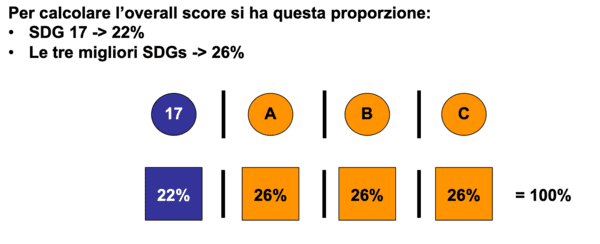
This ranking therefore stimulates institutions to document continuous improvement year after year on all aspects of sustainability, but especially on the commitment to global partnership.
More information or insights can be found on the page of the 2025 methodology of THE Impact Ranking.
THE - INTERDISCIPLINARY SCIENCE RANKING (ISR) - METHODOLOGY
>>> Performance

THE Interdisciplinary Science Rankings is the first ranking launched by an agency, which evaluates the contributions made by world universities to scientific progress in terms of interdisciplinarity, using some of the data already used by the ranking agency to draw up THE World University Ranking.
This ranking is the result of a collaboration between THE (Times Higher Education) and the Schmidt Science Institute, founded by Eric Schmidt, former Delegate Officer (CEO) of Google and then Executive Chairman of Google until 2015.
At the moment only the sciences have been considered: Computer Science, Engineering, Life Science, Physical Sciences. Already in the next editions, the expansion of the disciplines analyzed is planned.
The methodology of the Interdisciplinary Science Rankings 2026 consists of eleven indicators, summarized in three main directions (pillars), each of which represents a phase of the life cycle of research projects: Input (which insists on 19% of the overall result), Process (weight 16%) and Output (weight 65%).
In the following image the methodology of THE - ISR:

[Click here] to download the pdf file of the methodology (year 2026)
UPCS_Ranking
Page edited by:
Ranking Unit
Statistical Data and Ranking Coordination Sector
UPCS - Strategic Planning and Control Office